

The White House is asking Congress to approve an additional $30.1 billion to modernize America’s airports and air traffic control system, a sweeping investment aimed at replacing decades-old technology, improving flight safety, and reducing disruptions across the nation’s airspace.
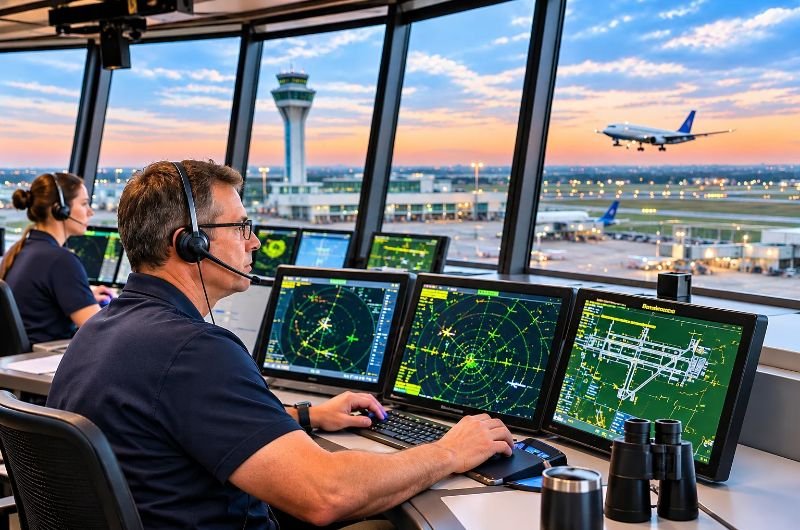
The proposal, announced November 13 by Transportation Secretary Sean Duffy and White House budget director Russell Vought, includes $10.1 billion for air traffic control technology, $2 billion for control towers, and $18 billion for airport improvements. Of the technology funding, $7.2 billion would support updated controller workstations and a common automation platform, while $2 billion would go toward cloud computing infrastructure.
The urgency reflects longstanding problems with aging aviation equipment. The Federal Aviation Administration (FAA) still relies on decades-old computer systems and equipment that can be difficult to maintain. The agency recently announced plans to eliminate floppy disks used for weather and other critical information at more than 400 air traffic control facilities by the end of 2028. In September, separate communications failures disrupted thousands of flights across the Northeast, demonstrating how vulnerable the nation’s air transportation network remains.
Congress previously approved $12.5 billion for air traffic control improvements and controller hiring in July 2025. However, a September report from the Government Accountability Office (GAO) warned that the FAA’s broader modernization initiative lacked a reliable estimate of its total costs and a comprehensive schedule coordinating thousands of individual projects. Those shortcomings could increase the risk of delays and cost overruns even as the agency makes progress replacing outdated infrastructure.
Major U.S. airlines, including American, Delta, United, and Southwest, have expressed support for the additional funding. The administration is urging lawmakers to act before the end of the year, when the current Republican-controlled Congress gives way to Democratic control in January. For travelers, the proposed investment could eventually mean more reliable flights and modern airport facilities, but its benefits will depend on congressional approval and the FAA’s ability to deliver a complex nationwide overhaul.
The Readovia Lens
America’s aviation modernization effort is as much a test of federal project management as it is an investment in technology. Replacing aging computers, communications networks, and airport facilities could improve reliability across the country, but the GAO’s findings underscore the importance of realistic budgets, coordinated construction schedules, and accountability for results. The challenge is ensuring that billions in additional spending produce lasting improvements in a system millions of Americans depend on every day.