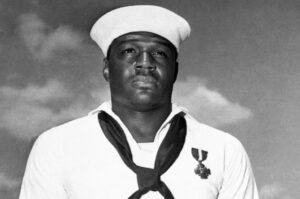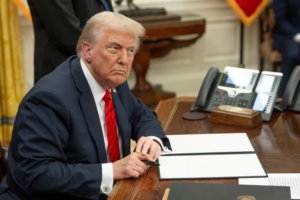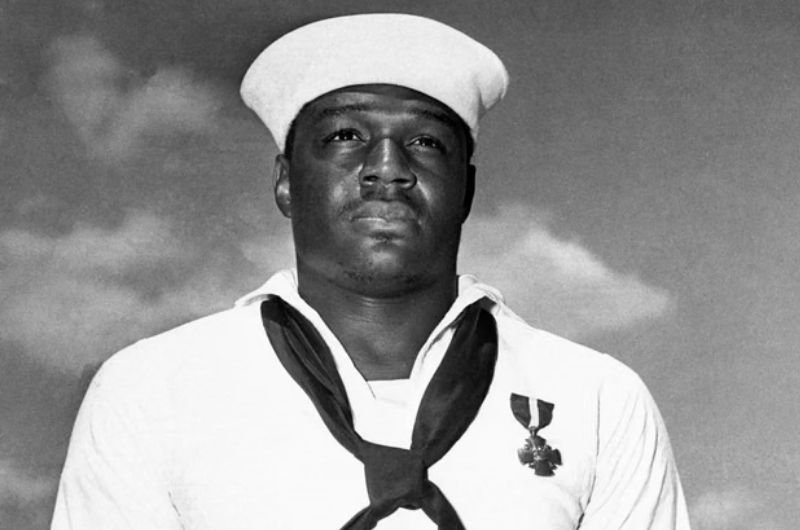
The U.S. Navy is discussing whether to remove the name of World War II hero Doris Miller from a future aircraft carrier and name the ship for President Donald Trump instead, according to multiple reports. No final decision has been announced, and the Pentagon has said it has nothing to announce about the carrier’s name at this time.
The Gerald R. Ford-class carrier, designated CVN-81, was named the future USS Doris Miller in 2020 during Trump’s first administration. The designation was historic: Miller became the first Black American to have an aircraft carrier named in his honor and the first enlisted sailor honored with a carrier bearing his name. Official Navy materials continue to identify CVN-81 as the future USS Doris Miller.
Miller earned his place in Navy history during the Japanese attack on Pearl Harbor on Dec. 7, 1941. Serving aboard the USS West Virginia, he helped move wounded sailors, including the ship’s commanding officer, and then operated an anti-aircraft machine gun despite having no formal training on the weapon. Miller became the first Black sailor to receive the Navy Cross, one of the military’s highest awards for valor. He was killed in action in 1943 when the USS Liscome Bay was torpedoed and sank in the Pacific.
NBC News and other outlets report that Navy officials have discussed naming CVN-81 for Trump while potentially honoring Miller with another vessel. Miller’s family was not informed in advance about the possibility that his name could be removed from the carrier, according to NBC News. The discussions come as construction on the nuclear-powered carrier continues, with the ship expected to join the fleet in the next decade.
Changing the name would reverse a decision the Navy itself described in 2020 as recognition not only of Miller’s heroism but of generations of enlisted sailors. The Navy said at the time that naming the carrier for Miller honored the contributions of service members across ranks and backgrounds. Unless a new designation is formally announced, however, CVN-81 remains the future USS Doris Miller.
The Readovia Lens
This potential change goes well beyond a military naming dispute. Doris Miller’s place in American history, the significance of the Navy’s decision to honor him with an aircraft carrier, and the possibility of replacing his name with that of a sitting president turn the discussion into something larger: a decision about whose service America chooses to honor, and how enduring that honor is meant to be.
There is also a broader question about who should make decisions of this magnitude. Naming military vessels has traditionally been the responsibility of the Department of the Navy, not something decided by popular vote. But an aircraft carrier is more than government property with a name painted on its hull. It is a highly visible symbol of the United States that can serve for decades, carrying its namesake — and the history attached to that name — around the world.
That makes the prospect of removing an established name different from choosing one for a new ship. The Navy already made the decision to honor Miller in 2020. Reversing it would mean taking a national honor that has already been bestowed on one American and transferring that distinction to another.
For decisions carrying that kind of historical weight, there is a reasonable argument that the American public should have a greater voice. A nationwide vote on individual ship names would raise obvious practical questions and would represent a major departure from the traditional process. But public participation does not necessarily have to mean a national referendum. Congress could have a formal role. A public-comment period could be required. An independent commission could review proposed changes. Some mechanism could ensure that removing an established national honor requires more than an internal administrative decision.
Doris Miller’s story makes that conversation particularly important. If the Navy moves forward with changing the name, Americans may also want to consider a more fundamental question: who should have the authority to take an honor already bestowed on one American and give it to another?