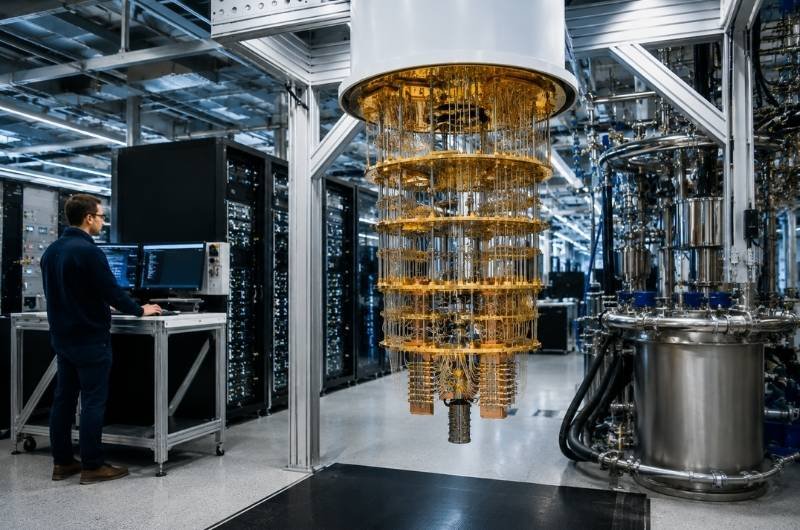
The U.S. government is preparing to spend up to $1 billion helping IBM build something America has never had before: a factory designed specifically to make critical components for quantum computers.
That sounds highly technical, but the reason behind it is fairly simple. Quantum computing could become one of the most important technologies of the next several decades, potentially helping scientists develop new medicines, discover new materials, solve enormously complicated logistical problems and perform certain calculations that overwhelm today’s most powerful computers. And the United States wants to make sure it can build that technology here.
IBM and the U.S. Department of Commerce announced the proposed $1 billion federal investment in May. IBM plans to contribute another $1 billion in cash, along with technology, facilities and expertise, to establish a new operation called Anderon in Albany, New York.
First, What Is a Quantum Computer?
A regular computer — whether it’s your laptop or one of the world’s most powerful supercomputers — processes information using tiny units called bits. Those bits essentially work as switches that are either on or off: 1 or 0.
Quantum computers work differently. They use quantum bits, called qubits, which can handle information in ways ordinary computer bits cannot. That gives quantum computers the potential to work through certain extremely complicated problems differently than today’s machines.
It doesn’t mean your next laptop will be a quantum computer. You don’t need one to check email, browse the internet, stream Netflix or write a document. Traditional computers are already very good at those things. Quantum computers are being developed for problems that become almost unimaginably complex.
What Could We Actually Do with One?
Imagine a pharmaceutical company trying to predict how countless combinations of molecules might behave while developing a new drug. Or a scientist searching through huge numbers of possible materials to find one that could produce a better battery.
A transportation company might use advanced computing to search for the most efficient way to move thousands of vehicles, packages and people through an enormous network. Researchers also see potential applications in financial modeling, chemistry and other fields where the number of possible outcomes can become overwhelming.
There is another possibility that has governments paying especially close attention: encryption. Powerful future quantum computers could potentially break some of the encryption methods used today to protect sensitive information, making quantum computing not just a technology race, but increasingly a national-security race.
So What’s a Quantum Foundry?
Think of a foundry as a highly advanced factory.
Today’s computer chips are manufactured in semiconductor fabrication plants — enormous, highly sophisticated facilities capable of producing the tiny components inside phones, computers, cars and data centers. Quantum computers need their own specialized components.
IBM’s planned Anderon facility would manufacture wafers used to build quantum processors. The operation is intended to produce them not only for IBM, but potentially for other American companies developing quantum technology.
That matters because inventing a technology is only part of winning a technology race. You also have to be able to manufacture it.
The United States learned that lesson with conventional computer chips. Much of the world’s advanced semiconductor manufacturing became concentrated overseas, prompting Washington to spend billions of dollars rebuilding domestic chip production. With quantum computing, the government appears determined to get ahead of the next technology race.
Why Is the Government Spending So Much?
No one knows exactly how important quantum computing will eventually become, but the potential is too large for governments to ignore. The U.S. is not alone in pursuing it; China and other countries are also investing heavily in quantum research and infrastructure.
That creates a familiar competition over who develops the best systems, owns the important discoveries, attracts the skilled workers and, crucially, can manufacture the technology at scale.
IBM itself is making a much larger bet. The company announced in June that it plans to invest more than $10 billion in quantum computing over the next five years, with a long-term goal of building increasingly capable systems while overcoming one of the technology’s biggest problems: errors.
Are Quantum Computers Ready Now?
No — and that’s an important part of the story.
Today’s quantum computers are still experimental machines. They are extremely difficult to build and operate, their quantum bits are fragile, and errors remain a major obstacle. Many of the revolutionary applications associated with quantum computing have not happened yet.
Some may take years. Some may take decades. And some predictions about what quantum computers will eventually accomplish may prove overly optimistic. IBM’s timelines and projections should therefore be viewed as ambitious goals rather than guarantees.
But governments and technology companies are not waiting for every technical problem to be solved before investing. They are building the infrastructure now.
The Next Technology Race May Already Be Underway
Artificial intelligence is today’s dominant technology story, with companies spending hundreds of billions of dollars on chips, data centers and power systems to support it. Quantum computing is nowhere near that stage yet.
But America’s proposed $1 billion investment in IBM’s quantum foundry offers an important glimpse of what could come next. The U.S. is not simply funding another experimental computer; it is helping build the manufacturing base for an industry that barely exists today.
If quantum computing ultimately lives up to even part of its promise, the countries that build the factories, train and attract the scientists and engineers, secure the patents and establish the supply chains now could hold a major advantage later.
That’s why a highly specialized factory planned for Albany, New York, could turn out to be far more important than it sounds.