

Charlie Kirk, the conservative activist and founder of Turning Point USA, was assassinated onstage at Utah Valley University Wednesday — shot by a sniper in front of a stunned campus audience. The killing unfolded in real time during his American Comeback Tour appearance, and within minutes the footage was ricocheting across social media. What might have been just another charged campus event instantly transformed into a national crisis, igniting urgent questions about political violence, free speech, and the fragility of civic life in America.
A Shot Heard on Campus
Kirk’s visit to Utah Valley University (UVU) was designed to energize young conservatives with a message of political revival. But security was minimal: no metal detectors, no bag checks, and little to prevent a rooftop sniper from targeting the event from 200 yards away. The alleged gunman remains at large. Two men detained in the aftermath were later released, underscoring how elusive accountability can be when violence strikes from the shadows.
For UVU students, the memory of Kirk collapsing mid-sentence will not fade soon. The assassination pierced the idea of the campus as a safe haven for debate — a chilling reminder that America’s broader cultural battles now spill freely into lecture halls.
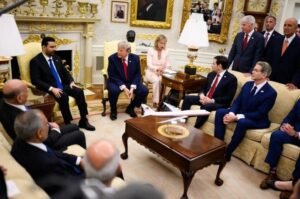
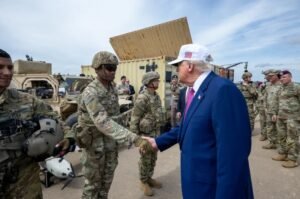
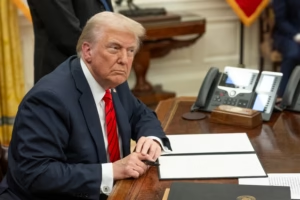
President Trump Responds
Free Speech on the Line
Kirk’s killing isn’t just about one man. It speaks to the future of open debate in a democracy on edge. Universities — already caught between accusations of “cancel culture” and criticisms of enabling hate speech — now confront a more terrifying calculus: can controversial speakers ever be truly safe?
If dissenting voices are silenced by bullets rather than arguments, the loss to civic life is immeasurable. America’s public square depends on citizens clashing over ideas, not fearing for their lives. Yet Kirk’s assassination signals that we may be sliding into what some scholars call an “assassination culture” — a climate where violence is seen as a permissible response to political disagreement.
The Law Enforcement Challenge
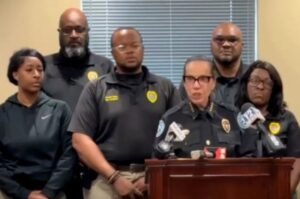
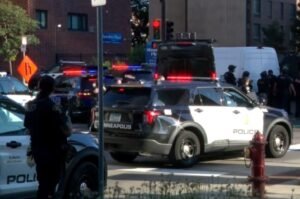
Law enforcement scrambled in the aftermath: campus police, local authorities, and federal agents launched a joint investigation. But as with recent attacks on political figures and their families, the randomness of lone-actor violence makes prevention nearly impossible.
Investigators face the technical nightmare of a rooftop sniper strike: limited evidence, fragmented surveillance, and a flood of online speculation muddying the search for truth. The case illustrates how modern political violence spreads twice — first through the bullet, then through the viral video.
The Political Fallout
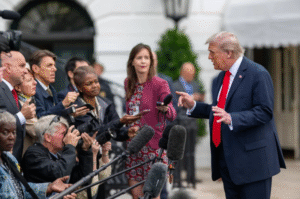
Reaction was swift and bipartisan. Republican leaders denounced the killing as “despicable,” while Democrats condemned the act as an assault on democracy itself. Former President Obama called it “a betrayal of democracy.”
But almost immediately, partisan commentators weaponized the tragedy. Some blamed inflammatory rhetoric; others saw it as proof that campus protests had spiraled out of control. The risk is clear: instead of forging consensus against political violence, the assassination could become yet another wedge in an already fractured public discourse.
Democracy’s Breaking Point
Political assassinations are not new to America. The 1960s claimed Martin Luther King Jr. and Robert F. Kennedy. But Kirk’s murder feels different. It comes not in an era of sweeping movements, but amid social-media-fueled polarization, crumbling trust in institutions, and the unsettling sense that even the most ordinary civic events are vulnerable.
If violence continues to escalate, public life itself could contract. Politicians may retreat from live rallies. Universities may cancel high-risk speakers. Citizens may avoid public debate altogether. With every withdrawal, democracy shrinks, leaving space for fear and extremism to thrive.
What Comes Next
The Kirk assassination is both a tragedy and a test. It forces America to confront uncomfortable questions:
- Can universities safeguard free speech without inviting mortal danger?
- Will political leaders cool their rhetoric or exploit the moment?
- And most urgently, can the nation stop its slide into a future where assassinations punctuate civic debate?
For now, the image lingers: a stage, a sudden shot, and a democracy shaken once more by the violence of its own divisions. Whether this moment proves to be an aberration or a grim harbinger depends on how leaders — and citizens — respond.
Between the Lines
The Kirk assassination is more than a campus tragedy. It’s a warning flare: if America chooses violence over argument, democracy itself becomes the casualty.