


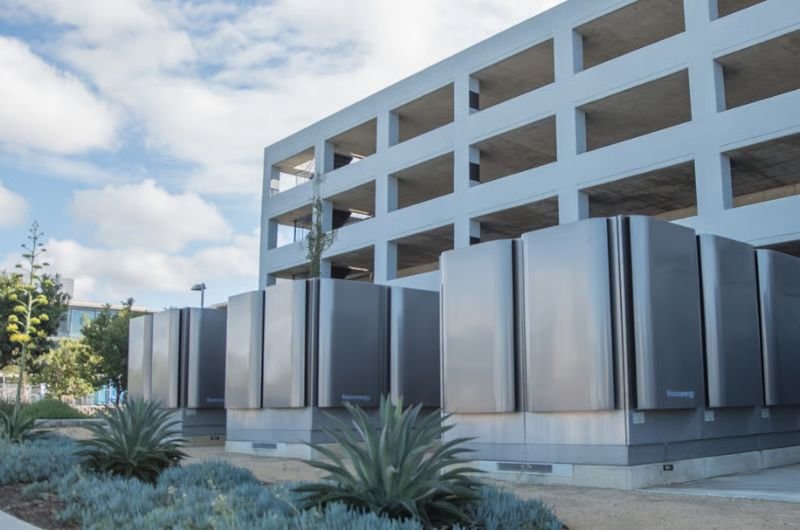
While Nvidia, OpenAI, and Microsoft dominate headlines about the artificial intelligence boom, a less visible group of companies is supplying the electricity, cooling systems, and infrastructure that keep it running. Among them is Bloom Energy, a San Jose, California, company whose on-site power systems are helping businesses meet the enormous electricity demands of AI.
Bloom Energy is part of the supporting structure beneath the AI boom. It may not be the star of the revolution, but it’s helping keep the stars running.
Bloom makes fuel-cell systems called Energy Servers that can be installed directly on customer properties, including data centers, hospitals, manufacturing plants, and other commercial facilities. Rather than depending entirely on the traditional electrical grid, businesses can generate some or all of their own electricity, potentially avoiding years of delays associated with securing new utility connections.
The technology uses solid-oxide fuel cells to convert fuel, commonly natural gas, into electricity through an electrochemical process rather than conventional combustion. The systems can operate around the clock and produce fewer greenhouse gas emissions than many traditional fossil-fuel power sources, although they are not emissions-free when fueled by natural gas. For companies spending billions on AI infrastructure, having their own source of electricity could be a significant advantage. After all, even the world’s smartest computers are considerably less impressive when someone tells them the power won’t be ready for three years.
Bloom’s Financial Growth Is Already Taking Shape
Bloom’s growth is already substantial. This isn’t merely a speculative business hoping that demand from artificial intelligence will eventually materialize.
In its third-quarter financial results, released October 22, Bloom reported approximately $1.24 billion in revenue, a 138.1% increase from the same period in 2025. Operating income climbed to $225.4 million from $7.8 million a year earlier, while net profit attributable to shareholders reached approximately $250 million. The company also raised its full-year 2026 revenue forecast to between $4.4 billion and $4.6 billion and joined the S&P 500, marking another milestone in its expansion.
The company’s opportunity extends well beyond data centers. Bloom serves customers in healthcare, manufacturing, retail, higher education, and other industries where reliable electricity is essential. Its expanded partnership with Brookfield Asset Management includes a $25 billion financing framework for AI-related power projects, although that amount does not represent guaranteed revenue for Bloom. As electricity demand grows, the company’s ability to generate power where businesses need it could open the door to an increasingly broad market.
Wall Street Has Its Eyes on Bloom, Too
Bloom Energy trades on the New York Stock Exchange under the ticker symbol BE, and its extraordinary growth has attracted considerable investor attention. But the company’s share price has also experienced a turbulent stretch, falling approximately 25% during the month leading up to November 17, despite its strong financial performance.
Wall Street apparently likes Bloom’s electricity business, but lately, investors have been getting a few shocks of their own.
The decline highlights an important distinction between a growing company and an attractive stock investment. Bloom’s shares have already enjoyed substantial gains during 2026, and investors must weigh the company’s expanding business against expectations that may already be reflected in its valuation. Risks include manufacturing expansion costs, project delays, fuel availability, competition, and the possibility that AI infrastructure spending may not grow as quickly as anticipated.
Bloom’s financial performance also illustrates the costs of rapid expansion. Although the company reported approximately $250 million in third-quarter profit, its operating activities used $27 million in cash, partly reflecting growing inventory and the timing of customer payments. However, Bloom generated approximately $273 million in operating cash during the first nine months of 2026 and ended September with nearly $2.5 billion in cash. Those figures provide a fuller picture of the company’s financial position than one quarter’s cash flow alone.
The Readovia Lens
Bloom Energy is helping reshape how businesses obtain electricity at a time when artificial intelligence is placing enormous demands on America’s power infrastructure. Its ability to install generation systems directly at customer facilities offers a practical solution to a challenge that could otherwise slow the development of data centers and other major commercial projects.
For investors, Bloom presents a compelling business story accompanied by significant stock-market risk. Its recent share-price decline does not erase its financial achievements, but neither does impressive revenue growth guarantee future investment returns. The company’s ability to turn growing electricity demand into sustained profitability and stronger cash flow will help determine whether its stock can ultimately live up to the enthusiasm surrounding it.