


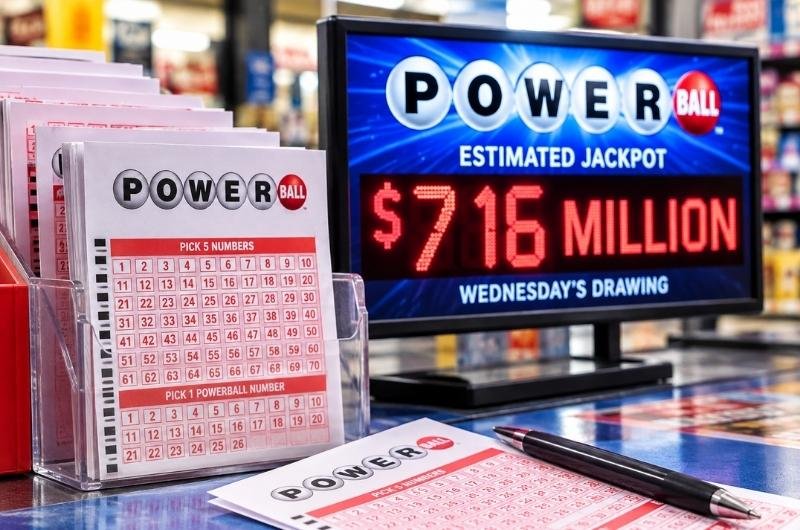
The Powerball jackpot has soared to an estimated $716 million for Wednesday’s October 28 drawing, offering another chance at an extraordinary fortune after no ticket matched all six numbers Monday night. But while the advertised prize approaches three-quarters of a billion dollars, the amount a winner could actually take home is considerably smaller, depending on how the money is collected and how much is owed in taxes.
The $716 million figure represents the estimated value of an annuity paid over 29 years, beginning with an immediate payment followed by 29 annual installments that increase by 5% each year. A winner who prefers to receive the money all at once could instead choose the estimated $307.2 million cash option before taxes. That difference is not a tax deduction. It reflects the amount needed to fund the larger prize through long-term payments.
Taxes would take another substantial bite out of the winnings. Under federal rules, lottery prizes of this size are generally subject to an initial 24% withholding, which would reduce the $307.2 million cash payout to approximately $233.5 million. However, that withholding would not cover the winner’s entire federal income tax obligation. With most of the prize subject to the highest federal income tax rate of 37%, the eventual federal tax bill could approach $114 million, leaving roughly $193.5 million before any applicable state or local taxes.
Monday’s drawing produced winning numbers of 18, 26, 49, 50 and 54, with Powerball 1. Although nobody claimed the grand prize, tickets sold in Florida and Georgia each matched the five white balls to win $1 million. The odds of matching all six numbers remain approximately one in 292.2 million, making the jackpot an exceptionally rare prize even as its advertised value continues to grow.
The next Powerball drawing takes place Wednesday at 10:59 p.m. Eastern Time, with tickets costing $2 per play. For anyone fortunate enough to win, the decision between immediate cash and decades of annual payments could have lasting financial consequences. Financial advisers generally recommend that major lottery winners seek professional tax, legal and investment guidance before claiming or spending their winnings.
The Readovia Lens
Billion-dollar Powerball jackpots were once almost unimaginable, but they have become increasingly familiar in recent years. The current $716 million jackpot is still well below that historic threshold, yet it demonstrates how quickly lottery prizes can grow when consecutive drawings produce no grand-prize winner.
Since the game launched in 1992, eight Powerball jackpots have reached or exceeded $1 billion, including the record-breaking $2.04 billion prize won in California in November 2022. The first billion-dollar jackpot occurred in January 2016, when three winning tickets shared $1.586 billion.
The growing prizes reflect changes to the game’s structure, including longer jackpot runs that allow winnings to accumulate when no ticket matches all six numbers. Yet even as jackpots reach historic heights, the odds of winning remain extraordinarily slim: approximately one in 292.2 million.