

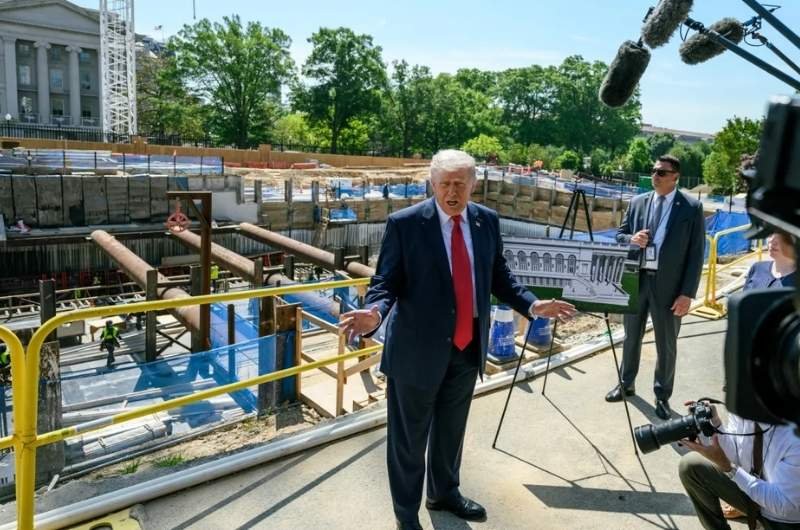
President Trump’s administration asked the U.S. Supreme Court on Friday to allow construction of his $400 million White House ballroom to continue, escalating a legal battle over whether a president can undertake a major transformation of the White House complex without approval from Congress.
A divided federal appeals court ruled last week that the administration must halt the project because Congress never authorized it. The 90,000-square-foot ballroom is being built on the site of the demolished East Wing and is already about 65% complete. The appeals court delayed its order for two weeks to give the administration time to seek Supreme Court intervention, with the construction halt scheduled to take effect August 21 unless the justices step in.
The dispute reaches beyond the ballroom itself. In its 2-1 decision, the U.S. Court of Appeals for the D.C. Circuit concluded that the president does not have unilateral authority to fundamentally reshape the White House. The lawsuit was brought by the National Trust for Historic Preservation, which argues the administration began the massive project without obtaining the congressional authorization required for changes to federal property.
The Trump administration argues that stopping construction would create national-security risks. Solicitor General D. John Sauer told the Supreme Court that leaving the East Wing site unfinished would threaten security, while Trump has described the larger project as a “military center.” Administration officials say the complex includes security infrastructure intended to better protect the president and other White House officials.
The Readovia Lens
The Supreme Court is now being asked to decide whether construction can continue while the administration pursues its appeal, rather than issuing a final ruling on the legality of the ballroom itself. But the dispute could ultimately force the justices to confront a much larger question about presidential power: how far a president can go in altering one of the country’s most important federal properties without first receiving authorization from Congress.