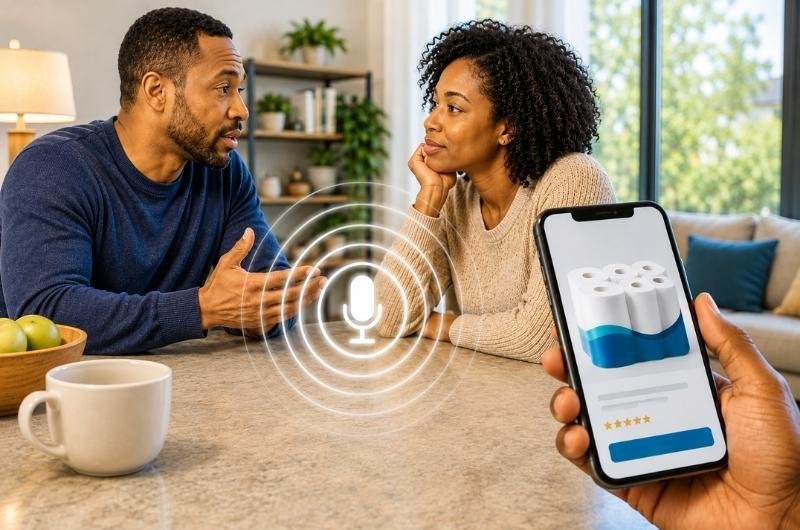
You mention a particular brand of bathroom tissue at home. Later that day, an ad for the same brand appears on your phone. You never searched for it. You never typed the name. You only said it out loud. Experiences like that have fueled a persistent suspicion for years: Are our phones secretly listening to us?
Now, a newly finalized Federal Trade Commission case has put that suspicion under an unusually bright spotlight — but not because regulators caught companies secretly recording consumers. The FTC says Cox Media Group, MindSift and 1010 Digital Works deceived advertising customers by claiming they could use conversations captured around smartphones and other smart devices to target ads.
The companies promoted the service as an AI-powered advertising technology capable of identifying potential customers based on things they said near their devices. In one particularly striking marketing pitch, Cox described the concept this way: “Creepy? Sure. Great for marketing? Definitely.” According to the FTC, however, the companies were largely reselling consumer email lists obtained from other data brokers while charging customers substantially more for what was presented as a sophisticated voice-powered advertising product.
The FTC also says the companies falsely assured advertising customers that consumers had consented to having their conversations collected and used for advertising. Regulators say that consent did not exist. That creates an unusual twist: the companies allegedly sold customers a technology by claiming it did something that, had it actually been done without adequate consumer consent, could itself have violated federal law. The companies will pay a combined $930,000, with Cox paying $880,000 and the other two firms paying $25,000 each.
The case does not prove that smartphones never listen to conversations for advertising purposes, nor does it explain every strangely well-timed ad people encounter. What it does establish is something almost as remarkable: companies were selling advertisers a service based on essentially the same idea consumers have worried about for years — that smart devices could overhear everyday conversations and turn those words into targeted ads. The FTC says this particular service did not actually work that way.
The Readovia Lens
So why can advertising sometimes feel as though your phone must have overheard you? Modern advertising systems can assemble enormous amounts of information from browsing activity, purchases, location, app usage and other behavioral signals. Those systems can sometimes predict what interests you with enough accuracy to feel unsettling. Sometimes coincidence plays a role. And sometimes an ad may have already been appearing around you before you consciously noticed it.
What makes the FTC case different is that “your phone is listening” wasn’t merely a consumer suspicion — it became a marketing pitch. Regulators say the technology behind that pitch wasn’t doing what advertisers were told it was doing. But the fact that companies believed the claim would be compelling enough to sell says something about just how believable the idea has become.