
Instagram and Facebook are about to work differently for millions of children and teenagers. Under Meta’s proposed settlement with a nationwide coalition of state attorneys general, users under 18 will face new limits on how long they can use the platforms, when they can access them and some of the features designed to keep them scrolling.
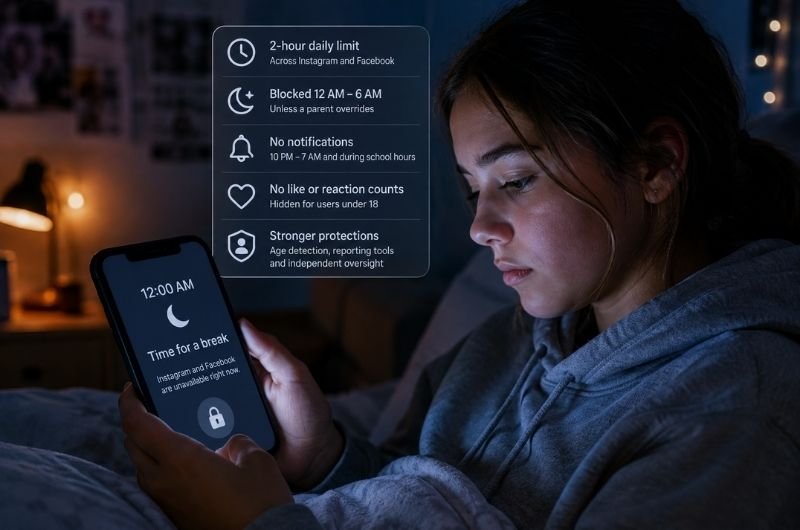
The biggest change is a two-hour daily limit across Facebook and Instagram, excluding messaging. Users under 18 will also be blocked from accessing the platforms between midnight and 6 a.m., while push notifications will be shut off from 10 p.m. to 7 a.m. and during school hours. Parents will be able to override certain restrictions, but young users will not be able to simply turn them off themselves.
Meta will also stop displaying like and reaction counts to users under 18, ban cosmetic-procedure image filters for minors and provide tools for teens to report potentially harmful content. Younger users will have the option of switching to a chronological feed containing posts from accounts they follow rather than a personalized recommendation feed. Meta must also strengthen its age-detection systems, identify children under 13 using its platforms and submit to oversight by an independent auditor.
Some of those changes could become even stricter. If other major social media companies agree to comparable settlements, Meta’s daily limit could eventually fall to one hour per platform, nighttime restrictions could expand from 10 p.m. to 7 a.m., and push notifications could be disabled entirely for users under 18. The initial restrictions are required to remain in place for at least five years, with additional provisions potentially extending protections for another decade.
But the agreement is not the end of the debate over how social media affects children. Critics note that Meta is not being required to turn off personalized recommendation algorithms for every young user by default — teens are instead being given the option of choosing a non-personalized feed. That leaves one of the industry’s most controversial features largely intact, even as the settlement imposes some of the most significant restrictions yet on how children use Facebook and Instagram.
——————–
Related:
Meta Agrees to Pay Up to $17.1 Billion in Landmark Child Safety Settlement
Australia Officially Becomes First Country to Ban Social Media for Under-16s
Australia Locks Under-16s Out of Social Media — and Yes, That Now Includes YouTube