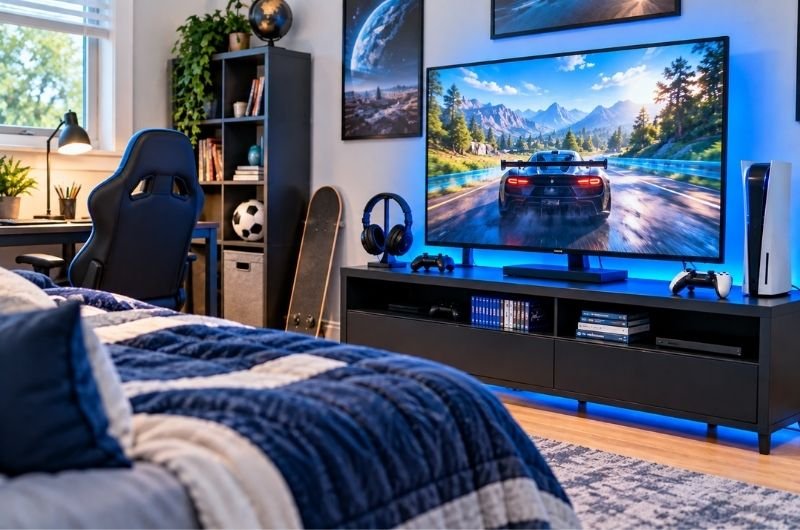
Video games can be a perfectly normal part of childhood, giving kids a place to compete, solve problems and socialize with friends. But when a child becomes increasingly irritable or aggressive, stays online for hours at a time, routinely uses profanity while playing or erupts when a parent says it’s time to stop, gaming may be taking up too much space in everyday life.
For parents, the difficult question is often surprisingly simple: How much gaming is too much?
There isn’t one medically accepted number of hours that applies to every child or teenager. The American Academy of Pediatrics has moved away from universal screen-time limits for school-age children and teens and instead recommends looking at the child, the content they’re consuming and what media use may be crowding out. Gaming becomes more concerning when it repeatedly interferes with sleep, homework, exercise, family time, friendships or other activities a child once enjoyed.
The warning signs can show up in behavior
One of the clearest signals isn’t necessarily how long a child plays. It’s what happens when the game stops.
Parents should pay attention when a child routinely becomes intensely angry, anxious or irritable when asked to turn off a console or computer; repeatedly ignores agreed-upon limits; sneaks in additional gaming time; loses interest in other activities; stays up late to play; or continues gaming despite problems at home or school.
The World Health Organization recognizes gaming disorder as a condition involving impaired control over gaming, giving gaming increasing priority over other activities and continuing or escalating play despite negative consequences. A diagnosis requires significant impairment in important areas of life and ordinarily involves a pattern lasting at least 12 months. Most children who play video games do not develop gaming disorder.
Still, parents don’t need to wait for a clinical diagnosis before addressing unhealthy behavior.
Gaming, anger and aggression are complicated
Research has found an association between problematic gaming and aggressive behavior among adolescents and young adults. That does not mean playing PlayStation, Xbox or PC games automatically makes a child aggressive, nor does it prove that gaming is responsible when an individual child begins behaving aggressively.
The relationship can run in multiple directions. Children already struggling with anger, anxiety, attention or emotional regulation may be especially drawn to intensive gaming, while excessive play, competitive frustration, lack of sleep and constant exposure to highly charged online interactions may compound existing problems.
That distinction matters. Instead of asking only, “Is this game making my child angry?” parents may get more useful answers by asking whether their child’s behavior is changing around gaming—and whether those changes are spilling into life away from the screen.
Don’t overlook what kids are hearing online
Modern gaming isn’t just a child sitting in front of a television playing against a machine. Games such as online shooters, sports titles and other multiplayer experiences can place children in live voice or text conversations with friends and strangers of all ages for hours.
That means parents should pay attention not only to the game itself but also to the culture surrounding it.
Profanity, insults, harassment and other toxic behavior can become normalized in some multiplayer environments. Hearing crude or aggressive language repeatedly doesn’t guarantee a child will imitate it, but parents should know who their children are communicating with, listen periodically to gaming interactions and establish clear rules about language and respectful behavior.
Age ratings can help parents evaluate game content, but they don’t necessarily tell parents what another human player may say through a headset.
Sleep may be one of the biggest casualties
Gaming becomes particularly concerning when it pushes bedtime later.
Research has consistently linked problematic gaming with shorter sleep duration, poorer sleep quality and more sleep problems. Teenagers ages 13 to 18 generally need eight to 10 hours of sleep each night. When late-night gaming begins cutting into that window, the effects can appear the next day as difficulty concentrating, irritability, behavior problems and poorer learning.
For parents wondering whether gaming has become excessive, bedtime may therefore be one of the easiest places to look.
So how much gaming should parents allow?
For older children and young teens, parents don’t have to wait for the medical industry to produce a universal number before establishing household limits.
A practical approach is to treat recreational gaming as something that comes after essential parts of the day are protected: adequate sleep, school and homework, physical activity, meals, household responsibilities, family interaction and some time away from screens.
Families can then establish a predictable gaming window that works for their household. A parent might decide that gaming is limited to a defined period on school nights and allow somewhat more flexibility on weekends. The exact limit matters less than whether it is clear, consistent and prevents gaming from taking over the child’s day.
If several hours of gaming every afternoon routinely turn into arguments, missed responsibilities, late bedtimes or resistance to doing anything else, that’s useful information. The current arrangement isn’t working, regardless of what the clock says.
Parents can make gaming easier to supervise by keeping consoles and computers in common areas when practical, using built-in parental controls to enforce schedules, and avoiding gaming immediately before bedtime.
What if limiting gaming causes an explosion?
Pushback doesn’t necessarily mean a child has a gaming disorder. Kids often resist limits on activities they enjoy, and the American Academy of Pediatrics specifically advises parents to expect some behavioral resistance when new media limits are introduced.
Consistency matters.
Rather than negotiating the limit every night, families can establish the rule in advance, explain when gaming begins and ends, and use console or router controls where appropriate so that the parent isn’t personally pulling the plug during every session.
It also helps to give children advance warnings. Online games sometimes can’t be paused, and suddenly demanding that a child leave in the middle of a match can create unnecessary conflict. A warning gives the child time to finish a round without turning the household rule into an endless extension.
But threats, physical aggression, destruction of property or severe and persistent emotional reactions shouldn’t simply be dismissed as a child being passionate about a game. Those behaviors warrant closer attention, particularly when they’re occurring repeatedly.
The goal isn’t to eliminate gaming
Gaming can provide entertainment, friendships, competition and even meaningful family time. The goal isn’t to turn every console into the enemy. It’s to make sure the game remains one part of a child’s life instead of becoming the center of it.
Parents who are concerned can start by watching what happens before, during and after gaming. Is the child sleeping enough? Keeping up with school? Exercising? Spending time with family? Completing household chores? Maintaining offline interests? Able to stop playing without a major confrontation? Following household rules about language and behavior?
If the answers begin moving in the wrong direction, reducing gaming time is a reasonable first step. If a child cannot regain balance despite consistent limits—or gaming is accompanied by serious aggression, anxiety, depression, school problems or major changes in behavior—parents should consider discussing those changes with the child’s pediatrician or another qualified health professional.
The Readovia Lens
The most useful measure of excessive gaming may not be the number displayed on a timer. It’s what gaming is costing a child. When a console begins taking away sleep, school performance, exercise, relationships, respectful behavior or the ability to handle being told “enough,” parents have good reason to intervene—and they don’t need to wait until the problem meets the definition of an addiction.