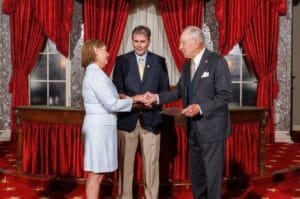



Nancy Pelosi, the first woman ever to serve as Speaker of the U.S. House of Representatives, has announced she will retire from Congress at the end of her current term, closing a remarkable 38-year career that shaped the modern Democratic Party and redefined the boundaries of political leadership in Washington.
Pelosi, 85, made the announcement Thursday from San Francisco, telling supporters that the time had come to “pass the torch to a new generation.” She will not seek re-election in 2026, formally ending a tenure that spanned multiple presidencies, political upheavals, and some of the most consequential legislative battles in recent memory.
A Career That Redefined Power
First elected in 1987, Pelosi rose to prominence as a shrewd strategist and tireless negotiator, earning a reputation for her discipline, message control, and mastery of vote-counting. In 2007, she broke a 218-year precedent by becoming the first woman to wield the Speaker’s gavel — a milestone that reverberated far beyond Capitol Hill.
She would go on to serve two separate terms as Speaker, leading the House through the 2008 financial crisis, the passage of the Affordable Care Act, two Trump impeachments, and the pandemic-era relief bills that reshaped the federal response to public health emergencies.
Her tenure was not without controversy. Critics — including many within her own party — sometimes bristled at her top-down leadership style and iron-fisted approach to floor discipline. But even her detractors concede her unmatched ability to deliver votes when it mattered most. As former President Barack Obama once remarked, “She’s one of the most effective Speakers in history — period.”
From Baltimore Roots to National Leadership
Born into a prominent Baltimore political family, Pelosi learned the rhythms of power early. Her father, Thomas D’Alesandro Jr., served as mayor and as a Democratic congressman, instilling in her both Catholic faith and political realism.
She brought those instincts to Congress, quickly rising through the ranks of Democratic leadership — first as whip, then minority leader, and finally as Speaker. Throughout her career, she framed herself as a consensus-builder grounded in pragmatism but unafraid of confrontation.
Her command of caucus politics became legendary: allies often credited her with “counting every vote before walking into the room,” while opponents noted her uncanny sense of timing — knowing precisely when to push, and when to wait.
A Symbol of Generational Change
Pelosi’s retirement underscores a broader generational shift inside the Democratic Party. In recent years, a younger cohort of lawmakers — many inspired by the policies and activism of the Obama and Biden eras — have pressed for fresh leadership and a more progressive economic vision.
With President Biden out of office and new figures emerging in the 2026 cycle, Pelosi’s departure could accelerate the transition toward that next generation of party leadership. Her San Francisco seat, one of the safest Democratic districts in the nation, is expected to draw intense competition among rising California Democrats.
Political observers note that Pelosi’s decision is as symbolic as it is strategic. “Her exit marks the end of an era,” said political historian Julian Zelizer. “But it also signals a moment of renewal — she’s clearing space for what comes next.”
Legacy and Reflection
Pelosi’s impact on national politics extends far beyond her legislative record. She redefined how female leadership is perceived in the halls of power, becoming both a trailblazer and a lightning rod. From her confrontations with Presidents George W. Bush and Donald Trump to her steadfast defense of democratic norms, Pelosi often stood at the center of American political storms — and seemed to thrive there.
In her statement, Pelosi thanked her constituents for “nearly four decades of trust,” and reflected on her journey from a new mother advocating for children and working families to Speaker of the House. “I leave Congress with gratitude,” she said, “for the privilege of serving our country and the hope that future generations will serve with the same purpose.”
The Takeaway
Nancy Pelosi’s retirement marks the conclusion of a political chapter that stretched across six presidencies and reshaped the modern legislative landscape. Her departure is both a historical bookend and a reminder that political power — even at its height — is a relay, not a throne.
As Washington braces for another election cycle and another wave of change, the woman who became synonymous with the Democratic establishment steps aside, leaving behind a legacy of mastery, endurance, and history written in real time.