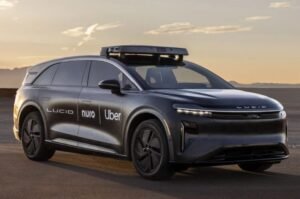

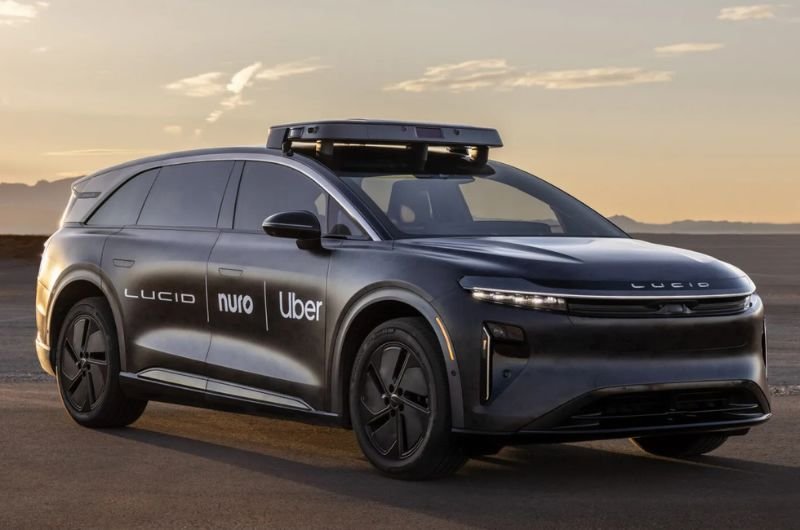
Uber, Lucid and autonomous driving technology company Nuro announced on November 24 that they have begun testing fully driverless vehicles on public roads in California’s San Francisco Bay Area. The milestone brings the three companies closer to introducing a commercial robotaxi service, with a public debut expected in early 2027.
Testing is underway in Palo Alto, Mountain View, Los Altos and Sunnyvale, following nearly a year of supervised autonomous driving trials in California and Texas. Lucid has supplied more than 100 vehicles for the latest phase of development, which will soon include employee rides without a human driver behind the wheel.
The partnership brings together three distinct areas of expertise: Lucid’s electric vehicle engineering, Nuro’s autonomous driving technology and Uber’s established ride-hailing network. Cameras, radar and light detection and ranging (lidar) sensors help the vehicles interpret their surroundings, while extensive simulations and real-world testing inform the development of their autonomous systems.
Uber has committed to purchasing at least 35,000 Nuro-equipped Lucid vehicles, with ambitions to expand the service into dozens of markets worldwide. The vehicles will be operated by Uber and its fleet partners, with passengers booking their rides exclusively through Uber’s platform.
The Readovia Lens
Uber’s approach to autonomous transportation offers an interesting example of how technology partnerships could reshape entire industries. By combining automotive engineering, autonomous software and an established customer network, three companies are building a service that none would necessarily need to develop independently. For passengers, however, the ultimate measure of success will be how reliably, safely and affordably that technology gets them to their destinations.