


The Readovia Stock Stack: Eight Skyrocketing Stocks and the Trends Driving Them
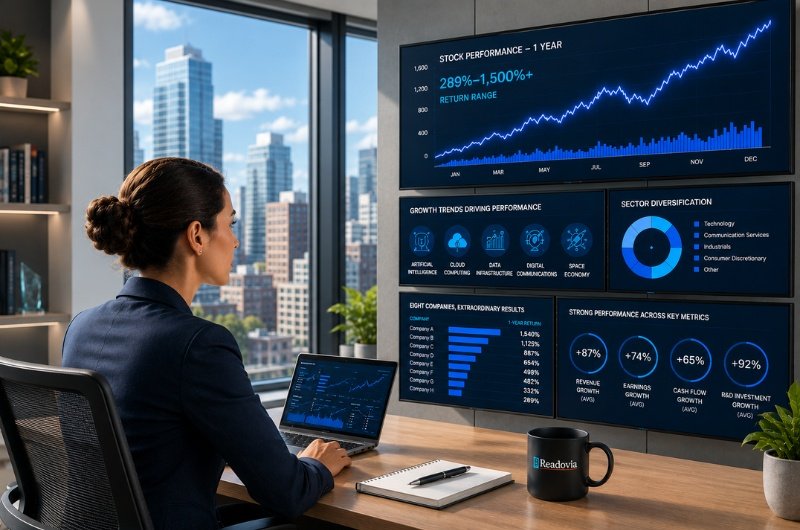
Over the past year, a select group of companies has delivered extraordinary stock market returns ranging from approximately 289% to more than 1,500%. These companies have positioned themselves at the center of some of today’s most powerful growth trends, capturing investor attention along the way. While each company operates in a different sector, many are benefiting from trends tied to artificial intelligence, cloud computing, data infrastructure, digital communications, and the emerging space economy. That observation inspired the creation of The Readovia Stock Stack. The new digital report highlights eight companies that have delivered remarkable market performance while participating in some of today’s most significant economic and technological trends. Inside, readers will find company profiles, performance data, and insights into the themes helping drive growth across multiple industries. The goal is not to predict the future or identify the next stock market winner. Instead, the report highlights companies that have already demonstrated extraordinary growth while offering readers a deeper understanding of the trends that helped fuel their rise. For investors, business leaders, technology enthusiasts, and anyone interested in the forces shaping tomorrow’s economy, understanding the trends behind today’s market leaders can be just as important as understanding the companies themselves. Get The Readovia Stock Stack – available now as an instant digital download
The Visibility Era, Part II: The New Gatekeepers

In Part I of *The Visibility Era*, we explored a growing reality of the modern internet: visibility is becoming increasingly difficult to earn. Every day, millions of articles, videos, podcasts, newsletters, social posts, and AI-generated pieces of content compete for attention across an already crowded digital landscape. But visibility is only part of the story. As the ways people find information continue to evolve, a new question emerges: who controls access to that information? In the past, search engines largely served as the primary gatekeepers of the web. Today, a growing collection of AI platforms, recommendation systems, marketplaces, social networks, and digital ecosystems are increasingly influencing what users see, what they trust, and ultimately what they choose. Advertisement Yet scarcity alone does not explain what people see. Increasingly, visibility is being shaped by systems operating behind the scenes. For years, the internet was celebrated as a force that removed traditional gatekeepers. Anyone could launch a website, start a blog, create a YouTube channel, publish a newsletter, open an online store, or build a personal brand. The barriers to publishing have never been lower. The barriers to discovery are another matter. Today, algorithms help determine which videos appear in feeds, which websites rank in search results, which products surface in online marketplaces, and which creators receive recommendations. Artificial intelligence is beginning to play an even larger role, influencing how information is summarized, presented, and discovered across the web. The old gatekeepers have not disappeared. They have evolved. In previous generations, publishers, broadcasters, editors, and producers often decided which voices reached the public. Today’s gatekeepers are less visible but no less influential. Recommendation engines, search algorithms, social platforms, app stores, and AI-powered systems increasingly shape the pathways through which attention flows. Most users rarely think about these systems. They simply open an app, perform a search, scroll through a feed, or ask an AI assistant a question. Behind each interaction, complex technologies are making decisions about relevance, quality, popularity, engagement, authority, and countless other signals. The result is a digital world where publishing is decentralized, but discovery is increasingly filtered. This does not mean the system is unfair. In many ways, algorithms help people navigate an overwhelming amount of information. Without them, the modern internet would be nearly impossible to use. The challenge is that every filtering system influences outcomes. Some content is amplified, some is overlooked, and some rises quickly while other material struggles to find an audience regardless of its quality. For creators, entrepreneurs, publishers, and businesses, this reality carries important implications. Success online is no longer determined solely by creating something valuable. Visibility often depends on understanding how information moves through the platforms where audiences spend their time, and the ability to earn attention increasingly requires adapting to systems that are constantly changing. The rise of artificial intelligence may accelerate this trend. As more people rely on AI assistants to answer questions, summarize information, recommend products, and discover content, new layers of visibility management are emerging. Instead of competing only for search rankings or social reach, businesses may soon find themselves competing for inclusion within AI-generated responses and recommendations. The competition for visibility is becoming more sophisticated, and the systems governing visibility are becoming more powerful. The internet remains one of the most democratic publishing environments ever created. Millions of people can share ideas with a global audience at virtually no cost. That opportunity remains extraordinary. At the same time, the path between publishing and discovery is increasingly shaped by technologies that most users never see. Understanding those systems may become one of the defining skills of the digital age. Because in the Visibility Era, being heard is not simply about having something to say. It is also about understanding who — or what — controls the flow of attention. ——————– Related: The Visibility Era, Part I: The Internet Enters an Age of Visibility Scarcity The Visibility Era, Part III: Mastering the New Visibility Economy
Why Some Experts Say Wellness Has Become Too Complicated

For years, the wellness industry has encouraged people to optimize nearly every aspect of their lives. Sleep scores, fitness trackers, recovery metrics, supplements, mindfulness apps, hydration goals, and productivity systems have become part of a growing culture focused on self-improvement. While many of these tools can provide valuable insights, some wellness experts say the pursuit of optimization may be becoming counterproductive. As people juggle increasing amounts of health data and wellness advice, a growing number are beginning to ask a simple question: when did healthy living become so complicated? Advertisement The trend comes at a time when many Americans report feeling overwhelmed by the demands of modern life. Between work responsibilities, family obligations, financial pressures, and constant digital connectivity, adding an extensive wellness checklist can sometimes create additional stress rather than reduce it. In response, some experts are encouraging a return to simpler habits. Regular walks, home-cooked meals, adequate sleep, time outdoors, meaningful social connections, and enjoyable physical activity continue to rank among the most effective ways to support overall well-being. Rather than striving for perfection, the emerging philosophy focuses on consistency. Supporters of the approach argue that sustainable habits practiced over months and years may provide greater benefits than complex routines that are difficult to maintain. For many people, the appeal is obvious. Wellness does not necessarily require expensive devices, elaborate routines, or constant monitoring. Sometimes the most effective habits are also the simplest. As the wellness industry continues to evolve, one idea appears to be gaining traction: better health may not always require doing more. In some cases, it may begin with doing less—and doing it consistently.
New Heart Health Guidance Focuses on Everyday Eating Habits

For years, Americans have been inundated with diet trends, superfoods, and conflicting nutrition advice. New guidance from the American Heart Association is encouraging a simpler approach: focus less on individual foods and more on building consistent eating habits that support long-term heart health. The updated recommendations emphasize overall dietary patterns rather than chasing the latest nutrition trend. The American Heart Association continues to encourage diets rich in fruits, vegetables, whole grains, legumes, nuts, and lean sources of protein while limiting highly processed foods that often contain excess sodium, added sugars, and unhealthy fats. Advertisement The guidance reflects a growing body of research suggesting that long-term eating habits may play a greater role in heart health than any single food or supplement. Rather than focusing on short-term diets, health professionals increasingly recommend sustainable changes that can be maintained over time. Another notable aspect of the guidance is its position on alcohol. While moderate alcohol consumption was once viewed by some as potentially beneficial for heart health, the American Heart Association says current evidence does not support drinking alcohol for health reasons. Instead, the organization continues to emphasize proven lifestyle factors such as healthy eating, regular physical activity, adequate sleep, and avoiding tobacco use. The recommendations arrive at a time when heart disease remains the leading cause of death in the United States. Health experts say small, consistent improvements in daily habits can help reduce risk factors and support better long-term cardiovascular health. For many people, the takeaway may be reassuring. Building a healthier diet does not necessarily require expensive supplements, complicated meal plans, or restrictive eating programs. Instead, lasting improvements often begin with simple choices made consistently over time. As nutrition advice continues to evolve, one message remains remarkably consistent: healthy eating is less about perfection and more about establishing everyday habits that support long-term wellness.
Americans Are Still Spending — But Savings Are Shrinking

Americans continue to spend despite ongoing concerns about inflation, affordability, and the broader economy, but new data suggests many households are saving less in the process. The U.S. personal saving rate fell to 2.6% in April, down from 4.3% in January and one of the lowest levels recorded in recent years. At the same time, consumer spending continued to rise even as disposable income softened, highlighting the financial balancing act many households are facing. Consumer spending remains one of the primary engines of the U.S. economy. Americans are still traveling, dining out, shopping, and spending on experiences, helping support businesses and economic growth despite a more challenging financial environment. Advertisement Yet the financial picture beneath the surface is becoming more complicated. Higher costs for housing, insurance, healthcare, groceries, and energy have increased pressure on household budgets. Recent inflation data showed consumer prices rising at the fastest annual pace in three years, driven in part by higher energy costs. As everyday expenses consume a larger share of income, many families are finding it more difficult to set money aside. For some households, savings accumulated during the pandemic have largely disappeared. Others continue to save, but at a slower pace than they did just a few years ago. The trend helps explain a seeming contradiction in today’s economy. Consumer spending remains relatively resilient, while surveys show many Americans continue to express concerns about their financial future and the rising cost of living. Employment levels remain stable, and many consumers continue to prioritize travel, entertainment, and discretionary purchases. However, the decline in savings suggests that maintaining those spending habits may be requiring greater tradeoffs than before. The American consumer has repeatedly defied predictions of a major pullback over the past several years. What appears increasingly clear, however, is that many households are working harder to maintain the same lifestyle amid higher costs. A healthy economy depends not only on spending, but also on financial resilience. As consumers continue supporting economic growth, the ability to rebuild savings may become an important measure of household financial health in the months ahead.
Life Beyond Earth? Inside SpaceX’s Mars Vision

For most of human history, the idea of living on another planet belonged to the realm of science fiction. Today, one of the world’s most ambitious companies is openly discussing a future in which millions of people could one day call Mars home. According to SpaceX, the company’s long-term goal is to help create a self-sustaining city on the Red Planet. The vision would require transporting enormous amounts of cargo, infrastructure, equipment, and eventually people to Mars over many years. SpaceX has suggested that a fully developed Martian settlement could one day support more than one million residents. While that goal remains decades away, the idea raises a fascinating question: what would life on Mars actually look like? Advertisement Unlike Earth, Mars has no breathable atmosphere, experiences extreme temperature swings, and receives significantly less sunlight. Any permanent settlement would require advanced habitats, reliable energy systems, food production, water recycling, medical facilities, and transportation networks. Future residents would likely live inside protected structures designed to shield them from radiation and the harsh Martian environment. The challenges extend beyond engineering. A city on Mars would also require schools, workplaces, laws, governance, healthcare, and community life. Families would need places to live. Children would need opportunities to learn and grow. In many ways, building a city on Mars may be as much a social challenge as a technological one. Supporters argue that becoming a multi-planet species could help ensure humanity’s long-term survival by reducing the risk of civilization existing on a single world. Critics counter that the technological and financial obstacles remain enormous and that many problems on Earth deserve greater attention. Even among experts who support human exploration of Mars, there is significant debate about how quickly such a vision could become reality. The Readovia Lens Whether a city on Mars arrives in 20 years, 50 years, or much later, the concept forces us to think differently about humanity’s future. For thousands of years, every nation, city, culture, and civilization has existed on a single planet. SpaceX’s vision challenges that assumption. It asks us to imagine a future in which human beings are no longer confined to Earth, but instead begin expanding into the broader solar system. So, we know we can get to Mars. Perhaps the most interesting question is what kind of civilization we would choose to build once we get to there.
SpaceX Is Coming to Wall Street—and Could Become the Largest IPO in History

For years, SpaceX has occupied a unique place in the business world: one of the most influential companies on Earth that ordinary investors could not buy. That may soon change. SpaceX is reportedly preparing for a blockbuster initial public offering that could value the company at approximately $1.75 trillion, potentially making it the largest IPO in Wall Street history. The company is expected to list on Nasdaq under the ticker symbol SPCX as early as June 12, though final timing, valuation, and offering terms could still change before shares begin trading. Advertisement Advertisement The company has transformed the global launch industry, dramatically reducing the cost of sending payloads into space while building a growing portfolio of businesses that includes Starlink, one of the world’s largest satellite internet networks. Together, those operations have helped position SpaceX at the center of several powerful trends, including commercial spaceflight, global communications, national security, and next-generation infrastructure. But the most interesting story may not be SpaceX itself. A company approaching a $1.75 trillion valuation has the potential to influence the broader market long before its first day of trading. Institutional investors, pension funds, mutual funds, and eventually major index funds could face pressure to allocate capital toward one of the world’s largest newly public companies. Billions of dollars could be repositioned across portfolios as investors make room for a company of unprecedented scale. The timing is also notable. Artificial intelligence has dominated business and technology headlines for much of the past two years, capturing investor attention and driving conversations about the future of innovation. A successful SpaceX debut could help elevate another emerging theme: the rapidly expanding space economy. Not everyone agrees on the company’s reported valuation. While SpaceX is reportedly targeting a valuation near $1.75 trillion, some analysts have assigned substantially lower estimates, highlighting the challenge of valuing one of the world’s largest private companies. As with any IPO, the market will ultimately decide what investors are willing to pay. The Readovia Lens For decades, investors have heard that space represented the next great economic frontier. The challenge was finding companies with the scale, technology, and financial resources to turn that vision into reality. If SpaceX reaches public markets at anything close to its reported valuation, investors may finally gain access to a company that has already proven it can build rockets, launch satellites, create communications networks, and generate meaningful revenue at scale. The biggest question is whether investors are willing to pay one of the highest valuations ever attached to a newly public stock. If they are, Wall Street may be entering a new era where the space economy becomes a mainstream investment theme rather than a speculative niche.
Virgin Galactic Stock Soars 36% as Investors Double Down on the Space Economy

——————– UPDATE (June 2, 2026 — 10:15 a.m. ET): Shares of Virgin Galactic fell sharply Tuesday morning after soaring more than 36% during the previous trading session. The stock was down more than 30% in early trading as investors appeared to take profits following one of the company’s strongest single-day rallies in recent years. While the pullback surprised some traders, rapid reversals are not uncommon among highly speculative stocks that experience sudden price spikes. ——————– Last week, Readovia examined the renewed interest in commercial space companies. Just days later, Virgin Galactic is providing one of the clearest examples yet that investor enthusiasm for the sector may be accelerating. Shares of Virgin Galactic surged 36.42% Friday after climbing more than 43% during afternoon trading before pulling back slightly into the close. The momentum carried into Monday morning, with the stock jumping another 26% shortly after the opening bell. Combined, the gains pushed the stock dramatically higher in less than two trading sessions and placed the company firmly back on Wall Street’s radar. The rally comes as investors increasingly focus on what many view as the next frontier of long-term growth. Renewed attention surrounding commercial launch systems, satellite networks, private spaceflight, and next-generation spacecraft has helped bring the space economy back into the spotlight. Excitement surrounding SpaceX’s ongoing Starship development program and broader commercial space ambitions has also contributed to growing interest across the sector. Advertisement For Virgin Galactic, the rally represents a dramatic shift in sentiment. The company has spent years working to advance its commercial space tourism business while navigating delays, funding concerns, and investor skepticism. At times, the stock seemed to spend more time falling back to Earth than reaching for the stars. Today, investors appear increasingly willing to revisit companies positioned to benefit from future growth in the commercial space industry. Whether the latest surge continues remains to be seen. What appears increasingly clear, however, is that investors are paying attention to the commercial space sector again. After years of turbulence, companies tied to the emerging space economy are once again attracting significant interest from Wall Street. The commercial space industry may still be years away from reaching its full potential, but investors do not appear interested in waiting for the launch countdown to hit zero. ——————– Related: Space Stocks Are Surging Again as Investors Chase the Next Big Boom
Why One Cruise Is Often Never Enough

For many travelers, a cruise vacation is supposed to be a one-time experience. Yet talk to experienced cruisers and you’ll often hear the same thing: they’re already planning their next voyage before the current one even ends. From first-time passengers to lifelong cruise enthusiasts, the industry has built an unusually loyal following that continues to grow year after year. Part of the appeal is convenience. Unlike traditional vacations that may require multiple hotel reservations, restaurant choices, rental cars, and transportation plans, a cruise combines nearly everything into one experience. Travelers unpack once, settle into their stateroom, and wake up in a new destination every few days without constantly repacking or navigating unfamiliar airports and highways. Advertisement The onboard dining experience is another major draw. Modern cruise ships offer an extraordinary variety of food options, ranging from expansive buffets and complimentary dining rooms to specialty restaurants serving everything from steaks and seafood to international cuisine. For many guests, dining becomes an attraction of its own, with the opportunity to enjoy different experiences throughout the voyage without leaving the ship. Entertainment also plays a significant role. Today’s cruise ships are floating resorts packed with activities from morning until late at night. Depending on the ship, guests may find Broadway-style productions, live music, comedy shows, water parks, casinos, fitness centers, spas, ice-skating performances, and countless other activities. The variety helps explain why cruises appeal to couples, families, retirees, and multigenerational groups alike. Value remains another important factor. While prices vary widely depending on the cruise line and itinerary, many travelers appreciate knowing that accommodations, meals, entertainment, and transportation between destinations are bundled together. That simplicity can make vacation budgeting easier and often compares favorably with the cost of visiting multiple destinations independently. Perhaps the biggest reason travelers return, however, is the unique feeling that cruising creates. Life on board moves at a different pace. Mornings begin with ocean views, afternoons might include exploring a new port, and evenings often end with dinner and a show. For a few days, everyday responsibilities seem farther away than they do during many other types of vacations. That combination of convenience, entertainment, dining, value, and escape helps explain why so many travelers become repeat cruisers. The destinations may initially attract passengers to a cruise, but for many, it’s the overall experience that keeps them coming back.
The Growing Importance of “Third Places” in Modern Life

You may not know the term “third place,” but chances are you’ve been looking for one. In sociology, a “third place” refers to spaces outside of home and work where people gather, relax, socialize, or simply exist around other people. Coffee shops, bookstores, parks, walking trails, gyms, libraries, neighborhood restaurants, and even hotel lounges can all serve as third places — environments that offer connection without the pressure of formal social plans. As remote work, digital communication, and social media continue reshaping modern routines, many people are beginning to realize how much everyday life has changed. For millions of adults, the daily rhythm now revolves almost entirely around home and work, with fewer casual interactions in between. The result can feel surprisingly isolating, even in a hyper-connected world. Advertisement That shift may help explain why spaces designed for comfort, conversation, and quiet presence are gaining renewed attention. Across the country, people are increasingly gravitating toward cozy coffee shops, walking clubs, boutique gyms, public markets, and community-driven spaces that offer a sense of atmosphere and belonging without requiring constant engagement. In many ways, third places are becoming less about productivity and more about emotional balance. Some people go to a café not because they need coffee, but because they want to be around life. Others seek out bookstores, parks, or neighborhood gathering spots simply to step away from screens and routines that can feel repetitive or mentally exhausting. The concept is also emerging at a time when loneliness and digital fatigue remain major cultural conversations. While technology has made communication easier than ever, it has not necessarily replaced the value of physical spaces where people can casually interact, observe, recharge, or feel part of a community. Modern life may be faster and more connected than ever before — but for many people, the simple act of finding a comfortable place outside of work and home is quietly becoming one of the most valuable parts of the day.