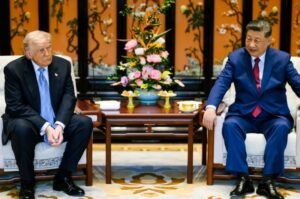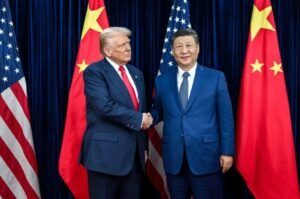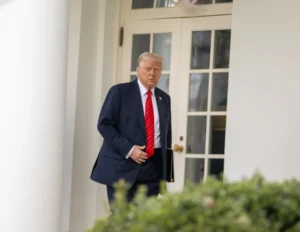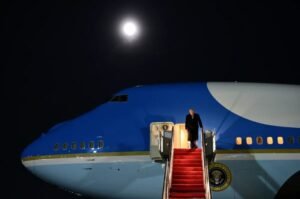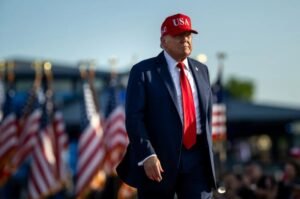


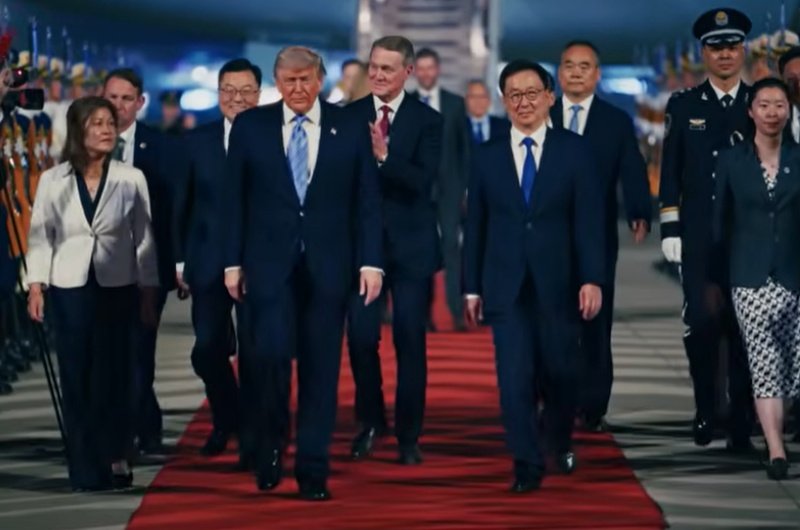
President Donald Trump arrived in Beijing Thursday for a high-stakes summit with Chinese President Xi Jinping, as tensions surrounding trade, artificial intelligence, Taiwan, and global influence converge during one of the most closely watched diplomatic meetings of the year.
The summit opened with elaborate ceremony inside Beijing’s Great Hall of the People, where Trump received a red-carpet welcome and full military honors in a carefully staged display of cooperation between the world’s two largest economies. Behind the symbolism, however, both nations entered the talks facing growing pressure over economic competition, military positioning, and the future balance of technological power.
Artificial intelligence quickly emerged as one of the defining themes surrounding the visit. Technology leaders and executives connected to the rapidly expanding AI sector traveled alongside the U.S. delegation as Washington and Beijing continue competing for dominance in semiconductors, advanced computing systems, and next-generation infrastructure. The discussions reflect a growing reality that AI is increasingly becoming a matter of national strategy and geopolitical leverage.
The summit comes amid rising tensions over Taiwan, ongoing economic uncertainty, and a growing effort by both nations to reduce dependence on one another while still preserving critical trade ties. Although both leaders publicly emphasized cooperation, the meetings highlighted how competitive and increasingly fragile the relationship between the United States and China has become.
For governments, investors, and global technology companies, the talks represent more than a diplomatic event. They offer an early glimpse into how the next era of global influence may be shaped — not only through military strength or trade agreements, but through control of AI systems, semiconductor supply chains, and the digital infrastructure powering the modern economy.