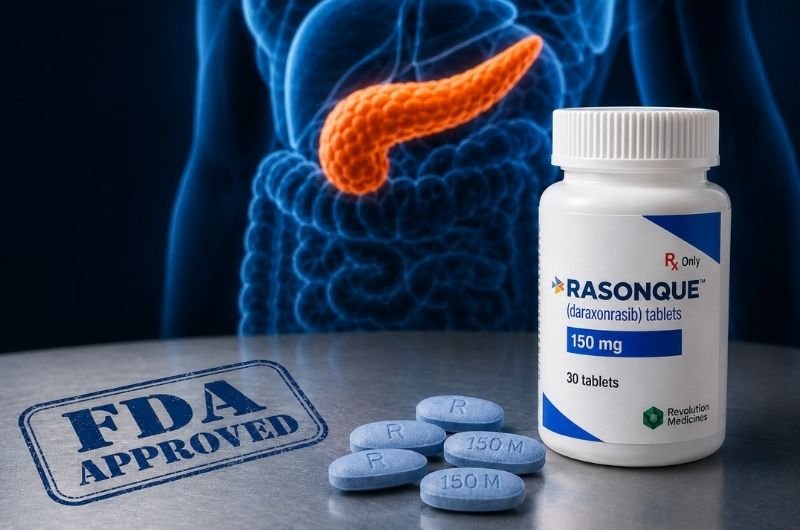
The FDA has approved a new treatment for advanced pancreatic cancer after a major clinical trial found that patients taking the drug survived nearly twice as long as those receiving standard chemotherapy. The once-daily pill, called Rasonque, is the first approved treatment designed to directly target RAS proteins that drive most pancreatic cancers.
The approval covers adults with metastatic pancreatic adenocarcinoma who have already received at least one systemic treatment or who are not candidates for multiagent therapy. Pancreatic adenocarcinoma accounts for roughly 90% to 95% of the approximately 67,000 pancreatic cancer cases diagnosed in the United States each year and remains one of the most difficult cancers to treat.
In the Phase 3 trial involving 500 patients, median overall survival reached 13.2 months among patients taking Rasonque, compared with 6.7 months for those receiving standard chemotherapy. The treatment also doubled the median amount of time patients lived without their cancer progressing — 7.2 months compared with 3.6 months — while tumors responded to treatment in 30% of patients taking the drug versus 11% receiving chemotherapy.
The drug, also known as daraxonrasib, works by blocking multiple forms of RAS, a family of proteins that can drive tumor growth when their signaling goes awry. Researchers have spent decades trying to effectively target this pathway in pancreatic cancer, where RAS mutations are extremely common. The FDA granted the treatment Breakthrough Therapy, Orphan Drug and Priority Review designations and ultimately approved it approximately six and a half months ahead of its target decision date.
The Readovia Lens
Rasonque is not a cure, and the treatment can cause significant side effects, including rash, diarrhea, mouth inflammation, nausea, fatigue and abdominal pain. But for patients with metastatic pancreatic cancer who have historically had few effective options after initial treatment stops working, nearly doubling median survival represents an important advance — and potentially a new starting point for developing treatments that attack the underlying biology of one of the deadliest cancers.
——————–
Related:
Moderna Has Developed a Cancer Vaccine — and a Major Phase 3 Trial Shows It Can Work