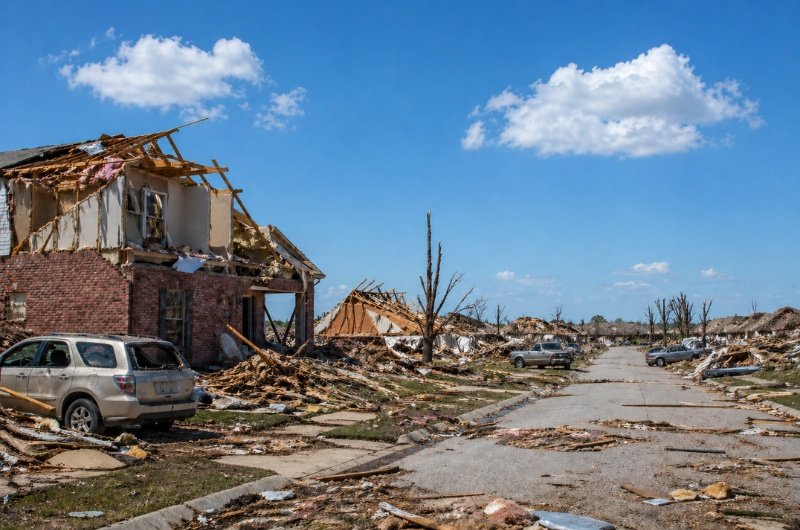
Across the Midwest and Great Plains, the past several days have unfolded in a grim, repeating pattern: sirens and communities bracing for impact—again and again. The late-April severe weather outbreak has produced dozens of tornadoes, including multiple high-intensity systems powerful enough to flatten homes, uproot infrastructure, and leave entire neighborhoods unrecognizable.
This wasn’t a single catastrophic strike. It was a sequence—wave after wave of storms tracking across state lines, giving emergency crews little time to recover before the next rotation touched down. In some areas, residents sought shelter multiple times in the span of 48 hours. The scale and persistence have made this one of the most taxing severe weather stretches in recent memory.
Meteorologists classify the strongest of these storms as EF4 tornadoes—violent systems with winds exceeding 160 miles per hour. At that intensity, the distinction between “damage” and “erasure” becomes thin. Buildings don’t just lose roofs; they lose structure. Streets don’t just flood; they disappear under debris fields stretching for miles.
But the deeper story is about frequency—and the growing sense that these events are no longer rare. Scientists continue to study how shifting atmospheric conditions, influenced in part by climate change, are contributing to more volatile storm environments: warmer air holding more moisture, clashing with unstable systems to produce longer and more intense outbreaks.
For the communities in the storm paths, the consequences are immediate and tangible. Power grids fail. Hospitals switch to emergency protocols. Insurance claims pile up even as some insurers quietly scale back exposure in high-risk regions. Recovery, once measured in weeks, increasingly stretches into months—sometimes overlapping with the next disaster.
There’s also a psychological toll that doesn’t show up in damage estimates. The unpredictability, the repetition, the constant readiness to drop everything and take cover—it reshapes how people live. When warnings come this often, the question isn’t just how to rebuild, but how to sustain a sense of normalcy at all.
The United States has always had a tornado season. What’s changing is its character. Outbreaks like this are testing the assumption that these events are isolated interruptions rather than recurring features of daily life.
In that sense, this week’s storms are a signal: the sirens may be temporary, but the conditions behind them are not.