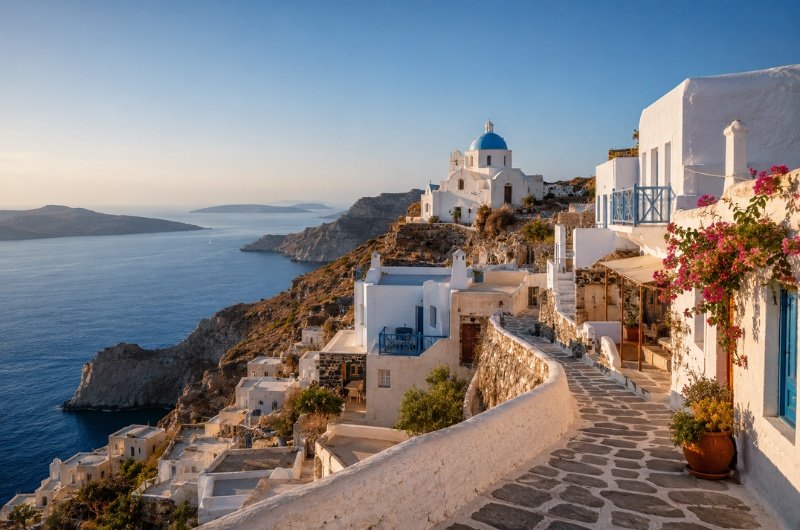
Greece’s lesser-known islands offer travelers a chance to experience whitewashed villages, winding stone pathways, and sweeping Aegean views away from the crowds. Santorini, the caldera-view island that launched a thousand Instagram accounts — with its stacked whitewashed houses, blue-domed churches, and sunsets so reliably gorgeous they feel almost theatrical — is grappling with a tourism crisis that has reshaped the conversation around Aegean travel.
With roughly 3.4 million visitors arriving annually against a permanent population of about 15,500, daily cruise ship arrivals frequently exceeding local capacity limits, and residential rents that have surged dramatically as short-term rentals crowd out long-term residents, the island’s own authorities now speak openly of a destination at a breaking point. Greece’s government has put new tourism management laws in place for 2026, and the conversation has finally turned to a question seasoned travelers have been asking for years: what about everywhere else?
The answer is richer than most people expect. Greece has more than 200 inhabited islands, and while Santorini and Mykonos have absorbed the bulk of international attention, a constellation of Cycladic alternatives offers Aegean beauty without the structural strain. Milos, the volcanic island in the western Cyclades roughly three hours by ferry from Athens, is frequently described by those who have visited as the most visually dramatic island in Greece. Its coastline is a geological theater — sculpted by ancient volcanic activity into formations of wild color and improbable shape.
Sarakiniko beach, with its lunar landscape of bleached white pumice and electric blue water, looks unlike anything else in the Mediterranean. The colorful fishing village of Klima, with its boatshed houses painted in faded ochres and reds, painted directly into the rock above the sea, is quietly one of the most photogenic places in Europe. A boat tour around Milos to the sea caves of Kleftiko is considered non-negotiable by those who have made the trip.
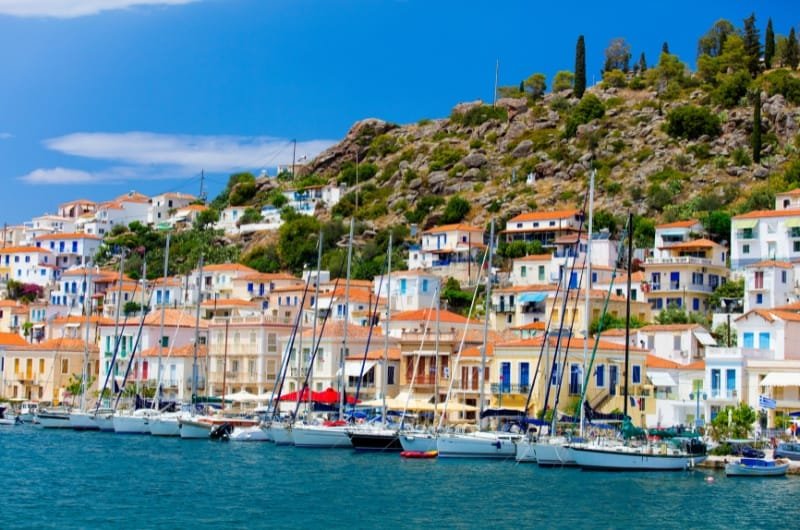
Folegandros, tucked an hour’s ferry ride southwest of Santorini, operates at an entirely different frequency. The island has no airport, one main road, and no cruise ship calls — a combination that enforces the kind of unhurried pace that the rest of the Cyclades has largely surrendered. Its main town, Chora, is widely considered to have the most beautiful village center in the island group: a medieval settlement of flower-draped passageways and Venetian-era architecture, perched on a cliff above the sea with views that shift from gold to violet as the sun goes down. Above the village, the Church of Panagia sits on a dramatic rocky promontory, reached by a steeply winding path that rewards the climb with a panorama of open Aegean. There are beaches to swim from, hiking paths that trace the island’s ridgelines, and restaurants where the octopus drying on the line outside is the same one arriving on your plate. For travelers who want romance without performance, Folegandros is the answer.
Naxos, the largest of the Cyclades, works best for those who want variety rather than a single defining experience. It has long sandy beaches — Agios Prokopios and Plaka among the finest in Greece — that Santorini conspicuously lacks. It has ancient ruins, including the massive marble doorway of the unfinished Temple of Apollo standing alone at the harbor entrance. It has mountain villages in its interior where the air smells of thyme and the pace of life has barely shifted in decades. And it produces exceptional food: Naxian potatoes and cheeses are considered among the best in the country, and the island’s tavernas reflect that localism in a way that tourist-saturated destinations rarely manage. Naxos also functions as an excellent ferry hub, connecting easily to the smaller islands of the Little Cyclades — Koufonisia, Schinoussa, Donousa — which for now remain almost entirely off the international radar.
The Readovia Lens
The shift in how travelers are approaching the Greek islands feels durable rather than merely fashionable. Greece itself is responding to it, investing in ferry connectivity to less-visited destinations and promoting its interior and northern regions alongside the classic Cycladic circuit. Travelers who act on this moment — before Milos becomes the next Santorini, before Folegandros acquires a direct flight — will find an Aegean that still rewards curiosity. The blue-domed postcard image remains beautiful. But the real Greece is bigger, quieter, and considerably more interesting than any single island can contain.