

Social Security Could Run Short by 2032 — What It Means for Younger Americans

If you’re under 50, there’s a good chance your Social Security retirement benefits could look different from those received by today’s retirees. According to the latest report from the Social Security Board of Trustees, the program’s retirement trust fund is now projected to have enough reserves to pay full scheduled benefits only until the fourth quarter of 2032—three years sooner than many Americans expected just a few years ago. If Congress does not act before then, continuing payroll tax revenue would be enough to pay about 78% of scheduled retirement benefits, resulting in an automatic reduction rather than the complete loss of benefits. Here’s what that means in plain English: Social Security isn’t expected to disappear. Instead, future retirees could receive smaller monthly checks unless lawmakers approve changes to strengthen the program’s finances. For younger Americans, that makes personal retirement savings, employer-sponsored retirement plans, and long-term investing more important than ever. Several long-term trends continue to drive the funding challenge: Americans are living longer and collecting benefits for more years. Birth rates have declined, leaving fewer workers supporting each retiree. Congress has debated potential reforms for years but has yet to agree on a long-term solution. What happens if nothing changes? Beginning in late 2032, the retirement trust fund would no longer have enough reserves to pay full scheduled benefits. Under current projections, ongoing payroll tax revenue would cover about 78% of promised retirement benefits, meaning beneficiaries could see an automatic reduction of roughly 22% unless Congress acts first. Lawmakers continue to discuss possible solutions, including raising payroll taxes, adjusting benefits for higher-income retirees, increasing the retirement age, or adopting a combination of reforms. While there is broad agreement that changes will eventually be needed, there is little consensus on which approach should be taken. For younger Americans, the broader lesson remains the same: social security was designed to provide a foundation for retirement—not to be the only source of retirement income. Building personal savings, investing consistently, and planning for multiple income sources can provide greater financial flexibility regardless of how the program evolves in the years ahead.
U.S. Launches Ninth Consecutive Night of Strikes Against Iran After American Troop Deaths

On Sunday night, the United States carried out a ninth consecutive night of military strikes against Iran as the conflict intensified following the deaths of additional American service members. U.S. officials said the latest operations targeted Iranian military capabilities linked to attacks on U.S. forces and commercial shipping in the region. The Defense Department identified two soldiers killed in a recent Iranian attack on a military base in Jordan as 1st Lt. Tyler James Feehan of Hawaii and Pvt. Isabella Gonzales of Texas. Their deaths have become a focal point in the administration’s justification for continuing the military campaign. According to U.S. Central Command, recent strikes have targeted air defense systems, missile and drone facilities, coastal surveillance sites, and other military infrastructure intended to reduce Iran’s ability to threaten U.S. forces and maritime traffic through the Strait of Hormuz. The latest military action comes as diplomatic efforts remain uncertain and tensions across the Middle East continue to rise. Oil markets and global shipping have remained on edge as both sides exchange attacks, raising concerns that the conflict could broaden further if negotiations fail.
AI Could Wipe Out Half of Entry-Level White-Collar Jobs: What We Know One Year Later

One year after Anthropic CEO Dario Amodei warned that artificial intelligence could eliminate up to half of all entry-level white-collar jobs, the conversation has shifted from speculation to observation. As AI tools become a routine part of the workplace, many employers are rethinking how they hire, train, and deploy early-career talent. Across industries including technology, finance, consulting, marketing, and customer service, companies are increasingly using AI to handle routine tasks that were once assigned to junior employees. Some employers have slowed hiring for entry-level positions, while others now expect new hires to arrive with practical AI skills already in place. Although the long-term impact remains uncertain, there is growing evidence that AI is reshaping the first rung of the career ladder. When Amodei made his remarks in 2025, his prediction drew widespread attention because of its scale. He warned that AI could eventually eliminate up to half of all entry-level white-collar jobs and significantly increase unemployment if businesses and governments failed to prepare for the transition. At the time, many viewed the comments as a bold forecast rather than an immediate reality. A year later, the picture is more nuanced. AI has not replaced half of all entry-level office jobs, but it has changed how many organizations approach hiring and productivity. Rather than eliminating entire professions overnight, companies are often redesigning roles, automating repetitive work, and expecting employees to accomplish more with AI as a daily coworker. For many businesses, AI has become less about replacing workers and more about changing what employers value. For students and professionals entering the workforce, the message is becoming increasingly clear: technical knowledge alone may no longer be enough. Employers are placing greater emphasis on critical thinking, communication, adaptability, and the ability to use AI effectively to solve real-world problems. As the technology continues to evolve, learning how to work alongside AI may prove to be one of the most valuable career skills of the decade.
Deadly Flooding Returns to Texas Hill Country as Hundreds Are Rescued
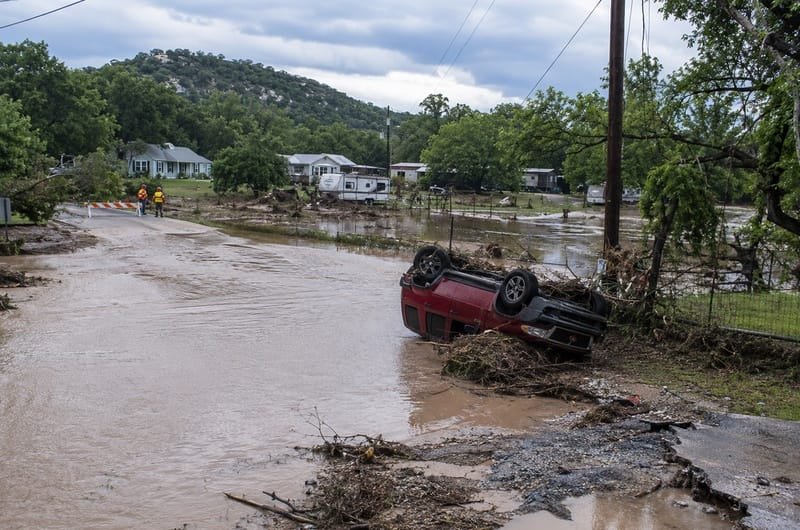
At least two people have died and hundreds have been rescued Thursday as torrential rain sent rivers surging across Central Texas, including communities still recovering from last year’s catastrophic flooding. Parts of the Texas Hill Country received more than two feet of rain—approximately a year’s worth—in just a few days. The extreme rainfall produced fast-moving flood waves along multiple rivers, overwhelming roads, homes and low-lying areas. Officials reported more than 230 water rescues across the state. More than 2,300 emergency personnel and 1,400 pieces of equipment have been deployed, including helicopters, rescue boats and high-water vehicles. The National Weather Service said moderate to major flooding was occurring or expected across several river basins, including the Guadalupe, Pedernales, Frio, Medina, San Antonio and Nueces. Although conditions were expected to improve in parts of the region Friday, river flooding could continue after the heaviest rain ends. The disaster comes just over a year after flash flooding killed more than 130 people in the Texas Hill Country, including children and counselors at Camp Mystic. This time, officials and residents credited expanded sirens, river warning towers and more urgent forecast messaging with helping communities respond sooner and potentially limiting an even greater loss of life.
More American Men Are Embracing Preventive Health — And Doctors Say That’s a Good Thing

More men across the United States are beginning to take preventive health more seriously, a shift doctors say could help improve long-term health outcomes and encourage earlier detection of potentially serious conditions. For years, healthcare experts have warned that many men are less likely to schedule routine checkups, discuss mental health concerns, or seek medical attention early when symptoms appear. But physicians say attitudes are gradually beginning to change as more men focus on longevity, energy levels, stress management, and overall quality of life rather than waiting until a health issue becomes urgent. The shift comes at an important time. Heart disease remains the leading cause of death among men in the United States, while high blood pressure, diabetes, elevated cholesterol, and certain cancers continue to affect millions of Americans each year. Doctors say regular screenings and preventive care can often identify problems earlier, when treatment options may be more effective. Mental health is also becoming a larger part of the conversation. Physicians and wellness experts say more men are openly discussing stress, burnout, anxiety, sleep problems, and emotional fatigue than in previous generations. While stigma still exists, growing awareness surrounding mental wellness is helping some men become more proactive about their overall health. At the same time, many men are increasingly embracing practical lifestyle changes tied to long-term wellness, including walking, strength training, healthier eating habits, better sleep routines, and regular medical visits. Men over 50 are increasingly displaying active lifestyles directly in their dating app profiles, with many highlighting gym routines, fitness habits, and workout schedules that can reach three to four times per week — a shift that is often visible not only in profile descriptions, but in the photos themselves. The trend reflects how wellness, longevity, and physical health are becoming a growing part of modern male identity later in life. Doctors say prevention does not require perfection — consistency and awareness often matter more than extreme health trends. The Readovia Lens A quiet cultural shift may be underway. For generations, many men were taught to ignore discomfort, avoid vulnerability, and “push through” health concerns. Increasingly, however, more men are beginning to view preventive care not as weakness, but as a form of long-term strength, responsibility, and self-awareness.
OpenAI Launches ChatGPT Work for Complex, Multi-Step Tasks

OpenAI has introduced ChatGPT Work, a new agent designed to help users complete longer, more involved projects inside ChatGPT. Announced July 9 and now rolling out to eligible accounts, Work can research information, use connected apps and files, create finished materials and continue working through multi-step assignments that would ordinarily require several separate prompts. The simplest way to understand Work is as the “get things done” side of ChatGPT. A standard conversation may help someone think through a problem or produce an individual answer. Work can take responsibility for a broader workflow—gathering information, planning the steps and turning a user’s goal into a finished, reviewable result. Powered by OpenAI’s new GPT‑5.6 model and technology developed for Codex, Work can create presentations, spreadsheets, documents, reports, websites and other creative assets. It can also assist with research, content production, data analysis and software projects, while breaking especially complex assignments into smaller tasks that can be completed independently. Scheduled Tasks extend those capabilities beyond a single session. Users can arrange for Work to complete a task once, repeat it on a schedule, respond to a future trigger or monitor for changes. A digital publisher, for example, could schedule a morning news search that identifies promising stories, organizes them by editorial channel and prepares article drafts and supporting materials for review. Users remain involved throughout the process. They can follow Work’s progress, answer questions, change direction and approve important actions before they occur. That combination of sustained execution and human oversight signals a meaningful evolution for ChatGPT: from an AI that primarily discusses the work to one increasingly capable of helping complete it.
Canadian Wildfire Smoke Drifts Across Parts of the U.S.

Smoke from hundreds of wildfires burning across Canada this week drifted into large portions of the United States on Friday, creating hazy skies and unhealthy air quality from the Midwest to the Northeast and Mid-Atlantic. Some of the poorest air quality was reported around the Great Lakes, where Detroit, Chicago and other cities experienced elevated pollution levels. The smoke also spread into communities farther east, including Washington, Philadelphia and New York City, prompting air quality alerts across more than 20 states. The smoky conditions also disrupted sporting events. A Major League Baseball game between the Pittsburgh Pirates and Cleveland Guardians was postponed after air quality in Cleveland reached a level considered “very unhealthy.” Another game in Philadelphia had already been rescheduled because of the smoke. Wildfire smoke contains tiny particles that can travel deep into the lungs and bloodstream. Health officials advised children, older adults, pregnant women and people with heart or lung conditions to limit strenuous outdoor activity, keep windows closed when possible and consider wearing a well-fitting N95 mask if spending extended time outdoors. Forecasters said weather conditions could bring temporary improvements to some areas over the weekend, but shifting winds may continue carrying smoke into different parts of the country. Residents are encouraged to check local air quality forecasts before making outdoor plans.
Trump’s ‘Really Big News’ Primetime Address Centers on Election Security Claims

President Donald Trump used a nationally televised primetime address Thursday night to focus on election security, announcing the declassification of intelligence documents that he said reveal foreign efforts to target U.S. election systems and expose vulnerabilities in the nation’s voting infrastructure. During the nearly 30-minute address, Trump alleged that China obtained millions of U.S. voter records and argued that intelligence officials withheld critical information from both his administration and the public. He also called on Congress to advance election security legislation and said the Justice Department should investigate those involved if wrongdoing is found. The White House described the declassified records as evidence of significant foreign election threats and said the documents highlight the need for stronger safeguards to protect future elections. Administration officials said the release is intended to improve transparency and restore public confidence in the electoral process. Election experts and several news organizations, however, said the newly released documents do not provide evidence that votes were altered or that the outcome of the 2020 presidential election was changed. They noted that while the documents discuss foreign interest in U.S. election systems and cybersecurity concerns, many of the broader claims made during the address remain disputed. The speech, which Trump had previewed earlier this week as containing “really big news,” quickly became one of the day’s most closely watched political events and is expected to keep election security at the center of national debate as the country moves toward the 2026 midterm elections.
Trump Promises ‘Really Big News’ in Primetime Address Tonight
President Donald Trump is scheduled to deliver a nationally televised primetime address Thursday evening, promising what he has described as “really big news” in a speech that is expected to focus on election security and voting systems ahead of this year’s midterm elections. The White House has provided few details about the announcement, but officials have indicated the president plans to discuss election integrity, the 2020 election, and what the administration describes as vulnerabilities in the nation’s voting infrastructure. The address is scheduled to begin at 9 p.m. Eastern. The speech comes as election policy continues to be a major political issue in Washington, with lawmakers, state officials, and advocacy groups debating voting rules, election security, and public confidence in the electoral process. Because the White House has not released the full contents of the address, it remains unclear whether the president will announce new executive actions, propose legislation, or outline additional election initiatives.
U.S. Airstrikes Move Closer to Iran’s Capital

The U.S. military carried out another round of strikes against Iran early Thursday, reaching targets farther north and near Tehran for the first time in the latest phase of the conflict. The movement toward the Iranian capital marks a notable expansion of the American campaign. Tehran serves as the country’s political center, making attacks in surrounding areas especially significant as the fighting continues. U.S. Central Command said American forces struck several military sites and assets connected to Iran’s operations in the Strait of Hormuz. CENTCOM said the mission was intended to weaken Iran’s ability to threaten civilian mariners traveling through the strategically important waterway. The command also reported disabling an oil tanker in the strait. The passage remains central to the conflict because of its importance to international shipping and global energy supplies. The latest strikes show that the U.S. campaign is reaching deeper into Iranian territory, further increasing pressure on Tehran as the conflict continues without a clear path toward de-escalation.