

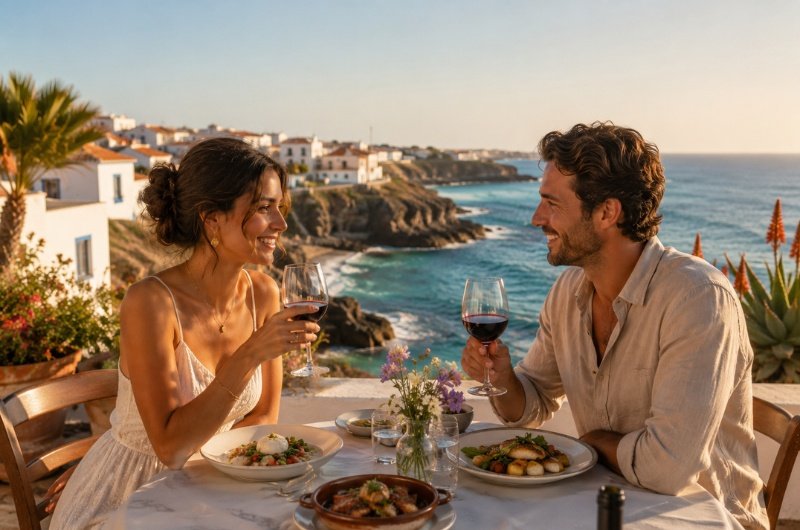
Most travelers who visit Portugal never make it past Lisbon, the Algarve, and perhaps a day trip to Sintra. That itinerary is entirely understandable — Portugal’s capital is among the most livable and beautiful cities in Europe, and the southern beaches are genuinely world-class. But there is a region between the capital and the coast that covers nearly a third of the country, contains some of the most extraordinary landscapes on the Iberian Peninsula, and remains almost entirely undiscovered by the international travelers rushing past it on the way to somewhere more familiar. The Alentejo is Portugal at its most authentic, it is quietly emerging as one of Europe’s most compelling slow-travel destinations.
The defining characteristic of the Alentejo — a name that translates roughly as “beyond the Tagus river” — is its extraordinary sense of space. Rolling golden plains stretch to every horizon under an immense sky. Ancient cork oak forests shade empty back roads where the only sound is the wind moving through the wheat.
The region is home to just 5% of Portugal’s population despite covering roughly 30% of its land area, and that imbalance gives the Alentejo a rare quality in modern travel: true quietude. At its heart lies Évora, a UNESCO World Heritage city that has been continuously inhabited since Roman times, its medieval walls and iconic Roman Temple rising from the plains as they have for two thousand years. The city’s streets contain more history per square kilometer than almost anywhere else in Western Europe — and its restaurants, serving slow-cooked lamb and black pork dishes with locally pressed olive oil and bread still warm from the oven, are making serious inroads on the culinary map.
The villages surrounding Évora are where the Alentejo’s character becomes unmistakable. Monsaraz, a medieval walled settlement perched on a hilltop above the glittering Alqueva Reservoir — Europe’s largest artificial lake — feels genuinely suspended in time, its narrow cobblestone lanes and whitewashed houses with blue trim offering some of the most striking golden-hour views in Portugal. Marvão, up in the northern Serra de São Mamede mountains, is a fortified village on a granite outcrop with panoramic views stretching into Spain on a clear day. And scattered across the countryside between these villages lie the megalithic stone circles of the Cromelque dos Almendres, among the oldest prehistoric monuments in Europe — predating Stonehenge by two thousand years, and standing largely in solitude among the cork trees with no ticket queue in sight.
The wine story here is as compelling as anything the region offers culturally. The Alentejo has emerged over the past decade as one of Portugal’s most exciting wine regions, producing bold, generous reds from varieties like Alicante Bouschet and Aragonez alongside increasingly refined whites. The terroir — granite, schist, and limestone soils under a Mediterranean climate tempered by Atlantic breezes — creates wines of genuine complexity, and the region’s estate wineries welcome visitors with the kind of unhurried hospitality that more famous wine regions have largely lost. In 2026, the southern sub-region of Baixo Alentejo holds the designation of European Wine City of the Year, bringing a calendar of open-cellar days, amphora tastings, and village wine routes that offer rare access to winemakers still fermenting in ancient clay vessels as the Romans did. For travelers who love wine but have grown tired of Napa or Tuscany, this is the new frontier.
What the Alentejo requires from its visitors is a car, a willingness to linger, and a resistance to over-scheduling. The region reveals itself slowly — through a long lunch on a winery terrace, through an afternoon drive through cork forest where the trees are being harvested by hand as they have been for centuries, through an evening glass of local red in the square of a village where the same families have gathered at dusk for generations. This is travel as restoration rather than consumption, and it has found its moment precisely because so many travelers are reaching the end of their patience with destinations designed entirely around the needs of mass tourism. The Alentejo was not designed for tourism at all. It was designed for living, and that, increasingly, is exactly what makes it worth visiting.