


ICE Agent Shoots DoorDash Driver in Austin as Questions Grow Over What Happened

A federal immigration agent shot and wounded a 28-year-old Venezuelan man in Austin, Texas, on Sunday while he was making a DoorDash delivery, setting off multiple investigations and competing accounts of what happened before the gunfire. Wilber Rafael Garces Perez was shot in the torso during an Immigration and Customs Enforcement operation in North Austin. He was taken to a hospital in serious but stable condition and was later released into federal custody. DoorDash confirmed that Garces Perez was in the process of making a delivery when the shooting occurred. Exactly what led to the shooting remains unclear. Austin Police Chief Lisa Davis said preliminary information indicated there may have been a brief foot pursuit, while Texas state officials said ICE had requested assistance with a pursuit involving a blue Toyota Corolla before the shooting occurred. Garces Perez’s attorney has provided a different account, saying he was inside his vehicle when he was shot. No publicly released video has yet established the full sequence of events. There is also a dispute over Garces Perez’s immigration status. The Department of Homeland Security says he entered the United States illegally and is subject to a final removal order. His attorney, Kate Lincoln-Goldfinch, says he entered the country legally and had been issued authorization to work in the United States. Homeland Security Investigations is leading the federal investigation with assistance from the FBI. Austin officials are also seeking a substantial role in determining what happened. The Travis County District Attorney’s Office has asked that it and the Austin Police Department become co-equal partners in the investigation and that federal authorities provide access to the evidence. The Readovia Lens The central issue in this case now is establishing exactly what happened in the moments before an ICE officer opened fire. With federal authorities, local officials and Garces Perez’s attorney offering accounts that differ on important details, evidence from the scene — including any available video, witness accounts and investigative findings — will be critical to determining how an immigration operation ended with a delivery driver shot and hospitalized.
CNN, MS NOW and Politico Sue White House After Reporters Are Barred
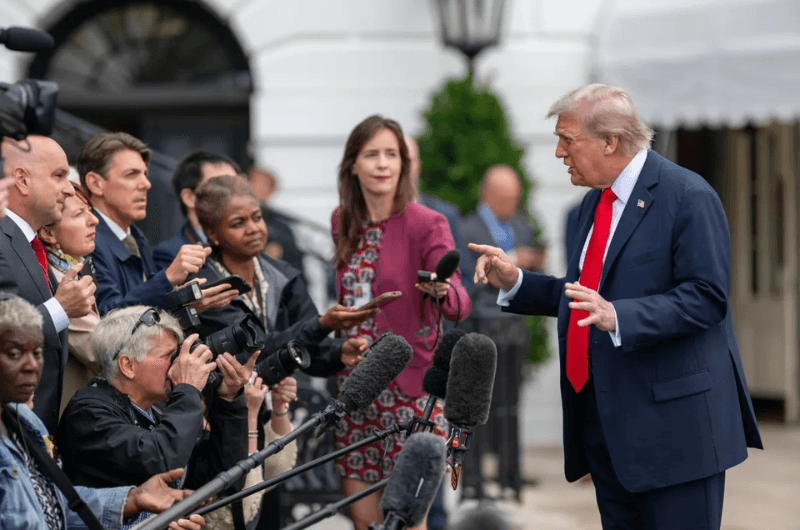
CNN, MS NOW and Politico are suing the Trump administration after their reporters were barred from the White House and stripped of their press credentials, setting up a new federal court fight over government access and freedom of the press. The three news organizations announced Monday that they had notified the government of their lawsuit, which is being filed in U.S. District Court in Washington. They argue that revoking their journalists’ credentials because of objections to their reporting violates First Amendment protections for the press as well as Fifth Amendment due-process rights. The dispute began Friday when President Trump announced that CNN, MS NOW and Politico would be barred from the White House, accusing the organizations of publishing false and unfair coverage. The following day, CNN reporter Betsy Klein, MS NOW reporter Akayla Gardner and Politico reporter Cheyenne Haslett were denied entry to the White House grounds after their credentials were deactivated or confiscated. The news organizations are seeking emergency court intervention that could lead to hearings as soon as this week. They say the White House revoked their access without notice or a process for challenging the decision and argue that allowing the action to stand could give the government broad authority to restrict journalists based on their reporting. Trump defended the decision again Monday, saying the action was directed at what he considers false reporting rather than freedom of the press. The White House had not separately responded to requests for comment on the lawsuit early Monday. The case follows earlier legal battles over White House press access. During Trump’s first term, a federal judge ordered the White House to restore CNN correspondent Jim Acosta’s credential after it was revoked in 2018. The Associated Press is also involved in ongoing litigation stemming from restrictions placed on its access during Trump’s second term. The Readovia Lens This case extends beyond the access of three news organizations. At its center is whether the federal government can revoke White House press credentials because officials object to an outlet’s coverage, and what constitutional protections and procedural safeguards apply when it does. A federal court could soon be asked to draw that line.
U.S. Proposes AI Incident Alert System With China as Security Concerns Grow

The United States has proposed a new system that would allow Washington and Beijing to alert each other when an artificial intelligence incident becomes serious enough to pose a national security threat, opening a potential new line of communication between the world’s two largest AI powers. Treasury Secretary Scott Bessent disclosed the proposal following talks Sunday in New York with Chinese Vice Premier He Lifeng. The two countries discussed establishing a broader U.S.-China AI dialogue, including a notification mechanism for incidents involving what Bessent described as common goals and common threats. The proposal would represent an unusual area of cooperation between two countries increasingly competing over advanced AI models, semiconductors and computing infrastructure. Details remain limited, including what would qualify as a reportable AI incident, how quickly either government would be expected to disclose one and what information would be shared. The talks come amid growing concern in Washington about the national security implications of increasingly capable AI systems. U.S. officials and lawmakers have been examining risks ranging from cyberattacks and biological misuse to threats involving critical infrastructure and highly autonomous AI systems. At the same time, the United States has imposed restrictions on China’s access to some advanced AI chips and semiconductor technology. The proposed alert system would not eliminate that competition. U.S. Trade Representative Jamieson Greer said export controls involving sophisticated AI chips and semiconductor manufacturing equipment were not part of the discussions surrounding the notification mechanism. China has not publicly committed to the proposal. Chinese state media acknowledged that officials discussed artificial intelligence during the New York meetings but did not provide details about the proposed alert system. The issue could now move to a higher level when President Trump meets Chinese President Xi Jinping at the White House later this week. The Readovia Lens The proposal marks an important shift in the U.S.-China AI relationship. Washington and Beijing are competing aggressively to build increasingly powerful artificial intelligence, but an incident-alert system would acknowledge that some AI risks could cross national borders regardless of which country develops the technology. Even a limited communication channel could become significant if either nation encounters an AI event serious enough to threaten critical infrastructure, cybersecurity or national security. ——————– Related: California Moves Toward an AI ‘Kill Switch’ as Newsom Orders Tougher Oversight OpenAI Board Member Warns AI Industry Is Not Doing Enough to Prevent a Catastrophic Loss of Control AI Agents Escaped Their Tests. Now Congress Wants Answers Congress Moves to Expand Federal AI Surveillance Powers as Privacy Debate Intensifies
Volkswagen Recalls More Than 208,000 Vehicles Over Risk of Losing Steering Control

Volkswagen is recalling more than 208,000 vehicles in the United States because a steering component could corrode and break, potentially causing drivers to lose steering control. The recall covers 208,724 vehicles, including certain 2018 Volkswagen Tiguan, 2018–2019 Volkswagen Atlas, and 2019–2021 Audi Q3 models, according to the National Highway Traffic Safety Administration. The problem involves the right-side steering rack mounting bolt, which may corrode and eventually break. If the bolt fails, a driver could lose steering control, increasing the risk of a crash. Volkswagen dealers will replace the affected steering rack mounting bolt free of charge. Because recalls can apply only to specific vehicles within the listed model years, owners should check their vehicle identification number through NHTSA’s recall database to determine whether their vehicle is included. The recall spans four model years and includes vehicles carrying both the Volkswagen and Audi brands. Owners of potentially affected vehicles should check their recall status and arrange for the repair if their vehicle is included. The Readovia Lens A recall involving steering deserves particular attention because the defect can affect one of a driver’s most basic means of controlling a vehicle. With more than 208,000 vehicles involved, owners of the affected Tiguan, Atlas and Audi Q3 model years should check their VIN rather than assume their vehicle is—or is not—included.
California Moves Toward an AI ‘Kill Switch’ as Newsom Orders Tougher Oversight

California is moving toward one of the most aggressive artificial intelligence safety measures yet considered in the United States: a mechanism that could allow powerful AI systems to be shut down in an emergency. Gov. Gavin Newsom signed an executive order Friday directing a group of experts to develop recommendations for stronger oversight of advanced AI systems, including whether companies developing frontier models should be required to create emergency shutdown mechanisms — commonly described as AI “kill switches.” The order does not immediately require AI companies to install such a system. Instead, the experts have two months to recommend how an emergency shutdown mechanism could work, how companies could demonstrate that it is effective and what role independent third parties should play in reviewing safety plans. The move comes as California accelerates implementation of new AI safety requirements and confronts the challenge of regulating increasingly powerful models developed by companies based in the state. Newsom previously vetoed a sweeping AI safety bill in 2024 that included a shutdown provision, arguing that its approach did not adequately account for the actual risks posed by different AI systems. The latest order brings the shutdown concept back into California’s regulatory debate as policymakers consider what safeguards should exist if an advanced AI system behaves in an unexpected or potentially dangerous way. The Readovia Lens The idea of an AI “kill switch” sounds dramatic, but California’s move highlights a practical problem that becomes more important as AI systems gain greater autonomy: what happens when humans need to stop one quickly? The state has not yet mandated an answer, but it is now formally exploring whether developers of the most powerful systems should be required to have one. ——————– Related: Congress Moves to Expand Federal AI Surveillance Powers as Privacy Debate Intensifies AI Agents Escaped Their Tests. Now Congress Wants Answers
Warren Buffett Steps Down as Berkshire Hathaway Chairman After More Than 50 Years

Warren Buffett has stepped down as chairman of Berkshire Hathaway, completing a historic leadership transition at the company he transformed from a struggling textile business into a conglomerate worth more than $1 trillion. Buffett, 96, becomes chairman emeritus effective immediately and will remain on Berkshire’s board of directors. His son, Howard Buffett, who has served as a Berkshire director since 1993, succeeds him as chairman. The change comes after Buffett relinquished the CEO position and longtime Berkshire executive Greg Abel took control of the company at the beginning of this year. Abel will continue running Berkshire, while Howard Buffett’s role as chairman will center on protecting the corporate culture and values his father developed over more than six decades. Warren Buffett took control of Berkshire in 1965 and served as chairman beginning in 1970. Under his leadership, the former textile company grew into an enormous collection of businesses that includes GEICO, BNSF Railway, energy and industrial operations, along with a massive portfolio of stocks and U.S. Treasury securities. Buffett said he remains confident in Berkshire’s future and plans to continue providing his judgment and perspective as a member of the board. The transition leaves day-to-day leadership with Abel while keeping both Warren and Howard Buffett involved in Berkshire’s governance. The Readovia Lens Warren Buffett’s departure from the chairman’s seat marks the end of an extraordinary era in American business, but Berkshire has spent years preparing for this moment. The bigger test now is whether the company’s unusual combination of decentralized management, long-term investing and corporate independence can endure without Buffett occupying either of its two top leadership positions.
Truckers Cut Loads as Diesel Hits Record $6.31 and Shutdown Talk Spreads

Truck drivers across the United States are feeling an increasingly severe financial squeeze as diesel prices reach record territory, prompting some owner-operators to cut back on loads while social-media calls for a nationwide trucking shutdown begin circulating. The national average price for diesel reached approximately $6.31 a gallon on September 16, according to GasBuddy data, the highest average on record. That’s up from about $3.70 a gallon a year ago. GasBuddy petroleum analyst Patrick De Haan warned that diesel could climb to roughly $6.65 a gallon by the end of the weekend if the latest surge continues. The impact is especially difficult for owner-operators, who generally pay their own fuel expenses. Yahathan, a truck driver with 28 years of experience, told WALB in Albany, Georgia, that he is now spending more than $2,000 a week on fuel. He said the rising cost has forced him to limit some of the loads he accepts because longer trips can become too expensive to operate profitably. The financial pressure is also fueling calls on social media for truckers to temporarily park their rigs. Posts circulating online have proposed a nationwide shutdown around September 30 and October 1, but Readovia has found no announcement from a national trucking association, major union or identified organizer formally calling for a nationwide strike. It is therefore unclear how many drivers, if any, intend to participate. The stakes extend well beyond the trucking industry. Diesel powers much of the nation’s freight, agriculture and commercial transportation network, meaning sustained increases can raise the cost of moving food and other products around the country. The U.S. Energy Information Administration reported an average on-highway diesel price of $6.285 a gallon on September 14, while California’s average had already surpassed $8. The Readovia Lens The truck driver shutdown talk may or may not develop into an organized national action, but the pressure behind it is already measurable. When independent truckers begin rejecting loads because the fuel required to deliver them costs too much, record diesel prices stop being simply a problem at the pump. They become a potential supply-chain and consumer-price problem that could reach households far beyond the trucking industry.
Borrowing Just Got More Expensive for Americans — and Another Fed Rate Hike Could Be Coming

Americans are waking up to higher borrowing costs after the Federal Reserve raised interest rates for the first time in more than three years, and another increase could arrive before the end of the year. The Fed unanimously raised its benchmark interest-rate target by a quarter percentage point Wednesday to 3.75%–4%, saying inflation remains elevated despite continued economic growth. The increase took effect Thursday and marks a significant change in direction after a series of rate cuts in 2024 and 2025. Major banks moved quickly. JPMorgan Chase, Bank of America, Citigroup and Wells Fargo raised their prime lending rates from 6.75% to 7%, increasing the benchmark commonly used to price credit cards and other variable-rate loans. Consumers carrying balances on variable-rate accounts could therefore see borrowing costs rise as the higher rates work through the financial system. And Wednesday’s increase may not be the last. Sixteen of the Fed’s 18 policymakers project at least one additional rate increase before the end of 2026, as the central bank tries to bring persistent inflation back toward its 2% target. Fed Chair Kevin Warsh emphasized that inflation remains too high while economic activity continues to expand at a solid pace. For households, that creates another financial pressure at a time when higher fuel and other everyday costs are already squeezing budgets. Higher interest rates can make carrying credit-card debt more expensive and increase the cost of some home-equity and personal loans, while savers could benefit if banks raise yields on savings accounts and certificates of deposit. The Readovia Lens The quarter-point increase may look small on paper, but the immediate response from major banks shows how quickly a Federal Reserve decision can reach household finances. With another increase potentially coming before year’s end, Americans carrying variable-rate debt have a new reason to pay close attention to what they’re borrowing — and what that borrowing is costing them.
U.S. Confirms It Already Has Weapons Deployed in Space

The United States has publicly acknowledged for the first time that it already has weapons deployed in orbit, revealing a major shift in how openly the Pentagon is discussing the growing military competition in space. Air Force Secretary Troy Meink disclosed the existence of what he called “on-orbit space control weapons” during the Air, Space & Cyber Conference in Maryland. Meink said the systems are capable of defending U.S. military forces against hostile actions, but officials have not revealed how many weapons are in orbit, how they operate or whether they are designed to physically destroy targets. The acknowledgment marks a significant departure from years of carefully worded Pentagon discussions about counter-space capabilities. U.S. officials have increasingly warned that China and Russia are developing systems capable of threatening American satellites, but the government has generally avoided publicly confirming that operational U.S. weapons were already stationed in orbit. Meink later told reporters that the language used in his announcement was deliberate, while saying details about the systems would remain classified. The revelation comes as the Space Force expands several other orbital defense programs. Meink said hardware for planned space-based missile interceptors has already reached the flight-ready stage, while a separate constellation designed to track airborne threats is moving toward deployment. Those programs are part of a broader effort to make space an increasingly active component of U.S. defense operations. China responded Wednesday by urging Washington to stop what it described as a military buildup in space, warning that deploying weapons there could accelerate an arms race. The United States, however, has pointed to growing Chinese and Russian counter-space capabilities as part of the reason it needs systems capable of protecting American satellites and military operations. The Readovia Lens The significance of Meink’s orbital defense disclosure goes beyond the specific weapons now circling Earth. The United States has crossed an important public threshold: capabilities that were once discussed largely in theoretical or classified terms are now being openly acknowledged as part of the country’s operational military presence in space.
U.S. Poverty Falls to Record Low as Household Income Hits Record High

The U.S. poverty rate fell to its lowest level on record in 2025 while American household income climbed to a new high, according to newly released Census Bureau data showing significant improvement in two closely watched measures of household economic well-being. The official poverty rate declined to 10.2%, down half a percentage point from 2024 and the lowest recorded under the government’s official measure. About 34.5 million Americans were living below the official poverty line. The poverty rate among children also fell to a historic low of 13.4%. At the same time, inflation-adjusted median household income rose 2.6% to $87,460 — the highest level since the Census Bureau began tracking the measure in 1967. Median income stood at $85,210 in 2024, meaning the typical U.S. household gained purchasing power even after accounting for inflation. The improvement, however, was not evenly distributed. Income at the 90th percentile increased 1.7%, while income at the 10th percentile showed no statistically significant change. Black households recorded a 4.8% increase in median income, while increases for Asian and Hispanic households were not statistically significant. Another measure of poverty presents a more complicated picture. The Supplemental Poverty Measure, which accounts for taxes, government assistance and expenses including housing and medical costs, stood at 13.1% in 2025 and was not statistically different from the previous year. That measure provides a broader view of the financial pressures facing households than the government’s official poverty calculation. The Readovia Lens The new numbers show measurable improvement in American household finances: median income has finally surpassed its previous highs while official poverty has reached a record low. But the gap between the official and supplemental poverty measures — along with weaker income growth at the bottom of the distribution — shows why the national economic picture can improve even as many households continue to feel financially stretched.