For nearly five hours Monday, Burbank’s air traffic control tower stood empty—yet planes still flew. The event exposed a fragile system, shifting control to remote operators and underscoring a latent danger in America’s airspace.
The autumn sun dipped low over the San Fernando Valley on Monday, casting long shadows across Hollywood Burbank Airport. Inside the glassed control tower—normally the pulsing heart of flight coordination—no one was watching.
From roughly 4:15 p.m. to 10:00 p.m., the tower sat empty. Staffing shortages tied to the ongoing federal government shutdown forced controllers to stay home, leaving one of the nation’s busiest regional airports without local oversight. During that time, the Southern California TRACON facility in San Diego took over remotely, guiding aircraft by radio while ground crews relied on “non-towered” procedures more common to rural airfields.
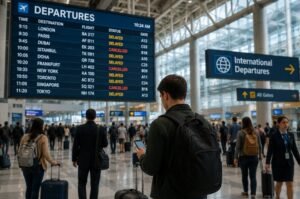
Despite the absence of on-site control, flights continued—though not without disruption. Many departures faced delays exceeding two hours, and several were canceled altogether. For travelers, it was another ripple effect of a shutdown that has turned the nation’s most vital systems into endurance tests. For aviation experts, it was something more alarming: proof of how fragile America’s air network becomes when a single node goes silent.
The Human Cost of “Essential” Work
Air traffic controllers are classified as essential workers, required to report for duty even when government funding halts. But essential doesn’t mean exempt from financial hardship. With paychecks now delayed, many are facing mounting bills, emotional strain, and burnout.
Insiders say morale is deteriorating as the shutdown stretches on. Some controllers have begun calling out sick, others are working double shifts, and training programs have been paused indefinitely. The result is a thinning workforce operating under increasing stress—and fewer layers of protection in a system that depends on redundancy.
In Burbank’s case, no safety incidents occurred. Still, the image of an unmanned tower in a major metropolitan area sent shockwaves through the industry, reigniting debates about whether contingency plans are sufficient when politics stops the paychecks that keep essential infrastructure running.
A Ripple Across the Nation
The Burbank episode is not isolated. Airports in Denver, Phoenix, Las Vegas, and Newark have all reported heightened delays amid staffing shortages, some operating with as much as fifty percent fewer controllers.
Industry officials warn that if the shutdown persists, more “ATC Zero” events—when a facility cannot safely provide air traffic services—could occur. For airlines, that means more ground holds and diversions. For passengers, more missed connections and overnight waits.
Behind it all are the human hands that make America’s skies safe. When those hands are forced to stop working—or to keep working unpaid—the entire system starts to wobble.
After the Lights Returned
At 10 p.m., the Burbank tower lights flickered back on, controllers returned, and local operations resumed. The incident passed without tragedy. But for aviation veterans, it left a lasting unease.
A silent control tower is a symptom of systemic vulnerability. In the air, as in government, the margin for error is small. And when the people who keep planes safely separated can’t afford to show up, the nation’s confidence in its own flight path begins to shake.