

America’s Electricity Grid Is Stepping Into the AI Economy
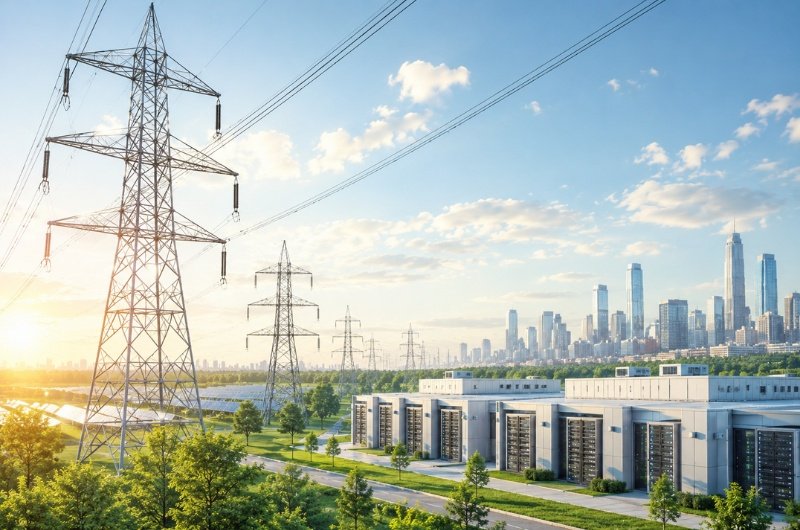
The artificial intelligence boom is beginning to reshape a part of the economy few investors expected: America’s power industry. A massive proposed merger involving two of the nation’s largest energy companies is drawing new attention to how quickly electricity demand is becoming one of the defining forces behind the next phase of the AI economy. The deal would create one of the most powerful utility operators in the United States at a time when artificial intelligence is driving an unprecedented expansion of data centers across the country. Advertisement For years, AI was largely viewed as a software revolution unfolding through chatbots, algorithms, and digital platforms. But behind the scenes, the technology depends on something far more physical: enormous amounts of electricity. Training and operating advanced AI systems now requires sprawling data centers filled with high-performance chips running around the clock. Those facilities consume massive amounts of energy for computing, cooling, and infrastructure support — and demand is rising rapidly as AI adoption accelerates across business, government, healthcare, finance, and consumer technology. The shift is beginning to change how Wall Street views utility companies and energy infrastructure. Investors who once treated power companies as slow-moving defensive plays are increasingly recognizing them as critical participants in the AI economy itself. In some regions, utility providers are already racing to expand grid capacity to support a growing wave of AI-related construction projects. Virginia has emerged as one of the clearest examples of the transformation underway. Already home to one of the world’s largest concentrations of data centers, the state has become a major hub for the infrastructure powering artificial intelligence. Similar expansions are beginning to spread into other parts of the country as technology firms compete to secure long-term energy access for future AI growth. The implications could stretch well beyond the technology sector. As AI infrastructure expands, energy demand is expected to fuel new investment in grid modernization, transmission systems, battery storage, renewable energy, and nuclear power. Some analysts now believe electricity availability itself could become one of the most important competitive factors in the global AI race. At the same time, the rapid growth of AI infrastructure is raising broader economic questions. Building and powering massive data centers requires billions of dollars in long-term investment, and some experts believe the growing strain on regional grids could eventually place upward pressure on electricity costs in heavily concentrated markets. The emerging reality is becoming harder to ignore: artificial intelligence may be digital, but the economy supporting it is deeply physical. For investors, the shift is becoming increasingly difficult to ignore. As artificial intelligence expands beyond software into full-scale infrastructure, utilities, grid operators, energy producers, and data center companies are beginning to attract renewed attention from Wall Street. The AI economy may ultimately create winners far beyond traditional technology firms. The Readovia Lens We’ve said it before – the next phase of the AI boom may depend less on apps and more on infrastructure. Behind every intelligent system is a growing network of power plants, transmission lines, cooling systems, and data centers consuming extraordinary amounts of electricity. In the years ahead, the companies supplying that energy may quietly become some of the most important players in the modern economy.
China Agrees to Major Boeing Purchase During Trump-Xi Diplomatic Push
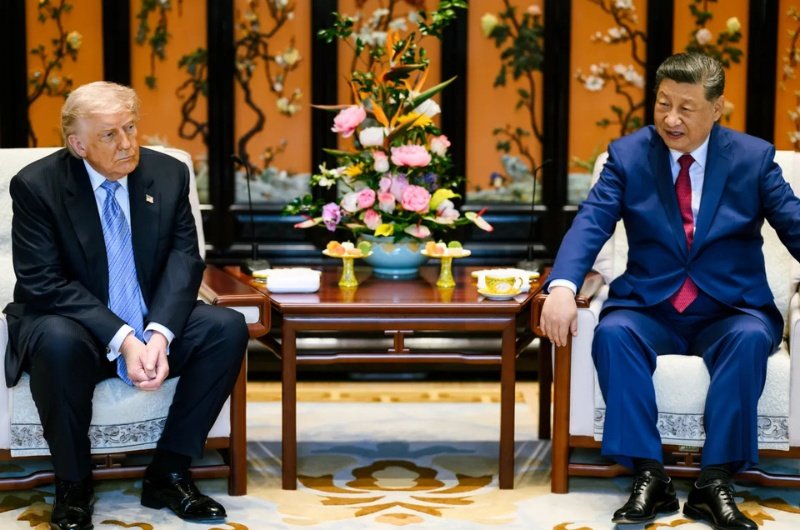
President Trump’s high-level summit with Chinese President Xi Jinping produced a series of major economic and geopolitical developments this week, including a massive Boeing aircraft agreement that could become one of the largest aviation deals in modern history. According to the White House, China agreed to purchase 200 Boeing aircraft, with discussions underway that could eventually expand the order to as many as 750 jets — a move expected to deliver a significant boost to American manufacturing and aerospace jobs. Advertisement The summit also produced broader diplomatic signals beyond aviation. Treasury Secretary Scott Bessent said the United States and China are now discussing the creation of a joint Board of Investment, a proposal that could open the door to deeper economic coordination between the world’s two largest economies after years of trade friction and strategic distrust. At the same time, both nations reportedly agreed that Iran must not control the Strait of Hormuz, one of the world’s most important energy shipping corridors. The agreement reflects growing concern over global energy stability as tensions continue to simmer across the Middle East. The summit concluded with President Trump inviting President Xi to visit the White House later this year, signaling what could become a broader effort to stabilize one of the most consequential relationships in global politics.
Inside the High-Stakes Clash Between Elon Musk and OpenAI

Elon Musk and OpenAI returned to court this week as closing arguments intensified in a high-profile legal battle over the future direction, governance, and commercialization of artificial intelligence. The increasingly public conflict between the billionaire entrepreneur and the company he once helped launch is evolving into far more than a courtroom dispute between former allies. Closing arguments in the latest phase of the legal fight have drawn renewed attention to Musk’s accusations that OpenAI abandoned its original nonprofit mission in pursuit of commercial dominance and massive corporate influence. OpenAI, meanwhile, has defended its evolution as necessary to compete in an AI race that now requires enormous computing power, infrastructure investment, and global-scale deployment. What began years ago as a research-focused effort to develop artificial intelligence responsibly has since transformed into one of the most influential technology companies in the world. OpenAI’s rapid rise — fueled in part by its partnership with Microsoft and the explosive adoption of ChatGPT — helped ignite a global AI arms race that is reshaping industries, governments, education, media, and the broader economy. For Musk, the dispute appears to center on whether artificial intelligence should remain open, transparent, and aligned with humanity’s interests rather than concentrated inside a handful of powerful corporations. But the broader implications now extend well beyond the individuals involved. The case has become symbolic of a much larger question facing the tech industry: whether AI will ultimately evolve as a public-serving technology ecosystem or become controlled primarily by a small number of companies with unprecedented influence over information, automation, and digital infrastructure. The stakes are enormous because artificial intelligence is no longer viewed as a niche technology sector. AI is increasingly becoming foundational infrastructure — comparable to electricity, the internet, or cloud computing — with the potential to shape economic power, military capability, scientific advancement, and global competitiveness for decades to come. The legal fight also arrives during a period of extraordinary investment across the AI economy. Companies are pouring billions into data centers, advanced semiconductors, cloud infrastructure, robotics, and large-scale AI systems as competition intensifies between the United States, China, and other global powers seeking leadership in the field. While the courtroom battle itself may take months or years to fully resolve, the public confrontation between Musk and OpenAI is already exposing the deeper tensions now emerging across the artificial intelligence industry: speed versus safety, openness versus control, and innovation versus concentration of power. The Readovia Lens The most important part of the Musk-OpenAI conflict may not be who wins the case. It may be what the battle reveals about the next era of technology itself. Artificial intelligence is rapidly becoming a new layer of global infrastructure — and the companies controlling it could hold extraordinary influence over how modern society functions in the years ahead.
White House Launches Moms.gov as Trump Honors Mothers at Rose Garden Event

The White House this week launched Moms.gov, a new federal resource platform designed to give expecting and new mothers centralized access to health information, benefits, and family support programs across the federal government. The rollout came as President Trump hosted a Mother’s Day Rose Garden luncheon honoring Angel Moms and Gold Star Mothers in what the administration described as a tribute to families who have experienced profound loss and sacrifice. According to the White House, Moms.gov is intended to simplify access to government services for mothers navigating pregnancy, early childhood care, and family assistance programs by bringing multiple federal resources together in a single online hub. First Lady Melania Trump also used the week to highlight progress tied to the “Fostering the Future” executive initiative, marking 180 days since the order was introduced. The White House says the initiative has already produced 10 measurable achievements aimed at improving support systems and long-term outcomes for foster youth across the country. The announcements reflect a broader effort by the administration to place family policy and motherhood initiatives more visibly at the center of its domestic messaging heading deeper into the election cycle.
The Immigration Debate Is Expanding Into State Health Systems

Several Republican-led states are moving beyond federal immigration reporting requirements by directing public health agencies to assist more directly with deportation-related enforcement efforts, adding a new layer to the national immigration debate. North Carolina recently became the latest state to require health agencies to flag Medicaid recipients to the Department of Homeland Security if questions arise about their immigration status, while similar measures are advancing in states including Tennessee and Oklahoma. The moves come as the Trump administration continues expanding its immigration crackdown through broader government data-sharing efforts. The controversy centers on Medicaid administrative and enrollment information — including names, addresses, phone numbers, birth dates, and immigration-status indicators — not detailed medical records. Earlier this year, a federal judge allowed limited sharing of certain Medicaid enrollee data with Immigration and Customs Enforcement to resume while ongoing legal challenges continue. Supporters of the policy argue the measures help identify people who may be receiving benefits unlawfully and strengthen coordination between federal and state agencies. Critics warn the growing use of health-related systems for immigration enforcement could discourage vulnerable communities from seeking emergency medical care or cooperating with healthcare providers. The broader legal battle is still unfolding. More than 20 states have challenged the federal government’s Medicaid data-sharing practices in court, arguing the information was originally collected for healthcare administration — not immigration enforcement. While courts have allowed limited sharing of basic biographical information to continue, judges have blocked broader access to sensitive medical data as litigation proceeds.
Musk’s Court Fight With OpenAI Exposes a Bigger Battle Over AI’s Future

The courtroom battle between Elon Musk and OpenAI reached a critical stage this week as closing arguments wrapped in one of the most closely watched technology cases in the world. At the center of the dispute is Musk’s claim that OpenAI abandoned the nonprofit mission it was originally founded upon and transformed itself into a profit-driven artificial intelligence powerhouse fueled by corporate partnerships and billions of dollars in investment. OpenAI and CEO Sam Altman have denied wrongdoing, arguing the company evolved in response to the extraordinary cost and complexity of developing advanced AI systems. But beneath the legal arguments and Silicon Valley drama, the trial has opened a much larger public debate — one that stretches far beyond the courtroom itself. What began nearly a decade ago as a research-focused organization built around the idea of developing artificial intelligence safely and openly has since become one of the most strategically important technology companies on Earth. OpenAI now sits at the center of a global race involving governments, cloud infrastructure giants, chipmakers, investors, and competing AI labs all pushing toward increasingly powerful systems. The transformation has been staggering. Artificial intelligence is no longer viewed simply as experimental software or futuristic consumer technology. It is increasingly becoming infrastructure — economic infrastructure, workplace infrastructure, information infrastructure, and potentially even geopolitical infrastructure. The companies building the most advanced models are now shaping how people search for information, write software, conduct business, create media, and interact with digital systems. That evolution helps explain why the Musk-OpenAI conflict has attracted such intense attention. The case is no longer just about whether promises were broken between former collaborators. It has become a public argument over what happens when organizations founded around idealism collide with the enormous financial and strategic pressures surrounding artificial intelligence. OpenAI was originally launched with a mission centered on benefiting humanity and openly sharing research. But the modern AI race quickly became extraordinarily expensive. Training frontier AI systems now requires massive computing infrastructure, specialized chips, vast data resources, and billions of dollars in investment. As competition intensified with rivals including Google, Anthropic, Meta, and Musk’s own xAI venture, the economics of AI development changed dramatically. Microsoft’s multibillion-dollar partnership with OpenAI became one of the defining examples of that shift. The relationship helped propel OpenAI into the center of the commercial AI boom while also raising new questions about influence, governance, and corporate control. Musk’s legal team has argued the company drifted far from its original nonprofit vision. OpenAI maintains that its current structure was necessary to continue competing and scaling safely. The broader implications extend far beyond Silicon Valley personalities. The trial is unfolding during a moment when governments worldwide are racing to regulate AI while simultaneously investing heavily in its development. Businesses are restructuring around AI tools, investors are pouring unprecedented capital into AI infrastructure, and nations increasingly view advanced AI systems as matters of economic and national security. In many ways, the courtroom fight reflects a deeper reality emerging across the technology industry: artificial intelligence is becoming too important, too expensive, and too powerful to remain insulated from corporate influence and geopolitical competition. The idealistic early vision of open collaboration around AI now collides with a marketplace driven by scale, speed, infrastructure dominance, and global strategic advantage. The case has also exposed a growing philosophical divide inside the AI world itself. One side argues that advanced artificial intelligence should remain closely controlled and carefully governed due to the risks associated with increasingly capable systems. Others believe concentrating AI power inside a small number of companies may create an entirely different set of dangers involving influence, access, transparency, and accountability. As the trial moves closer to a verdict, the legal outcome may ultimately matter less than the larger conversation now unfolding around it. The public is beginning to see that the future of artificial intelligence may not be shaped solely by engineering breakthroughs, but also by power struggles over who controls the systems, who funds them, and whose interests they ultimately serve. The Musk-OpenAI battle may have started as a dispute between former allies. It is increasingly becoming something much larger: a defining argument over the future governance of artificial intelligence itself.
Presidents Trump and Jinping Meet in Beijing as the World Watches a New Power Struggle Unfold
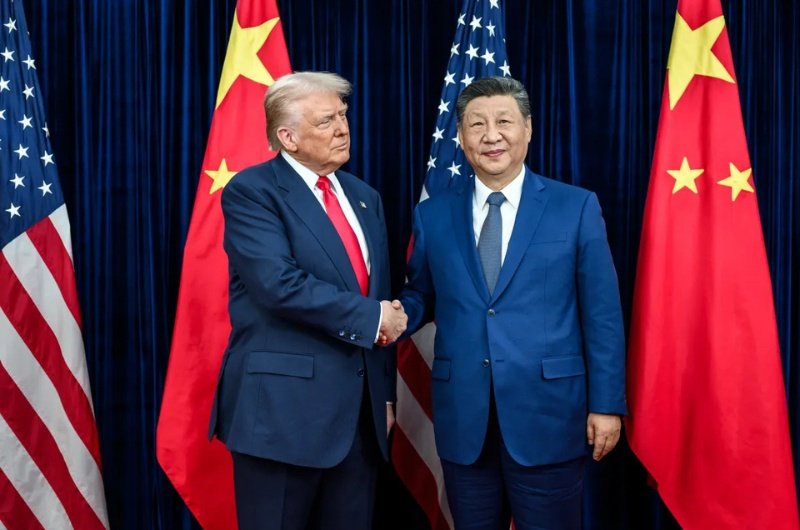
President Donald Trump arrived in Beijing Thursday for a high-stakes summit with Chinese President Xi Jinping, as tensions surrounding trade, artificial intelligence, Taiwan, and global influence converge during one of the most closely watched diplomatic meetings of the year. The summit opened with elaborate ceremony inside Beijing’s Great Hall of the People, where Trump received a red-carpet welcome and full military honors in a carefully staged display of cooperation between the world’s two largest economies. Behind the symbolism, however, both nations entered the talks facing growing pressure over economic competition, military positioning, and the future balance of technological power. Artificial intelligence quickly emerged as one of the defining themes surrounding the visit. Technology leaders and executives connected to the rapidly expanding AI sector traveled alongside the U.S. delegation as Washington and Beijing continue competing for dominance in semiconductors, advanced computing systems, and next-generation infrastructure. The discussions reflect a growing reality that AI is increasingly becoming a matter of national strategy and geopolitical leverage. The summit comes amid rising tensions over Taiwan, ongoing economic uncertainty, and a growing effort by both nations to reduce dependence on one another while still preserving critical trade ties. Although both leaders publicly emphasized cooperation, the meetings highlighted how competitive and increasingly fragile the relationship between the United States and China has become. For governments, investors, and global technology companies, the talks represent more than a diplomatic event. They offer an early glimpse into how the next era of global influence may be shaped — not only through military strength or trade agreements, but through control of AI systems, semiconductor supply chains, and the digital infrastructure powering the modern economy.
Google Is Quietly Building the AI Brain for the World’s Robots
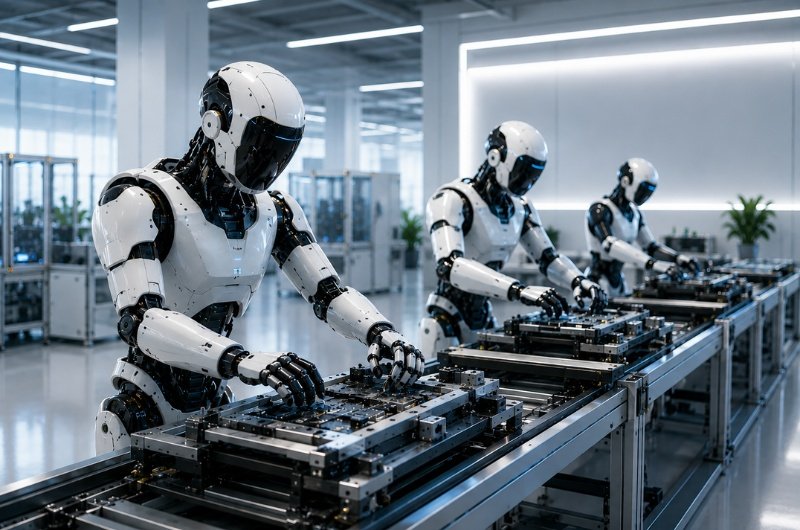
While much of the AI race has focused on chatbots and consumer tools, Google is now making a major push into something potentially far larger: giving industrial robots the ability to think, adapt, and operate more like humans inside real-world manufacturing environments. The company is expanding its robotics ambitions by integrating its Gemini AI models into industrial automation systems through a growing network of partnerships with some of the biggest names in robotics and manufacturing. Rather than building robots itself at scale, Google appears increasingly focused on becoming the intelligence layer powering the next generation of machines. One of the most significant developments came through a partnership with FANUC, the world’s largest industrial robot manufacturer. The collaboration allows FANUC systems to use Gemini Enterprise AI to process natural language instructions and better understand unpredictable environments — a major shift from the rigid, pre-programmed behavior that has traditionally defined factory robotics. Google is also working alongside Boston Dynamics to integrate Gemini models into the company’s Atlas humanoid robot platform, while DeepMind has partnered with Agile Robots to explore advanced AI-driven manufacturing systems. At the center of Google’s strategy is a growing focus on what the company calls “Physical AI” — systems designed not just to generate text or images, but to interact with and understand the physical world. Its Gemini Robotics-ER models are being developed to improve spatial reasoning, motion planning, safety awareness, and real-time decision-making inside industrial settings. Combined with emerging vision-language-action systems, the technology could allow robots to see, understand, and respond to their surroundings with far greater flexibility than traditional automation systems. The broader shift may fundamentally reshape manufacturing itself. Instead of relying on expensive hardware redesigns every time a factory changes processes, companies are increasingly moving toward software-defined robotics — machines that can adapt through AI updates rather than mechanical rebuilding. Google’s Intrinsic platform is also developing systems that allow multiple robots to coordinate tasks together using AI-optimized motion planning, potentially opening the door to smarter, more autonomous production lines. For years, robotics has struggled to move beyond repetitive factory work performed inside carefully controlled environments. Google’s growing push into AI-powered automation signals a much larger ambition: creating machines capable of handling dynamic, unpredictable tasks across industries ranging from electronics manufacturing to logistics and advanced assembly. If successful, the next major AI revolution may not happen on screens — but on factory floors.
Nvidia Surges Again as AI Boom Pushes Company Beyond $5.5 Trillion Valuation
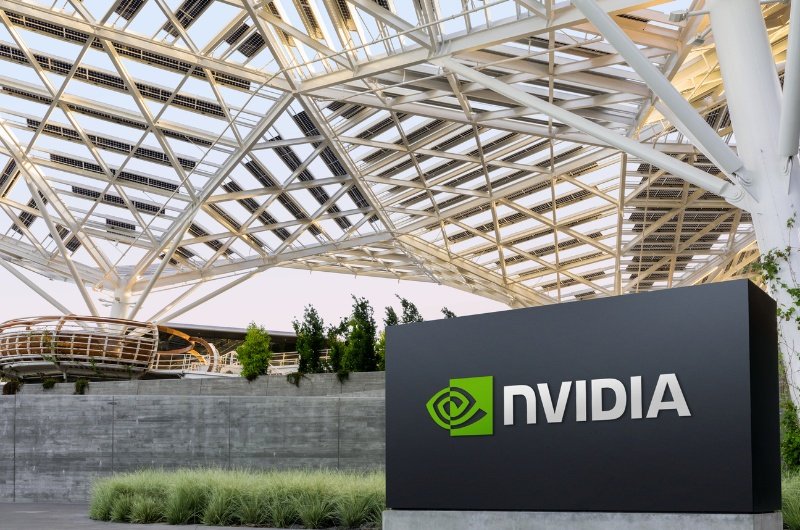
Nvidia stock surged Thursday as the company crossed a $5.5 trillion market valuation following a Reuters report that the U.S. Commerce Department approved advanced H200 chip sales to several Chinese technology companies. The surge adds to what has already become one of the most extraordinary runs in modern stock market history. Nvidia has transformed from a semiconductor company primarily known for graphics processing into the central infrastructure provider powering the AI economy, with its chips now driving everything from large language models to massive data centers and enterprise AI systems. Analysts across Wall Street have continued raising price targets as demand for AI computing power accelerates globally. Much of Thursday’s momentum appeared tied to growing optimism surrounding Nvidia’s position in China. Reports indicated that major Chinese technology companies were among those cleared to purchase the H200 chips under U.S. export restrictions. Although shipments have reportedly not yet begun, investors viewed the approvals as another sign that Nvidia could regain access to a critical market that had become increasingly uncertain amid rising U.S.-China tensions. Advertisement The rally also reflects a broader reality now reshaping Wall Street: artificial intelligence is no longer being treated as a speculative technology trend. Increasingly, investors are viewing AI infrastructure as the foundation of the next major era of economic growth, with Nvidia positioned at the center of that transformation. As markets opened Thursday morning, Nvidia shares continued moving higher, extending a run that has helped lift the broader technology sector and fuel record highs across major indexes. For investors who entered the stock earlier in the AI cycle, the gains have been staggering — and for Wall Street, Nvidia has become one of the clearest symbols yet of how aggressively capital is flowing into the future of artificial intelligence.
The AI Rally Hits Pause as Traders Lock In Gains

After one of the most explosive runs in modern stock market history, some of Wall Street’s hottest AI-linked stocks began to lose momentum late Wednesday morning as investors locked in profits and reassessed the next phase of the rally. Several artificial intelligence infrastructure companies traded lower Wednesday despite continued long-term optimism surrounding AI demand. The pullback comes after extraordinary gains across the sector over the past year, with some companies tied to semiconductors, storage, networking, and AI compute systems surging hundreds — and in some cases more than 1,500% — as the global AI race accelerated. Advertisement The shift does not necessarily signal fading confidence in artificial intelligence itself. Instead, investors appear to be navigating a more complicated market environment as rising oil prices, inflation concerns, and uncertainty around future interest rates begin weighing on broader sentiment. Many of the companies powering the AI economy remain central to Wall Street’s long-term growth narrative. Demand for advanced chips, memory systems, data-center infrastructure, and high-speed networking equipment continues rising as businesses, governments, and technology firms race to expand their AI capabilities. By Wednesday afternoon, several AI-linked stocks had begun climbing back from earlier losses, signaling that investor confidence in the long-term AI infrastructure boom remains largely intact despite short-term profit-taking. For now, the broader AI story remains intact. Yet Wednesday’s volatility offered a reminder that even the market’s biggest winners are not immune to periods of hesitation — especially after historic gains.