


Samsung Galaxy S26 Debuts With AI at the Core of the Smartphone Experience

Samsung has officially unveiled the Samsung Galaxy S26 series, positioning artificial intelligence at the center of its 2026 flagship strategy. Announced at its latest Unpacked event, the new lineup signals a clear shift: smartphones are no longer just faster and brighter — they are becoming more predictive, contextual, and autonomous. The S26 series includes three models: the standard S26, S26+, and S26 Ultra. Across the lineup, Samsung is expanding its “Galaxy AI” capabilities, integrating deeper on-device intelligence for everyday tasks such as smart scheduling, real-time language tools, contextual search, and advanced photo editing. Rather than operating as a separate feature layer, AI is embedded directly into the system experience, surfacing suggestions and automations based on user behavior. Under the hood, the devices are powered by next-generation processors optimized for neural performance, enabling faster AI processing without relying solely on cloud connectivity. Samsung says this allows for improved privacy protections, as more data processing occurs directly on the device. The Ultra model also introduces a new privacy-focused display technology designed to reduce side-angle screen visibility in public spaces. Design refinements remain evolutionary rather than dramatic, with high-refresh AMOLED displays, upgraded durability, and enhanced battery efficiency. The Ultra continues to lead in camera performance and storage capacity, offering configurations that push into professional-grade territory. Pricing reflects premium positioning, with the base model entering the high-end smartphone tier and the Ultra anchoring the lineup at flagship levels. The bigger story, however, is strategic. The Galaxy S26 series underscores a broader industry shift toward AI-first mobile ecosystems. As smartphones mature in hardware innovation, the competitive edge is increasingly defined by intelligence — how seamlessly devices anticipate needs, automate tasks, and integrate across digital life. With the S26 launch, Samsung is making clear that the future of the smartphone is not just faster — it is smarter.
Tech Layoffs Continue Into 2026 as Companies Restructure for Efficiency

The wave of tech layoffs that defined much of the past two years is showing no signs of slowing in 2026. In just the first several weeks of the year, tens of thousands of jobs have already been cut across the global technology sector, putting this year on pace to rival — or potentially exceed — the workforce reductions seen in 2025. Major players are once again leading the trend. Amazon has confirmed additional corporate job cuts as part of an ongoing restructuring effort, while Meta has trimmed roles within its Reality Labs division. Salesforce and Workday have also reduced headcount, describing the moves as strategic adjustments rather than emergency measures. Across companies, executives are citing efficiency, streamlined operations, and sharper focus on core priorities. The language surrounding these layoffs has shifted. Instead of recession-driven urgency, companies are framing the cuts as deliberate recalibration. Leadership teams are flattening management layers, consolidating overlapping roles, and reallocating resources toward high-growth initiatives — particularly artificial intelligence, automation, and enterprise services. Smaller startups and fintech firms are facing similar pressure. Some are pivoting business models entirely, moving away from consumer-heavy strategies toward business-to-business offerings in search of steadier revenue streams. The result is a broader reshaping of the tech workforce, not just a trimming of excess. While hiring has not disappeared altogether, the industry’s rapid expansion phase appears firmly behind it. For employees and investors alike, 2026 is shaping up to be a year of discipline — one defined less by explosive growth and more by structural reset.
Why Tech Companies Are Removing Features — and Calling It Optimization

In 2026, a quiet shift is underway in the technology landscape: many companies are scaling back or removing software features rather than constantly adding new ones. What might sound counter-intuitive — companies subtracting functionality in an era of rapid innovation — is increasingly being framed internally as “optimization” or a strategic refocus on essential user experiences. One reason for this trend is that complexity has a real cost. Too many features can make software harder to use, harder to maintain, and more resource-intensive for both developers and users. In some cases, removing or simplifying features can actually improve usability and performance by allowing teams to focus on what matters most. In development circles, eliminating clutter and “feature bloat” is seen by some engineers as a long-term productivity gain rather than a backward step. The broader tech ecosystem reflects similar patterns. Many companies are reallocating resources toward core priorities — especially artificial intelligence and efficiency-driven systems — and away from areas that are no longer seen as critical to future strategy. This has led to the winding down of some non-AI projects and the retirement of experimental initiatives that once captured attention but failed to deliver sustained value. Meanwhile, changes in platform requirements and regulatory pressures are also influencing how features evolve. Some proposed legal rules at the state level aim to curb addictive design elements in apps and social platforms by restricting notifications and other engagement-driven features. These kinds of external forces can accelerate internal decisions to simplify product lines and eliminate functions that might run afoul of emerging norms. The result is a technology landscape that is less about constant expansion and more about focused refinement. Companies are increasingly asking not just “What can we build?” but “What should we build?” For users, this shift may show up as fewer cluttered menus, more streamlined workflows, and software that feels lighter and more responsive — even if it means saying goodbye to some features once considered essential.
Apple Unveils Creator Studio — A Unified Creative Suite With AI Tools

Apple is launching Apple Creator Studio, a new subscription service that brings together its most powerful creative applications under one umbrella and layers in intelligent tools designed to streamline creative workflows. Priced at $12.99 per month or $129 per year, Creator Studio bundles several of Apple’s flagship creative apps — including professional video editing, music production, and graphic design tools — into a single subscription. The package spans both Mac and iPad, highlighting Apple’s strategy of unifying experiences across devices. Among the included apps are tools for video editing, music creation, and image design, all optimized to work seamlessly across Apple’s ecosystem. For the first time, some professional apps previously available only on Mac will also run on iPad, taking full advantage of touch and stylus input. In addition to the core creative applications, the subscription adds premium features and intelligent content to productivity tools, such as presentation, document, and spreadsheet apps, helping users move more quickly from ideas to finished work. Apple said the suite is aimed at creators, students, and professionals who want a more integrated, powerful set of tools — while reinforcing the company’s broader shift toward growing its services business, a priority as hardware sales face increasing competition. Creator Studio will be available on the App Store starting January 28, offering a one-month free trial and special pricing options for students and educators. This move positions Apple more directly against legacy creative software bundles and reinforces its emphasis on subscription services with meaningful enhancements.
AI’s Rapid Growth Could Push Smartphone and PC Prices Higher in 2026

Artificial intelligence is reshaping the technology industry in ways that extend far beyond software. As demand for AI computing power accelerates, the hardware required to support it is becoming more expensive — and consumers may begin to feel the effects this year. Much of the pressure stems from the massive infrastructure needed to train and operate advanced AI systems. Data centers built to support AI workloads require large amounts of memory and specialized components, drawing supply away from the consumer electronics market. That shift is creating tighter availability for key parts used in smartphones, laptops, and personal computers. As component costs rise, manufacturers face difficult choices. Some may absorb a portion of the added expense, but others are expected to pass higher costs on to consumers. For shoppers, that could mean higher prices for new devices or fewer discounts compared with previous years. The trend arrives at a time when many consumers are already being selective about technology upgrades. While innovation continues, the pace of must-have device features has slowed, making price increases more noticeable. Buyers may hold onto phones and computers longer, repair existing devices, or delay upgrades altogether. Looking ahead, AI’s impact on hardware pricing highlights an often overlooked side of technological progress. While software capabilities advance rapidly, the physical resources required to power them remain finite. In 2026, the growth of artificial intelligence may not just change what devices can do — it may also influence how much consumers pay to use them.
U.S. Moves to Block New Foreign-Made Drones Over National Security Concerns

U.S. regulators are moving to block approvals for new foreign-made drones, citing growing national security concerns tied to data collection and surveillance risks. The action targets future models produced by several overseas manufacturers, including industry-leading drone maker DJI, and marks a significant escalation in Washington’s scrutiny of consumer and commercial drone technology. Under the new restrictions, federal authorities will no longer grant approvals required for new drone models to enter the U.S. market. While drones already in use will not be affected, the move effectively freezes future sales and imports unless manufacturers meet stricter security standards. Officials have long warned that drones equipped with cameras, sensors, and location tracking capabilities could pose risks if sensitive data is accessed or transmitted outside the United States. The latest step reflects broader efforts to reduce reliance on foreign technology in areas deemed critical to national security. The decision could have wide-ranging implications for hobbyists, photographers, construction firms, agriculture operators, and public safety agencies that rely on drones for daily operations. DJI, which dominates the U.S. drone market, has consistently denied allegations that its products pose security threats and says customer data is protected. The drone restrictions arrive amid a larger push to tighten controls on foreign-made technology used in American airspace, communications, and infrastructure. As enforcement expands, consumers and businesses may soon see fewer choices — and higher costs — when it comes to next-generation drone hardware.
Australia Officially Becomes First Country to Ban Social Media for Under-16s

Australia has begun enforcing a world-first law that bans children under the age of 16 from using major social media platforms, marking a significant shift in how governments regulate online access for young users. The restrictions took effect at midnight local time early Thursday, requiring platforms such as TikTok, Instagram, Facebook, Snapchat, YouTube, X and others to block under-16 users from holding accounts or creating new ones. Companies that fail to comply face fines that can reach into the tens of millions of Australian dollars. Under the new law, responsibility for enforcement falls on the platforms themselves, not on parents or children. Companies are expected to implement age-verification systems and remove existing accounts held by users below the minimum age threshold. Australian officials say the move is designed to protect children from online harm, including exposure to harmful content and addictive social media behaviors. Technology companies, however, have raised concerns about implementation challenges, privacy implications, and the effectiveness of age-verification technologies. The ban is already drawing global attention, with policymakers in Europe, North America and Asia closely watching how the law is enforced and whether it withstands legal and technical scrutiny. Australia’s decision places it at the center of a growing international debate over where responsibility lies for safeguarding children online. —————— Related stories: Julie Inman Grant, The Regulator Reshaping Teen Social Media in Australia Australia Locks Under-16s Out of Social Media — and Yes, That Now Includes YouTube
AI Agents Take Center Stage at AWS re:Invent 2025

When AWS closed out its flagship cloud conference in Las Vegas today, the message was unmistakable: AI is quickly becoming the center of enterprise technology. At re:Invent 2025, Amazon unveiled a sweeping lineup of tools, chips, and intelligent services that together signal a new phase in computing: one where AI is embedded deeply into business infrastructure rather than added on top of it. For companies, developers — and ultimately everyday users — this marks a turning point in how modern software will be built and operated. At the heart of AWS’s announcements is a major push into what it calls agentic AI — autonomous systems designed to make decisions, plan tasks, and manage complex workflows without constant human oversight. These aren’t simple chatbot assistants. They are persistent agents capable of acting for hours or even days, coordinating processes across cloud applications, and adapting to new information as they work. AWS also introduced its next-generation Nova models, a new tool for building custom enterprise AIs, and advanced silicon designed to run massive workloads with greater efficiency and lower cost. One of the most striking shifts showcased at re:Invent is the move toward fully automated business operations. Customer-service platforms can now deploy AI agents that not only interact with callers but analyze context, determine next steps, and complete follow-up tasks end-to-end. Legacy software systems can be modernized more quickly using AI-driven refactoring tools. And for developers, new cloud-native workflows promise to eliminate much of the repetitive labor involved in deployment, testing, and maintenance — potentially freeing teams to focus more on innovation. But even with stunning technical progress on display, a lingering question remains: Are enterprises ready? Building and deploying autonomous agents at scale requires strong data governance, risk controls, and internal trust — areas where many organizations are still catching up. Some early adopters will sprint ahead, but for others, the transition to AI-driven infrastructure may unfold gradually as companies learn how to balance efficiency with oversight and accountability. For the broader tech world — and for consumers who will eventually use the products powered by these systems — AWS re:Invent 2025 signals a clear direction for the future. AI will not be a feature. It will be the foundation. As 2026 approaches, the landscape is shifting fast toward intelligent apps, self-operating cloud systems, and business processes driven by autonomous logic. In short: the next era of technology is already here.
Uber Partners with Starship to Launch Advanced Autonomous Delivery Robots in the UK
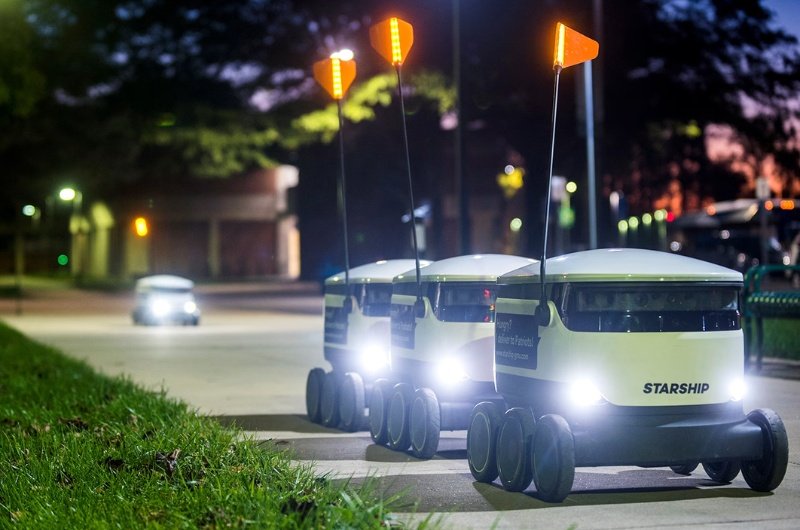
Uber Eats announced a new partnership with Starship Technologies this week, introducing advanced autonomous sidewalk-delivery robots that will begin operating in select UK cities starting in December. The agreement brings together Uber’s massive food-delivery network with what many analysts describe as the most mature, widely-deployed delivery-robot platform in the world — marking a shift from small-scale pilot programs to a larger commercial rollout. Starship Technologies has spent years developing and scaling ground-based delivery robots capable of navigating sidewalks and pedestrian traffic with minimal human oversight. Its compact six-wheel units have already completed millions of deliveries across hundreds of campuses, corporate sites, and city neighborhoods internationally. Built to operate at Level 4 autonomy, the robots are designed to function without direct human control within defined service areas — a capability that sets them apart from many emerging competitors still reliant on remote monitoring or assistance. Under the new partnership, Uber customers in the UK will be able to order meals as usual through the Uber Eats app and choose robot delivery where available. Once dispatched, the robot travels independently to the destination using onboard cameras, radar, sensors, and machine-learning navigation. Customers can track their robot in real time and unlock the insulated storage compartment with a secure code once it arrives at their doorstep. Early service regions include Leeds and Sheffield, with additional cities expected to follow as infrastructure and adoption expand. While Uber has already experimented with autonomous delivery partnerships in the United States, the collaboration with Starship represents a substantial technological upgrade. By leveraging a partner with a proven fleet already operating at scale, Uber positions itself at the forefront of last-mile transformation rather than simply testing emerging concepts. Industry watchers say the move could accelerate broader acceptance of robotic delivery, particularly in densely populated areas where short-distance vehicle trips contribute heavily to congestion and emissions. Looking ahead, Uber and Starship have signaled plans to expand to additional markets in Europe and eventually into the United States. Questions remain around regulatory frameworks, labor implications, weather resilience, and the pace of consumer trust — but if successful, the rollout could signal the beginning of a fundamental shift in how goods travel to homes and businesses.
Signal Shift: Apple Plans Ambitious iPhone Satellite Features

Heads up, Readovians — Apple is reportedly planning a major upgrade to its iPhone satellite connectivity — moving far beyond emergency SOS and positioning the device for true off-grid operation. According to insiders, the company has at least five upgraded satellite capabilities in development. These include offline maps that work without Wi-Fi or cell service, photo sharing via satellite in Messages, improved indoor performance, and integration with non-terrestrial 5G networks. There are also indications Apple may eventually build its own satellite service infrastructure to reduce reliance on outside operators. For anyone who builds, markets, or manages digital experiences, this shift means rethinking how content reaches people when there’s no traditional network connection. It’s a reminder that the next wave of connectivity will come not from towers, but from orbit. Still, many details remain unclear — including which devices will support these features, when they’ll launch, and whether Apple will charge for the service after the current free period ends. Regulatory and carrier considerations could also slow deployment, though Apple’s track record suggests the groundwork is already underway. For consumers, the vision is simple: a phone that stays connected wherever you are — on a mountain trail, in the desert, or miles from the nearest signal. For Apple, it’s another quiet move to keep the iPhone at the center of everyday life — even when the world around it goes offline.