


Trump Signs ‘Take It Down Act’ into Law, Targeting Deepfakes and Revenge Porn
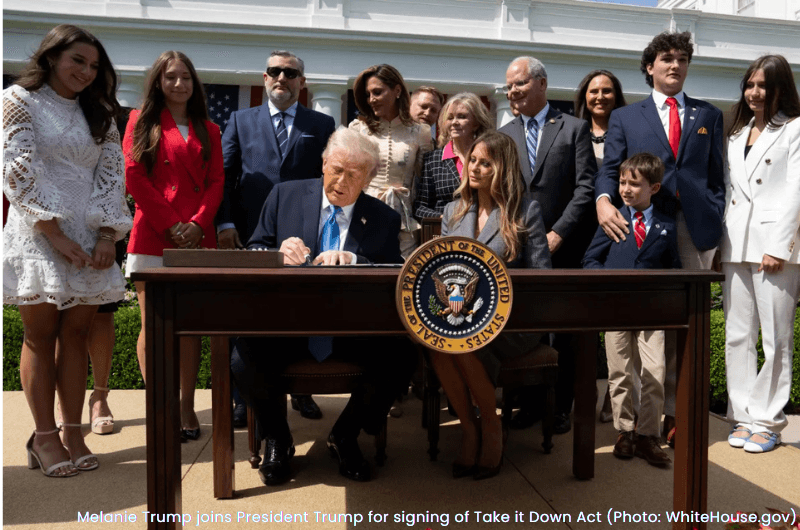
On May 19, 2025, President Donald Trump signed the “Take It Down Act” into law, marking a significant federal step against the distribution of non-consensual intimate imagery, including AI-generated deepfakes and revenge porn. The legislation, championed by First Lady Melania Trump as part of her revitalized Be Best campaign, received overwhelming bipartisan support—passing the House 409-2 after unanimous Senate approval. Key Provisions of the Law Criminalization of Non-Consensual Intimate Imagery: The law makes it a federal crime to knowingly publish or threaten to publish intimate images without a person’s consent, encompassing both real and AI-generated content. Mandatory Removal by Online Platforms: Social media companies and websites are required to remove such content within 48 hours of notification by the victim and take steps to prevent its reappearance. Enforcement by the Federal Trade Commission: The FTC is empowered to enforce compliance, ensuring that platforms adhere to the new regulations. Voices Behind the Legislation Senators Ted Cruz (R-Texas) and Amy Klobuchar (D-Minn.) co-sponsored the bill, highlighting its bipartisan nature. The act was inspired in part by the story of Elliston Berry, a teenager whose AI-generated explicit images circulated online, leading to a prolonged struggle to have them removed. First Lady Melania Trump emphasized the emotional toll on young victims, stating, “It is heartbreaking to see what teenagers, especially girls, go through after they are victimized by people who spread such content.” Support and Criticism While the law has been lauded by victim advocacy groups and industry stakeholders as a landmark protection against online abuse, some digital rights organizations have expressed concerns. Critics argue that the legislation’s broad language could lead to censorship and infringe upon free speech rights. A Step Forward in Digital Safety The Take It Down Act represents a significant move by the federal government to address the challenges posed by emerging technologies like AI in the realm of personal privacy and online exploitation. As the digital landscape continues to evolve, this legislation sets a precedent for how such issues might be tackled in the future. The Author
Cartel Leader Among 16 Arrested in Historic U.S. Fentanyl Bust

In what authorities are calling a landmark moment in the fight against fentanyl trafficking, U.S. federal agents have arrested 16 individuals — including a high-ranking cartel boss — tied to a sprawling drug ring that funneled the deadly opioid across the U.S. The operation, which spanned multiple states, culminated in a coordinated sweep earlier this week. At the heart of the arrests: a suspected leader of the notorious Beltrán-Leyva cartel, a criminal organization long linked to drug smuggling, violence, and transnational crime. According to officials, the group was using a network of couriers and stash houses to move massive quantities of fentanyl-laced pills and powder into American communities. Several of those arrested had direct ties to Mexico and were allegedly coordinating shipments with cartel operators south of the border. Seized during the bust were more than 100,000 pills, multiple firearms, and large sums of cash — reinforcing concerns over how deeply entrenched fentanyl trafficking has become in the U.S. criminal underworld. Authorities also uncovered encrypted messaging systems the group reportedly used to avoid detection. “This is one of the most significant takedowns in recent history involving fentanyl trafficking and cartel leadership,” said one official close to the investigation. “We’re not just talking about street-level dealers. We’re talking about people at the top of the chain.” The arrests arrive at a time when fentanyl remains the leading cause of overdose deaths in the U.S., with synthetic opioids responsible for nearly 75,000 deaths in 2023 alone. Law enforcement officials say this operation not only disrupts a major supply channel but sends a strong signal to other trafficking networks. Despite the win, agencies caution that the fight is far from over. “This isn’t the end. But it’s a critical blow to one of the most dangerous sources of fentanyl in America,” an agent said.
Is Cardinal Kevin Farrell The Likely Successor to Pope Francis?

As the Catholic Church mourns the passing of Pope Francis, attention is turning to the future leadership of the Vatican. With the world still processing the loss of the beloved Pope, speculation has begun swirling around Cardinal Kevin Joseph Farrell as a potential successor to lead the global faith. Farrell, a seasoned and respected figure within the Church, is often mentioned as one of the frontrunners to assume the papacy. Currently serving as the Prefect of the Dicastery for Laity, Family, and Life, Farrell has long been an advocate for reform, social justice, and inclusivity, aligning with many of the values that Pope Francis championed throughout his papacy. A Steady Hand in Times of Change Following Pope Francis’s passing, Cardinal Kevin Farrell has been appointed to serve as the interim manager of the Catholic Church, overseeing day-to-day operations until a new pope is elected. The temporary appointment speaks to the Vatican’s trust in his leadership during a period of mourning and transition. Farrell has spent much of his career emphasizing the importance of the laity’s role in the Church, advocating for a more inclusive approach to Catholic life. His leadership has focused on strengthening family life, supporting youth programs, and encouraging greater engagement between the Church and modern society. Farrell’s background as an experienced leader, especially in managing diverse global communities, positions him as a strong candidate to guide the Church through a period of reflection and renewal. Farrell’s candidacy for the papacy also reflects the Church’s need for a steady hand in times of upheaval. Following Pope Francis’s transformative reign, the Church is now looking for a leader who can continue his legacy of compassion and progress, while also fostering unity in the face of challenges from both within and outside the faith. A Unique Moment for the Catholic Church Though Farrell’s rise to power would be historic in many ways, including his role as an American-born cardinal, the global Catholic community remains divided on who would be the best fit for the papacy. As the College of Cardinals prepares to meet and vote on the next pope, all eyes will be on Farrell as one of the leading contenders to take on the immense responsibility of leading the Catholic Church. While no official announcement has been made regarding a successor, the conversation around Cardinal Kevin Farrell’s future as the next Pope reflects the critical moment of transition the Church is currently navigating. As the world watches, the next few days will be crucial in determining who will inherit the mantle of Pope Francis and shape the direction of the Church for generations to come.
Is the Rise of AI Deepfakes Eroding Trust in Reality?

In an era where technology evolves at breakneck speed, AI-generated deepfakes have emerged as a double-edged sword. While they showcase the incredible capabilities of artificial intelligence, they also blur the lines between reality and fabrication. From convincingly altered videos of public figures to synthetic voices mimicking real individuals, the proliferation of deepfakes poses a pressing question: Can we still trust what we see and hear? As these digital forgeries become more sophisticated, concerns grow about their potential misuse in politics, media, and personal relationships. The implications are vast—undermining public trust, spreading misinformation, and challenging the very notion of objective truth. So, what do you think?