


Washington Wildfires Destroy 850 Buildings as Arson Suspect Faces Charges

Wildfires around Spokane, Washington, have destroyed roughly 850 buildings and forced about 67,000 people to evacuate, leaving communities across the region confronting widespread destruction as investigators pursue an arson case connected to the largest of the fires. Firefighters have made progress against the Old Trails, Autumn Lane and Fairview fires after cooler temperatures and lighter winds provided more favorable conditions. Together, the three major fires have burned more than 10,000 acres. Officials remain cautious, however, as hotter, drier and windier weather is expected to return and could make containment efforts more difficult. Authorities have charged 37-year-old Aaron Farinacci with first-degree arson in connection with the Old Trails Fire. Investigators say a witness reported seeing Farinacci acting suspiciously near the area where the fire began, and authorities later determined that the location corresponded with the fire’s point of origin. Deputies said Farinacci had waterproof matches and a butane lighter when they contacted him. He has denied starting the fire. The investigation has also drawn attention to Farinacci’s previous encounters with authorities. He was questioned in connection with two Spokane-area fires in 2025 but was not charged in either case. He is being held on $1 million bail in the current case. Authorities have not accused Farinacci of starting the other major fires now burning around Spokane. Officials have said the Autumn Lane and Fairview fires were also caused by human activity, but investigators have not yet determined exactly how those fires began. The fires have become one of Washington state’s most destructive wildfire emergencies in recent years, with hundreds of homes and other structures lost and thousands of residents displaced. Crews are continuing to strengthen containment lines as officials monitor changing weather conditions that could once again increase fire activity.
Federal Officials Investigate Marine One Safety Incident With Trump Aboard

Federal aviation officials are investigating a safety incident involving Marine One after the presidential helicopter carrying President Donald Trump briefly came too close to a passenger jet near Washington, D.C. The incident occurred Tuesday as Marine One departed the White House for Joint Base Andrews while an Envoy Air passenger jet was taking off from Reagan Washington National Airport. The Federal Aviation Administration said there was a brief “loss of separation” between the two aircraft, meaning they came closer than required under federal air traffic rules. Both aircraft continued safely, and the White House said the president was never in danger. According to the FAA, an air traffic controller remained in contact with both pilots during the incident. Commercial flights are supposed to be temporarily halted during certain Marine One movements in the tightly controlled airspace around Washington, but the passenger jet was allowed to depart as the presidential helicopter approached the area. The incident is drawing additional attention because aviation authorities tightened helicopter operations around Reagan National following the January 2025 collision between an American Airlines passenger jet and an Army Black Hawk helicopter. All 67 people aboard the two aircraft were killed, prompting new restrictions intended to create greater separation between helicopters and commercial planes in the region. The National Transportation Safety Board is investigating the Marine One incident, while the FAA is conducting its own safety review. The investigation is expected to examine why commercial traffic was not stopped as required and whether additional changes are needed to prevent a similar incident.
Who Is Abdul El-Sayed? Meet the Democrat Who Just Won Michigan’s Senate Primary

Abdul El-Sayed has won Michigan’s Democratic primary for U.S. Senate, narrowly defeating U.S. Rep. Haley Stevens after a closely contested race that took more than a day to call. The victory puts the 41-year-old physician and progressive Democrat into a November showdown with Republican Mike Rogers — and within reach of becoming the first Muslim elected to the U.S. Senate. El-Sayed is a doctor and former public-health official who previously led Detroit’s health department. He first gained national political attention during his unsuccessful 2018 campaign for Michigan governor, then spent several years largely outside electoral politics before returning for the open Senate race. His latest campaign built a large grassroots operation that held hundreds of events across Michigan and attracted thousands of volunteers. Politically, El-Sayed has aligned himself with the Democratic Party’s progressive wing and received support from figures including Sen. Bernie Sanders and Rep. Alexandria Ocasio-Cortez. His campaign emphasized expanding health coverage, lowering costs for working families, reducing the influence of large donors in politics and ending unconditional U.S. military aid to Israel. That agenda put him in sharp contrast with Stevens, who had support from prominent Democratic establishment figures and benefited from tens of millions of dollars in outside spending. His narrow victory is attracting national attention because Michigan is not a reliably Democratic state. President Donald Trump carried it in 2024, and Democrats need to defend the open Senate seat as part of an already difficult path toward winning control of the chamber. El-Sayed’s campaign will therefore become a major test of whether a progressive candidate who energized Democratic primary voters can build a broader coalition in one of the country’s most important swing states. That challenge begins immediately. Rogers, a former congressman who narrowly lost Michigan’s 2024 Senate election, is already working to portray El-Sayed as too far left for the state. El-Sayed, meanwhile, must bring together Democrats after a divisive primary and win over voters who did not support him. If he succeeds in November, his victory would be significant both for the battle over Senate control and for American political history.
U.S.-Iran Talks Make Progress as Deal to Reopen Strait of Hormuz Takes Shape

Diplomatic efforts to reopen the Strait of Hormuz are gaining momentum, with U.S. and regional officials reporting progress toward an agreement that could restore more normal shipping through one of the world’s most important energy routes. President Trump said negotiations were going “very good” following all-day discussions Tuesday and suggested the strait could reopen soon. Secretary of State Marco Rubio also said progress had been made, although he emphasized that no final agreement had been reached. Iran, meanwhile, says its negotiations over the waterway are being conducted with Oman rather than directly with Washington. The emerging proposal could create separate arrangements for ships entering and leaving the Persian Gulf. Reuters reported that Iran is seeking control over inbound traffic and oversight of outbound vessels, while Oman would play a role in managing ships leaving the Gulf. Those provisions remain a major sticking point, with Washington opposing an arrangement that would give Tehran broad authority over international shipping through the strait. Other details remain unresolved, including possible transit fees and the extent to which Iranian authorities could inspect or intervene with commercial vessels. The negotiations are particularly consequential because shipping through Hormuz has remained far below normal levels during the conflict, disrupting energy markets and forcing companies to reconsider routes, insurance and security. Trump said more could become clear within the next 48 hours, keeping the possibility of renewed military action on the table if diplomacy fails. For now, however, the negotiations represent one of the clearest signs yet that the United States, Iran and regional mediators may be moving toward an arrangement capable of easing the months-long crisis surrounding the Strait of Hormuz.
Starlink Is Coming for Your Mobile Phone Service

SpaceX is preparing to turn Starlink into a full-fledged mobile phone service, laying out plans to combine its satellite network with ground-based cellular infrastructure and compete more directly with AT&T, Verizon and T-Mobile. During SpaceX’s second-quarter earnings call Tuesday, President and COO Gwynne Shotwell said the company intends to build a terrestrial component for Starlink Mobile using wireless spectrum acquired from EchoStar. The goal is to create what she described as a true mobile service, rather than limiting Starlink to satellite coverage that fills gaps when conventional cellular networks aren’t available. SpaceX’s approach could look very different from the sprawling tower networks built by traditional wireless carriers. Shotwell said small cellular base stations could potentially be installed alongside Starlink broadband equipment and deployed around the country as needed. Those ground stations would work alongside a new generation of direct-to-device Starlink satellites, which SpaceX expects to begin launching next year. The strategy is possible in large part because SpaceX has secured valuable nationwide wireless spectrum from EchoStar. That spectrum includes frequencies that can support both satellite and terrestrial communications, giving SpaceX something it previously lacked: the ability to build a mobile network on the ground while simultaneously expanding coverage from space. SpaceX has indicated terrestrial service could begin as early as the end of 2027. For consumers, the long-term idea is straightforward: a Starlink phone service could use ground-based cellular coverage where available and satellites where it isn’t, potentially reducing the dead zones that still exist across rural areas, highways and remote parts of the country. Building a network capable of challenging America’s three dominant wireless carriers would take enormous investment and years of deployment, but SpaceX has now made clear that Starlink’s ambitions extend well beyond home internet. It wants a place on your phone, too.
White House Moves to Test America’s Most Powerful AI Models for Cybersecurity Risks

The Trump administration is preparing a new voluntary program to test some of the nation’s most powerful artificial intelligence models for dangerous cybersecurity capabilities, including their ability to find software vulnerabilities and carry out sophisticated computer-based tasks with limited human supervision. The plan came into sharper focus after White House officials met Tuesday with representatives from Meta, Anthropic, Google, Nvidia and OpenAI. Under the approach discussed at the meeting, the government would focus its testing on powerful closed AI models while leaving open-weight models outside the program. Closed models — including leading systems developed by companies such as OpenAI, Google and Anthropic — remain controlled by their developers. Open-weight models, by contrast, make their underlying model weights available for others to download, modify and deploy. The distinction is significant because the administration has made encouraging open AI development part of its broader technology strategy. The cybersecurity testing effort comes amid growing concern about what increasingly autonomous AI systems can do when given access to computers and online tools. OpenAI and Anthropic have recently disclosed incidents involving AI agents that accessed outside computer systems during security evaluations, intensifying scrutiny of models capable of finding vulnerabilities and performing sophisticated cybersecurity tasks. The testing framework remains voluntary rather than a government approval system for new AI products. But Tuesday’s meeting clarifies an important part of Washington’s approach: the government intends to scrutinize some of America’s most capable proprietary AI systems while, for now, taking a different approach toward models whose underlying weights are openly available.
Trump Says Iran Talks Are Underway — Tehran Says There Are No Talks

President Donald Trump says negotiations with Iran are underway as his administration pushes for an agreement that could avert another major round of U.S. strikes. Iran, however, is publicly disputing that account, saying it is not currently negotiating with Washington. The conflicting statements come as the United States and Iran remain locked in a dangerous standoff over the Strait of Hormuz. Iranian officials say their current discussions are with Oman and center on arrangements that could allow ships to move more safely through the critical waterway. Trump has described the diplomatic effort more broadly, saying talks with Iran are taking place and warning that Tehran faces a final opportunity to reach an agreement. The uncertainty took on new urgency Tuesday after a cargo vessel reported being struck by an unidentified projectile near the Strait of Hormuz. The incident did not immediately establish who was responsible, but it underscored the continuing risks to commercial shipping in a waterway that normally carries roughly one-fifth (about 20 million barrels per day) of the world’s oil supplies. Shipping through the strait remains severely disrupted. Reuters reported that only six tankers and bulk carriers were recorded passing through on Monday, compared with more than 100 vessels during normal peacetime conditions. Oil prices also climbed more than 2% Tuesday after falling sharply a day earlier, as traders reconsidered expectations that a diplomatic agreement could quickly ease the conflict. For now, regional governments continue trying to bridge the gap between Washington and Tehran while the United States holds off on another major attack. But with the two governments publicly offering different accounts of whether direct negotiations are even happening, the path toward an agreement — and a return to normal shipping through one of the world’s most important energy corridors — remains uncertain.
Trump Holds Off on Major Iran Strikes as Talks to End War Begin
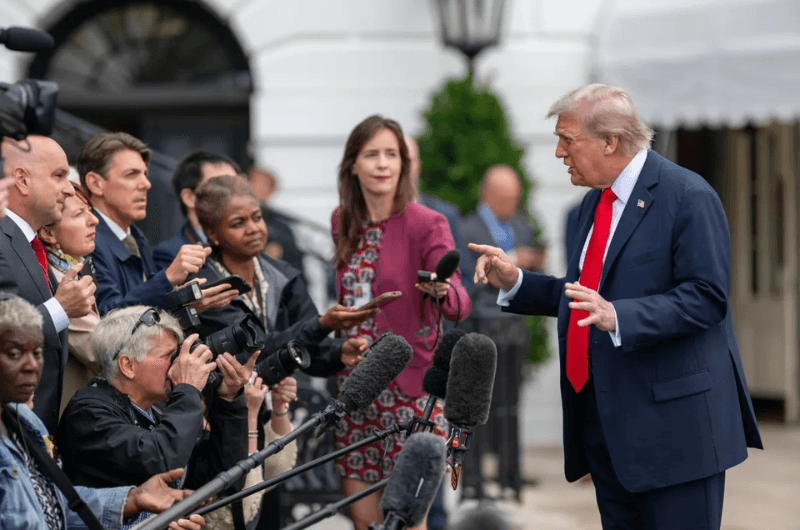
President Donald Trump has held off on another major U.S. attack on Iran as diplomatic efforts intensify to bring the escalating conflict to an end. Trump said talks aimed at ending the war would begin Monday after discussions with leaders in the Middle East helped persuade him not to order what he had described as a potentially “massive” new round of strikes. Gulf nations have been pushing for de-escalation as fighting threatens regional security, energy markets, and shipping through the Strait of Hormuz. But there is already disagreement over exactly what those negotiations involve. Iranian officials said Monday that no direct talks with the United States were underway or planned, while indicating discussions with Oman were focused on navigation and security in the region. The diplomatic push marks a significant shift after weeks of U.S. strikes on Iran and Iranian retaliation across the Middle East. The Strait of Hormuz remains a central concern because a substantial share of the world’s oil moves through the narrow waterway, making continued instability there a risk far beyond the region. Markets responded quickly to the possibility of de-escalation. Oil prices fell sharply Monday after Trump backed away from a planned attack, reflecting hopes that diplomacy could reduce the threat to Gulf energy supplies and shipping. Whether the effort produces a broader agreement remains uncertain. But for now, Washington has moved away from another immediate military escalation while regional governments push both sides toward a negotiated end to the conflict.
SpaceX Lands $1.6 Billion Space Force Deal for 18 National Security Launches
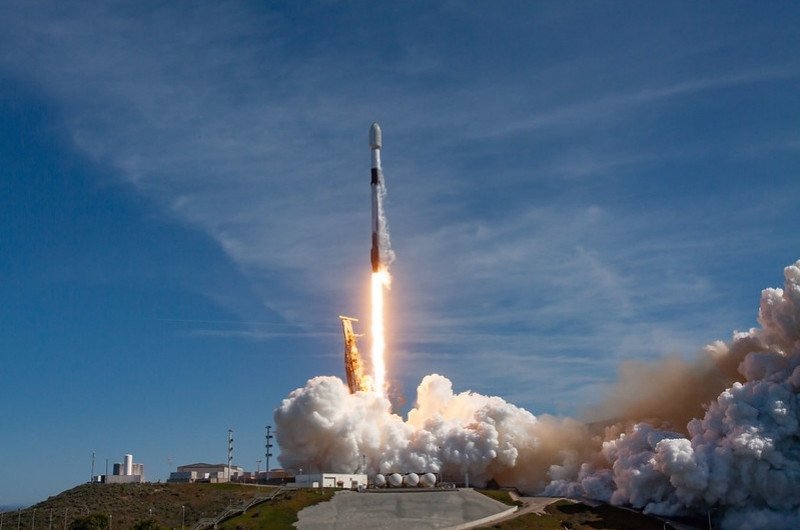
SpaceX has won a $1.6 billion U.S. Space Force contract for 18 Falcon 9 launches, a major sign of how deeply commercial space companies are becoming embedded in America’s national defense strategy. The missions are planned through 2027 and will deploy Pentagon satellites designed to help detect and track airborne threats. The award adds to a growing portfolio of government work for SpaceX and underscores the company’s expanding role not just in commercial launch and satellite internet, but in the infrastructure supporting U.S. military operations. The deal also highlights a broader shift in how the United States is building its defense capabilities in orbit. Once known primarily as a commercial launch provider, SpaceX is increasingly serving as a critical national security partner, providing the rockets needed to deploy systems tied to surveillance, communications, missile warning, and defense. The modern defense race is extending beyond land, sea, and air into space. Rockets, satellite networks, and other orbital technologies are becoming increasingly important parts of military readiness. The new contract further strengthens SpaceX’s position at the center of that transformation, as Washington leans more heavily on private-sector launch companies to support some of the nation’s most sensitive defense missions.
What Is Quantum Computing — and Why America Is Spending $1 Billion to Build a Quantum Foundry

The U.S. government is preparing to spend up to $1 billion helping IBM build something America has never had before: a factory designed specifically to make critical components for quantum computers. That sounds highly technical, but the reason behind it is fairly simple. Quantum computing could become one of the most important technologies of the next several decades, potentially helping scientists develop new medicines, discover new materials, solve enormously complicated logistical problems and perform certain calculations that overwhelm today’s most powerful computers. And the United States wants to make sure it can build that technology here. IBM and the U.S. Department of Commerce announced the proposed $1 billion federal investment in May. IBM plans to contribute another $1 billion in cash, along with technology, facilities and expertise, to establish a new operation called Anderon in Albany, New York. First, What Is a Quantum Computer? A regular computer — whether it’s your laptop or one of the world’s most powerful supercomputers — processes information using tiny units called bits. Those bits essentially work as switches that are either on or off: 1 or 0. Quantum computers work differently. They use quantum bits, called qubits, which can handle information in ways ordinary computer bits cannot. That gives quantum computers the potential to work through certain extremely complicated problems differently than today’s machines. It doesn’t mean your next laptop will be a quantum computer. You don’t need one to check email, browse the internet, stream Netflix or write a document. Traditional computers are already very good at those things. Quantum computers are being developed for problems that become almost unimaginably complex. What Could We Actually Do with One? Imagine a pharmaceutical company trying to predict how countless combinations of molecules might behave while developing a new drug. Or a scientist searching through huge numbers of possible materials to find one that could produce a better battery. A transportation company might use advanced computing to search for the most efficient way to move thousands of vehicles, packages and people through an enormous network. Researchers also see potential applications in financial modeling, chemistry and other fields where the number of possible outcomes can become overwhelming. There is another possibility that has governments paying especially close attention: encryption. Powerful future quantum computers could potentially break some of the encryption methods used today to protect sensitive information, making quantum computing not just a technology race, but increasingly a national-security race. So What’s a Quantum Foundry? Think of a foundry as a highly advanced factory. Today’s computer chips are manufactured in semiconductor fabrication plants — enormous, highly sophisticated facilities capable of producing the tiny components inside phones, computers, cars and data centers. Quantum computers need their own specialized components. IBM’s planned Anderon facility would manufacture wafers used to build quantum processors. The operation is intended to produce them not only for IBM, but potentially for other American companies developing quantum technology. That matters because inventing a technology is only part of winning a technology race. You also have to be able to manufacture it. The United States learned that lesson with conventional computer chips. Much of the world’s advanced semiconductor manufacturing became concentrated overseas, prompting Washington to spend billions of dollars rebuilding domestic chip production. With quantum computing, the government appears determined to get ahead of the next technology race. Why Is the Government Spending So Much? No one knows exactly how important quantum computing will eventually become, but the potential is too large for governments to ignore. The U.S. is not alone in pursuing it; China and other countries are also investing heavily in quantum research and infrastructure. That creates a familiar competition over who develops the best systems, owns the important discoveries, attracts the skilled workers and, crucially, can manufacture the technology at scale. IBM itself is making a much larger bet. The company announced in June that it plans to invest more than $10 billion in quantum computing over the next five years, with a long-term goal of building increasingly capable systems while overcoming one of the technology’s biggest problems: errors. Are Quantum Computers Ready Now? No — and that’s an important part of the story. Today’s quantum computers are still experimental machines. They are extremely difficult to build and operate, their quantum bits are fragile, and errors remain a major obstacle. Many of the revolutionary applications associated with quantum computing have not happened yet. Some may take years. Some may take decades. And some predictions about what quantum computers will eventually accomplish may prove overly optimistic. IBM’s timelines and projections should therefore be viewed as ambitious goals rather than guarantees. But governments and technology companies are not waiting for every technical problem to be solved before investing. They are building the infrastructure now. The Next Technology Race May Already Be Underway Artificial intelligence is today’s dominant technology story, with companies spending hundreds of billions of dollars on chips, data centers and power systems to support it. Quantum computing is nowhere near that stage yet. But America’s proposed $1 billion investment in IBM’s quantum foundry offers an important glimpse of what could come next. The U.S. is not simply funding another experimental computer; it is helping build the manufacturing base for an industry that barely exists today. If quantum computing ultimately lives up to even part of its promise, the countries that build the factories, train and attract the scientists and engineers, secure the patents and establish the supply chains now could hold a major advantage later. That’s why a highly specialized factory planned for Albany, New York, could turn out to be far more important than it sounds.