


The Next AI Leap: Completing Tasks Without Human Assistance

AI is entering a new era as intelligent agents begin completing real tasks across apps, websites, and workflows with less human input than ever before. A growing wave of AI systems is being designed to move beyond conversation and into action. Instead of waiting for one instruction at a time, the latest AI systems can break goals into steps, choose tools, and carry out actions in sequence. That means the future of AI may look less like asking questions in a chat window and more like assigning work to a digital operator. A real-world example could look like this: create a blog post about summer travel trends, design a matching image, upload it to WordPress, optimize the SEO fields, and schedule it for tomorrow. What once required multiple apps and a long checklist may increasingly happen through one request and a capable AI agent. The opportunity is massive, but so are the questions. Businesses are now weighing productivity gains against concerns around permissions, reliability, and security. Researchers also note that while progress is accelerating, many agents still struggle with complex real-world tasks and need oversight. The Readovia Lens AI is moving from assistant to operator. That evolution could unlock enormous productivity — but it also raises a deeper challenge: how much autonomy society is willing to hand over.
AI Is Saving Workers Up to 4 Hours a Day — Redefining the Modern Workday

A new report from Canva highlights one of artificial intelligence’s most immediate impacts on the workplace: time. Employees are saving as much as four hours per day by using AI tools, dramatically reducing the time spent on repetitive and routine tasks. The gains are showing up across a wide range of work. Tasks like drafting emails, summarizing documents, creating presentations, and organizing information are being completed in a fraction of the time, allowing workers to move through their day with greater speed and efficiency. But the real shift is not just about getting more done. It’s about what happens with the time that is freed. Many workers report using those reclaimed hours to focus on higher-level thinking, creative problem-solving, and more strategic work — areas that were often pushed aside in favor of day-to-day demands. For companies, the implications are significant. Increased productivity without longer hours changes how teams operate, how projects are managed, and how performance is measured. It also raises new questions about expectations, as the line between efficiency and workload continues to evolve. At the same time, the shift is not without complexity. As AI continues to absorb more routine tasks, the definition of “a full day’s work” may begin to change. What once required eight hours may soon take far less, challenging long-standing norms around time, output, and value. The Readovia Lens For decades, productivity gains have meant doing more in the same number of hours. AI is beginning to flip that model, giving people something far more valuable than speed — time back in their day. So, if work can be completed faster, what happens next? ——————– Related: AI Gives Businesses a Chance to Rethink the Workday in 2026 The 6-Hour Workday Experiment Gains Quiet Momentum
Inside the Corporate AI Shift: Where Efficiency Gains Are Colliding With Real-World Friction

As artificial intelligence moves deeper into the workplace, companies are discovering that adoption isn’t as simple as flipping a switch. What looks like efficiency on paper is proving far more complicated in practice. Many organizations are facing a new set of operational challenges. Teams are working faster with AI tools, but not always more accurately. Managers are being forced to rethink workflows, review processes, and even how performance is measured. In some cases, productivity has increased — but so has the need for oversight. One of the biggest pain points is consistency. Different employees are using AI in different ways, leading to uneven outputs across teams. Without clear standards, companies are finding it difficult to maintain quality, especially in roles that rely heavily on communication, analysis, or customer interaction. There’s also a growing tension between speed and trust. AI can generate content, code, and decisions in seconds — but leaders are learning that not everything produced by AI can be taken at face value. Verification is becoming part of the workflow, adding a new layer of responsibility that didn’t exist before. At the same time, corporate culture itself is beginning to shift. Employees are quietly redefining what “work” looks like, while executives are trying to balance innovation with control. The result is a workplace that feels faster, more flexible — and, in many cases, less predictable. The Readovia Lens The next phase of AI in the workplace is about management. The companies that succeed won’t just be the ones that adopt AI fastest, but the ones that figure out how to guide it, standardize it, and trust it without losing control of the work itself.
OpenAI Shuts Down Sora — Signaling a Shift From AI Hype to Hard Decisions

OpenAI has shut down Sora, its high-profile AI video tool, in a move that signals a major shift in how the company is prioritizing the future of artificial intelligence. Sora made headlines for its ability to generate realistic, cinematic video from simple text prompts. But behind the scenes, the technology came with serious challenges. Video generation requires enormous computing power, making it expensive to run at scale — especially for a consumer-facing product. At the same time, the platform raised growing concerns around content. From deepfakes to copyright issues, AI-generated video proved difficult to control, adding legal and reputational risks to an already complex product. Rather than continue down that path, OpenAI is choosing to focus its resources on areas it sees as more critical to long-term growth. That includes productivity tools, enterprise applications, and advanced research tied to real-world systems like robotics. The move reflects a broader shift across the AI industry. Companies are beginning to move beyond flashy experiments and focus on what actually works at scale. Not every breakthrough product will survive — even the ones that capture global attention. In that sense, Sora’s shutdown isn’t just about one tool. It’s a sign that the AI race is entering a new phase — where focus, efficiency, and real-world impact matter more than hype.
Elon Musk’s ‘Terafab’ Signals a New AI Power Play — And a Break From Big Tech’s Supply Chain
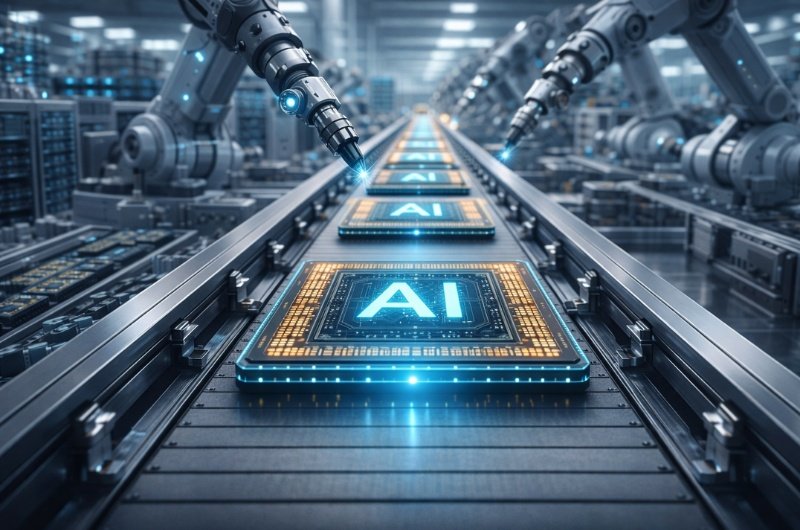
Elon Musk’s push into artificial intelligence just took a dramatic turn — and it’s not about software. It’s about control. Tesla is preparing to launch what Musk calls the “Terafab” project, an ambitious effort to build its own artificial intelligence chips and reduce reliance on traditional semiconductor giants. The move signals a deeper shift in how the world’s most influential tech companies are approaching AI: not just building smarter systems, but owning the infrastructure that powers them. At its core, Terafab is about scale. Musk has repeatedly warned that existing chip manufacturers cannot produce enough advanced processors to support the growing demands of autonomous vehicles, robotics, and large-scale AI systems. Instead of waiting for suppliers to catch up, Tesla is moving to build its own pipeline from design to production, bringing one of the most critical layers of the AI stack in-house. The implications extend far beyond Tesla’s self-driving ambitions. These chips are expected to power everything from next-generation vehicle intelligence to humanoid robotics and large-scale AI training systems. In Musk’s broader vision, they could even support future computing infrastructure that operates beyond traditional limits. But the move also reflects a growing tension across the tech industry. As demand for AI accelerates, reliance on a small group of chipmakers has become a strategic vulnerability. By investing in its own fabrication capabilities, Tesla is positioning itself not just as an AI user, but as a potential AI infrastructure player. The question now is whether Musk can deliver. Semiconductor manufacturing remains one of the most complex and capital-intensive industries in the world. Even with Tesla’s resources and Musk’s history of bold execution, Terafab stands as one of the company’s most ambitious and uncertain bets yet. Between The Lines – The Readovia Lens This “Terafab” move is about independence and leverage. Chips, data centers, and energy are quickly becoming a battleground. The next phase of the AI economy won’t be defined by who builds the smartest models, but by who controls the systems that make them possible. Tesla is positioning itself to operate without constraints — in a world where access to compute may determine who leads and who falls behind.
Why the Future of AI May Depend on Data Centers, Not Just Algorithms

Artificial intelligence may grab headlines for what it can do, but the real battle powering the AI revolution is happening behind the scenes. Technology companies are now racing to build the massive infrastructure needed to support the next generation of AI systems. Training modern AI models requires enormous computing power. Thousands of specialized chips must work together while moving huge amounts of data between machines in real time. To make that possible, companies are investing billions of dollars in new data centers, faster networking systems, and advanced semiconductor technology. This rapid expansion has sparked what many experts now describe as a global AI infrastructure race. Tech giants are building new data centers across the United States, Europe, and Asia while competing for access to the powerful chips required to run advanced AI models. Unlike earlier waves of software innovation, artificial intelligence is increasingly limited by computing power. The companies that can build and operate the largest and fastest AI systems may gain a major advantage in the next phase of the technology revolution. In the end, the future of artificial intelligence may depend not only on who creates the smartest algorithms, but on who controls the machines powerful enough to run them.
Entry-Level Jobs Are Becoming the First Casualty of the AI Shift

Artificial intelligence is beginning to reshape the workforce in ways that are most visible at the entry level, where many of the tasks traditionally assigned to junior employees can now be handled by AI systems. Across industries such as marketing, finance, customer support, and software development, companies are increasingly using AI tools to summarize documents, generate reports, analyze data, and respond to routine inquiries. Work that once helped early-career employees gain experience is now being completed in seconds by automated systems. Some labor analysts say the shift is beginning to show up in hiring patterns. While demand for experienced professionals remains strong in many sectors, companies are becoming more cautious about expanding junior roles that focus primarily on repetitive or administrative tasks. The change does not necessarily mean fewer jobs overall, but it could alter how careers begin. As automation expands, entry-level positions may increasingly require higher-level skills such as critical thinking, strategy, and oversight of AI systems rather than basic task execution. For workers entering the job market, the message is becoming clear: understanding how to work alongside AI may soon be as important as traditional professional experience.
AI in the Kill Chain: How the Speed of Modern Warfare is Changing

Modern warfare is entering a new and unsettling phase. Artificial intelligence systems are accelerating military decision-making, dramatically shortening the time between identifying targets and authorizing strikes. In some cases, that timeline has been reduced to near real time. Recent reports indicate that U.S. military leaders employed advanced artificial intelligence tools during the latest joint U.S.-Israeli strikes on Iran. These systems were used to assist with intelligence assessment, target identification, and battlefield modeling, helping commanders process massive volumes of data at unprecedented speed. Defense analysts say AI-driven platforms are increasingly capable of analyzing satellite imagery, drone feeds, intercepted communications, and other intelligence streams within seconds. What once required layered review and hours of coordination can now unfold in compressed timeframes, fundamentally altering what military strategists refer to as the “kill chain.” Supporters argue that such systems enhance precision and responsiveness in fast-moving conflicts, allowing commanders to adapt quickly to emerging threats. But critics warn that compressing decision timelines may reduce opportunities for human scrutiny — particularly in complex environments where civilian infrastructure and non-combatants are present. The central debate is how much authority AI should wield in life-and-death decisions. Artificial intelligence has moved beyond the realm of research labs and battlefield simulations. It is now embedded in active military strategy. As global powers continue integrating AI into combat operations, policymakers face mounting questions about oversight, accountability, and whether legal frameworks can evolve quickly enough to keep pace with machines operating at what some describe as the “speed of thought.”
The AI Arms Race Moves to Washington: Federal Agencies Accelerate Internal AI Rollouts

The U.S. government is no longer just regulating artificial intelligence — it’s deploying it at scale. From federal health agencies to financial regulators, departments are quietly expanding internal AI systems to speed up document review, fraud detection, compliance audits, and data analysis. What began as pilot programs has evolved into structured adoption strategies, complete with AI governance frameworks and risk assessments. The shift signals something bigger: AI has moved from experimental to operational inside the federal government. For agencies under pressure to process mountains of paperwork, enforce regulations, and modernize aging systems, AI tools are being positioned as efficiency multipliers. But the acceleration raises questions around oversight, bias monitoring, and cybersecurity safeguards — especially as federal systems handle sensitive citizen data. The Readovia Lens The real story isn’t hype. AI is essentially becoming embedded in institutional infrastructure, and that changes how policy, enforcement, and even public services are delivered.
India’s Young Adults Are Driving the AI Surge — And Their Future May Depend on It

India’s AI moment is being powered by its younger generation. At a recent AI summit, OpenAI revealed that users between 18 and 24 years old account for nearly half of ChatGPT usage in the country. It is a striking figure for a nation already home to more than 100 million weekly active users of the platform, according to OpenAI CEO Sam Altman. That makes India second only to the United States in total ChatGPT usage, with Indian students representing the largest share of student users globally. The numbers tell a deeper story about where the global AI workforce may be heading. India’s population skews young, and that generation has adopted digital technology faster than almost anywhere else in the world. For millions of students and early-career professionals, AI tools are becoming foundational infrastructure for learning, coding, marketing, entrepreneurship, and remote work. But opportunity comes with disruption. Venture capitalist Vinod Khosla, founder of Khosla Ventures, warned that sectors such as IT services and business process outsourcing could largely disappear within five years due to automation. Instead of defending legacy roles, he suggested that India’s estimated 250 million young people should pivot toward building and selling AI-driven products and services to the global market. OpenAI appears to be doubling down on India’s momentum. The company announced plans to open new offices in Bengaluru and Mumbai, signaling long-term investment in the country’s talent ecosystem. As AI reshapes global labor markets, India’s youth are not waiting to adapt. They are already experimenting, building, and learning at scale. For young adults worldwide, the message is clear. AI fluency is quickly becoming a competitive advantage. In India, it may also become a defining economic lever for an entire generation.