


Fostering the Future: White House Launches Major Scholarship and Technology Initiative for Foster Youth

The White House today announced Fostering the Future, a national initiative aimed at expanding educational access and career-path opportunities for young adults emerging from the foster-care system. The program provides technology-based scholarships to colleges and universities across the United States, positioning students with the tools and training needed to compete in high-growth fields. The effort centers on bridging the opportunity gap for the approximately 20,000 young people aging out of foster care each year without permanent family support. Introducing the initiative, First Lady Melania Trump emphasized both the practical and lifelong value of the new program. “Fostering the Future provides individuals from the foster care community with technology-based scholarships to attend colleges and universities throughout America. Fostering the Future sets these individuals on their career paths. But more significantly, it equips each scholarship recipient with the fundamental foundation of knowledge that will endure throughout their lifetime.” The program also creates new public-private partnerships designed to connect scholarship recipients with mentorship, internships and career-placement resources. Much of the initiative’s architecture appears focused on long-term stability — reducing the high rates of unemployment, housing instability and underemployment that disproportionately affect young adults transitioning out of the foster-care system. Technology access, career guidance and real-world support are positioned as the core pillars for success. Education and economic experts note that the financial burden of post-secondary training is one of the greatest barriers for former foster youth, many of whom navigate adulthood without a family safety net or generational resources. Scholarships tied to technology preparation — including STEM, digital literacy and emerging workforce fields — signal a shift toward aligning foster-care support with future labor demand rather than short-term assistance. For students, Fostering the Future represents a pathway to independence, dignity and upward mobility. For the nation’s colleges, businesses and civic partners, it presents an invitation to participate in building a stronger pipeline of talent and innovation. At its heart, the initiative reframes foster youth not as a vulnerable population, but as a powerful untapped resource whose potential can help shape America’s future.
Federal Government Reopens Following Deal to End Historic Shutdown

The federal government is fully reopening today after Congress passed a bipartisan agreement to end the shutdown that had brought agencies to a halt and forced hundreds of thousands of federal workers into uncertainty. President Trump signed the measure shortly after it cleared both chambers overnight, restoring funding and authorizing agencies to resume normal operations. While offices are reopening across Washington and beyond, many agencies face a backlog that will take days — in some cases weeks — to unwind. Employees returning to work are sorting through delayed services, paused benefits processing, and disrupted operations that affected everything from airport staffing to federal courts. The agreement approved by lawmakers keeps the government funded for now, but it does little to ease broader concerns about governing by crisis. Members of both parties acknowledged that the shutdown’s economic and operational fallout will linger, especially for federal workers who faced days without pay and for Americans who depend on government services. House Speaker Mike Johnson has urged members to remain in Washington this week as Congress prepares for another round of negotiations on longer-term funding. With deadlines layered throughout the winter, lawmakers are bracing for fresh battles even as the government restarts. For now, federal agencies are turning the lights back on — and millions of Americans are watching to see how long they stay that way.
House Democrats Release Epstein Emails Saying Trump ‘Knew About the Girls’

House Democrats on Wednesday released a batch of emails drawn from the Jeffrey Epstein/Ghislaine Maxwell case that they say raise fresh questions about how much Donald Trump knew about Epstein’s trafficking of under-age girls. One 2019 email from Epstein to author Michael Wolff states that Trump “knew about the girls,” prompting renewed scrutiny of Trump’s ties to Epstein and Maxwell. In other correspondence, Epstein wrote that Trump “came to my house many times” and “never got a massage,” while another exchange alleged that Epstein had “given” Trump a 20-year-old girlfriend in 1993 and mentioned photos of “girls in bikinis” in his kitchen. Trump, who has repeatedly denied any knowledge of Epstein’s trafficking, said the document release was a partisan diversion aimed at shifting attention away from the recent government shutdown. Epstein Emails Release by House of Representatives: The release coincides with the swearing-in of a new Democrat whose arrival gives party leaders the numbers needed to force a full House vote next week on releasing all unclassified Epstein-related records. Republicans have criticized the move, saying the documents do not contain definitive proof of wrongdoing by Trump and that victims’ names were redacted in ways that obscure context. Analysts say the timing could be politically calculated—with 2026 mid-term elections ahead and rising public weariness over the Epstein affair playing into broader narratives about elite impunity. The disclosures reinforce the challenge facing prosecutors, legislators and media alike when allegations hang in the balance of proof, redactions and unresolved investigations. The Takeaway The key takeaway is this: the record-release gamble has opened a distinct new front in the long-running Epstein saga, potentially reshaping perceptions of power, privilege and accountability in Washington.
U.S. Mint to Produce Final Penny as Costs Outweigh Its Value

The United States is preparing to mint its final batch of one-cent coins, bringing an end to a currency era that has lasted for more than two centuries. The decision follows growing recognition that the penny costs far more to produce than it’s worth. According to Treasury data, each coin now costs more than three cents to make — a discrepancy that has turned the penny into a long-running symbol of inefficiency. Ending production is expected to save the government tens of millions of dollars annually and align the U.S. with other major economies that have already phased out their smallest denominations. Pennies will remain legal tender, but no new coins will be produced for general circulation. Collectible editions will continue in limited runs, while the nation’s banking and retail sectors adjust to a new reality: cash transactions will now be rounded to the nearest five cents. The penny’s departure marks the end of an American icon first minted in 1793 and featuring Abraham Lincoln since 1909. Once a cornerstone of pocket change, it has largely been replaced by digital payments and rounded pricing — a quiet casualty of modern convenience. The Readovia Lens What looks like a small change in coinage signals a larger transformation in how Americans handle money. As the penny fades from daily use, the challenge for Washington will be ensuring a smooth transition in pricing, cash handling, and public sentiment, and recognizing that sometimes, even tradition must give way to practicality. ———— More on this topic: What the End of the Penny Says About Inflation and Everyday Value
Congress Braces for Critical Vote to End Shutdown

After the longest federal shutdown in U.S. history, the U.S. House of Representatives returns to session today for a pivotal vote that could reopen the government. The Republican-controlled chamber is expected to approve a stopgap funding bill later this afternoon following the Senate’s passage of the same measure. The legislation would fund federal agencies through January 30, restoring critical programs such as food assistance and air-traffic control that have been disrupted since the shutdown began on October 1. House Speaker Mike Johnson, under pressure to act, has urged members to return to Washington and support the plan. The proposal faces resistance from several House Democrats who argue that it fails to extend Affordable Care Act subsidies and other social-spending priorities sidelined in the negotiations. Meanwhile, the measure adds roughly $1.8 trillion in federal spending at a time when the national debt is approaching $38 trillion. Today’s vote will test whether the GOP can maintain unity and whether moderate Democrats will break ranks to end the stalemate. If the measure passes, it will go to President Donald Trump for his signature, bringing relief to hundreds of thousands of furloughed workers and restoring normal government operations. The Readovia Lens The shutdown may soon end, but its shadow will linger. What follows will test how Washington manages accountability after seven weeks of paralysis — whether this moment becomes a turning point for governance or another chapter in political fatigue.
Power, Oil, and Leverage: Inside Equatorial Guinea’s Quiet Real Estate Deals

The $7.5 million payment at the center of Washington’s latest controversy is part of a much larger picture. For two decades, the small Central African nation of Malabo, Equatorial Guinea — rich in oil, gas, and ambition — has drawn the attention of governments and corporations seeking both access and advantage. What unfolds here often says more about global strategy than aid or migration policy alone. Equatorial Guinea’s story is one of contrasts. Fueled by offshore oil wealth, the nation has built gleaming highways, new government complexes, and luxury properties that rise from its volcanic landscape like symbols of prosperity. Yet beyond the manicured developments and modern airports, much of the population still lives in poverty. Transparency monitors have long warned that the country’s rapid development has also created fertile ground for opaque deals that blend business, politics, and personal influence. The United States has maintained a cautious relationship with Malabo, largely defined by energy interests and regional security. But as attention turns to the recent $7.5 million transfer — framed by the Trump administration as part of a migration and enforcement strategy — questions have resurfaced about how far diplomatic cooperation can go before it begins to resemble economic leverage. In recent years, foreign investors from China, Spain, and the Gulf states have entered the same space once dominated by U.S. oil companies. Real estate has emerged as a strategic frontier — where private projects often mirror government priorities and where the line between public asset and political favor can blur. Each new development deal, port expansion, or urban renewal project quietly shifts the balance of influence in one of Africa’s most resource-rich yet politically complex nations. The Readovia Lens The debate now unfolding in Washington reaches beyond one transaction. It reflects a broader test of transparency in the modern age of diplomacy — when aid, investment, and power often travel together. In places like Equatorial Guinea, the true measure of any deal lies not just in the money exchanged but in how clearly the world can see its purpose. ———— More on this topic: The Trump Administration Transferred $7.5 Million to Equatorial Guinea for Deportations— Congress Wants Answers
What the End of the Penny Says About Inflation and Everyday Value

The penny may be vanishing from circulation, but its disappearance tells a bigger story about what a dollar — and value itself — means in modern America. For generations, the penny symbolized thrift, patience, and everyday exchange. Yet, its end arrives at a moment when the smallest denominations of value — both monetary and moral — are being quietly redefined. What once felt meaningful now often feels negligible. Inflation has eroded the penny’s worth so thoroughly that its purchasing power is virtually nonexistent. The price of coffee can fluctuate by fifty cents overnight, while entire industries debate whether physical cash is even necessary. The penny’s departure, in that sense, is less about cost efficiency and more about a collective recalibration of what we consider worth keeping. For consumers, the change is psychological as much as practical. Rounding purchases to the nearest five cents will go largely unnoticed, but it reinforces a deeper shift — away from tangible currency and toward abstract value, managed through screens, apps, and digital accounts. Money has become weightless, frictionless, and for many, detached from the everyday human sense of exchange. The Wallet Perspective The penny’s phase-out marks another step toward a frictionless economy. It’s a small loss that hints at something bigger: the slow disappearance of tangible money from everyday life — and perhaps a quiet farewell to the childhood habit of saving pennies, when a hundred small coins still felt like a big victory. ———– More on this topic: U.S. Mint to Produce Final Penny as Costs Outweigh Its Value
Bus and Train Bookings Surge as Air Travel Disruptions and Uncertainty Continue

With airports facing extended delays and flight cancellations tied to the government shutdown, many travelers are rediscovering the ground routes they once ignored. Amtrak and major intercity bus carriers are reporting a surge in bookings as Americans seek reliability — and a little less turbulence — in how they move across the country. Ridership on select long-distance Amtrak routes has climbed sharply in recent days, with Northeast Corridor trains running near capacity. Bus operators including Greyhound and Megabus have also seen double-digit growth as frustrated passengers opt for overland travel rather than risk a cancelled flight or closed terminal. The shift comes at a time when domestic air travel has become one of the shutdown’s most visible casualties. FAA staff shortages have forced flight reductions and tightened schedules, particularly at regional airports. For many, the appeal of buses and trains lies not only in avoiding cancellations, but in reclaiming a more predictable — and often less expensive — way to travel. The Readovia Lens This temporary transportation pivot could have lasting effects. Travelers who discover convenience in rail or coach service may rethink how they plan short- and mid-distance trips even after the skies clear. The pandemic already proved that behavior can change quickly; the shutdown may be another catalyst for rediscovering what slower, steadier travel has to offer.
The Trump Administration Transferred $7.5 Million to Equatorial Guinea for Deportations— Congress Wants Answers

A senior Senate Democrat is pressing for answers after the Trump administration approved a $7.5 million transfer to Equatorial Guinea, one of Africa’s most authoritarian nations. The funds, drawn from a U.S. account reserved for migration and refugee assistance, were reportedly tied to efforts to expand deportation partnerships abroad. Senator Jeanne Shaheen, the top Democrat on the Senate Foreign Relations Committee, called the payment “highly unusual,” noting that it exceeds the total U.S. aid the country has received over the past eight years. In a letter to Secretary of State Marco Rubio, she questioned whether the transfer bypassed oversight safeguards and whether Congress had been properly informed. Administration officials defended the payment as part of a broader strategy to secure third-country agreements for deportations. Critics counter that redirecting humanitarian funds for enforcement purposes risks violating statutory limits and may endanger deportees sent to nations with poor human-rights records. Equatorial Guinea, ruled for decades by President Teodoro Obiang Nguema Mbasogo, faces international scrutiny for corruption and rights abuses. Humanitarian organizations warn that using the country as a relocation partner undermines the credibility of U.S. migration policy. The Readovia Lens The controversy underscores a broader challenge for the Trump administration — ensuring that evolving policy goals align with established procedures. As funding priorities shift and enforcement strategies expand, maintaining clear oversight remains an ongoing test of administrative balance. ———— More on this topic: Power, Oil, and Leverage: Inside Equatorial Guinea’s Quiet Real Estate Deals
Trump Threatens $1 Billion Lawsuit Against BBC Over Edited January 6 Footage
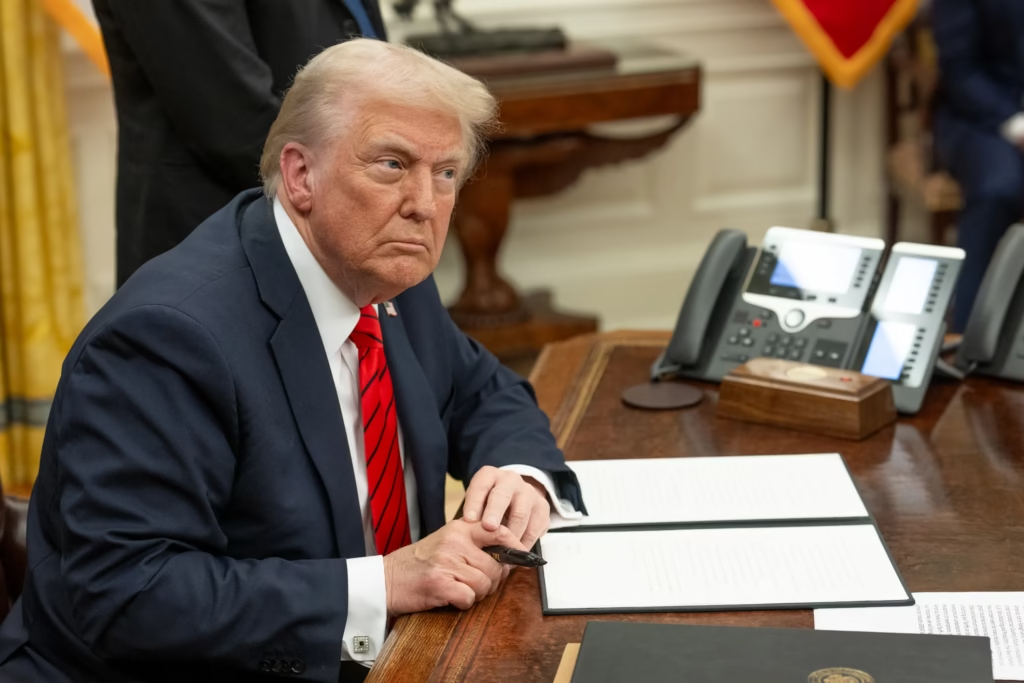
President Donald Trump has threatened to sue the BBC for $1 billion over what he calls “defamatory editing” of his January 6 speech in the network’s Panorama documentary. The move, part of his escalating campaign against the press, extends his attacks beyond U.S. borders and underscores how political power, litigation, and media accountability are colliding in a globalized information age. Two senior BBC executives have already resigned amid the fallout. Trump’s legal team claims the broadcast inflicted “massive reputational and financial harm,” though experts say a successful claim faces major hurdles, including jurisdiction and the high burden of proof under U.S. defamation law. A lawyer for Trump said the broadcast caused him “overwhelming financial and reputational harm” and may have violated Florida law — despite the fact that the channels carrying the Panorama documentary are not available in the United States. The BBC confirmed it has received correspondence from Trump’s legal team and said it “will respond directly in due course.” The episode reflects a broader shift in strategy — where litigation is increasingly used not just as recourse but as a tool of narrative control. It raises questions about how media organizations manage political risk and editorial integrity in a world of rapid, viral content cycles. For corporations and media outlets alike, the case highlights a new frontier in risk management: cross-jurisdictional reputational threats. As digital distribution blurs national boundaries, so too do the legal and ethical lines that govern accountability and influence. The Readovia Lens This fight is not about a documentary. It’s about who controls the story in an era when every edit, post, and headline can become a global legal battlefield.