

Sen. Lindsey Graham Dies at 71 After Decades of Public Service

Sen. Lindsey Graham, the longtime Republican lawmaker from South Carolina and one of the Senate’s most influential voices on national security and foreign policy, has died at the age of 71 following what his office initially described as a brief and sudden illness. Preliminary findings from the medical examiner indicate Graham died from an aortic dissection. Graham represented South Carolina in the U.S. Senate for more than two decades after first being elected in 2002. Before that, he served four terms in the U.S. House of Representatives and spent more than 30 years in the U.S. Air Force and Air Force Reserve, retiring with the rank of colonel. Throughout his career, he became known for his work on national defense, the judiciary, and international affairs. Although he was an outspoken critic of Donald Trump during the 2016 Republican presidential primary, Graham later became one of the president’s closest allies and a key adviser on foreign policy. He also played a prominent role in judicial confirmations, military policy, and legislation involving Ukraine, Israel, Iran, and Russia. Tributes poured in from political leaders in the United States and abroad, reflecting Graham’s influence on both domestic and international affairs. His death creates a vacancy in the Senate, with South Carolina’s governor expected to appoint an interim successor until voters choose a permanent replacement in a special election. For more than three decades, Graham remained one of the Republican Party’s most recognizable figures. Whether admired or criticized for his outspoken positions and evolving political alliances, he leaves behind a lasting legacy that shaped debates on national security, the federal judiciary, and America’s role on the world stage.
Wall Street Braces for Critical Week as Earnings and Inflation Take Center Stage

Wall Street is entering one of its busiest weeks of the summer as investors prepare for a wave of corporate earnings, fresh inflation data, and several closely watched economic events that could influence markets in the weeks ahead. The unofficial start of second-quarter earnings season begins Tuesday, with major financial institutions including JPMorgan Chase, Goldman Sachs, Citigroup, Wells Fargo, and Bank of America scheduled to report results. Investors will be looking for clues about consumer spending, loan demand, and the overall health of the U.S. economy. The week’s economic calendar is equally important. The June Consumer Price Index (CPI) is scheduled for release Tuesday, followed by the Producer Price Index (PPI) on Wednesday and retail sales data later in the week. Together, the reports are expected to shape expectations for future Federal Reserve interest-rate decisions. Adding to the uncertainty are tensions in the Middle East and testimony from Federal Reserve Chair Kevin Warsh before Congress. Investors will be watching both developments closely for signs of how geopolitical risks and monetary policy could affect financial markets during the second half of the year. While market volatility is likely throughout the week, many analysts believe the combination of earnings reports, inflation data, and Federal Reserve signals will provide a clearer picture of the economy’s direction—and could help determine whether Wall Street’s recent rally has room to continue.
Only 15% of Americans Show Strong Financial Literacy, New Test Finds

Only 15% of U.S. adults answered seven or eight questions correctly on a new financial literacy test, while more than one-third managed no more than two correct answers. The results point to widespread difficulty understanding money concepts that affect everyday decisions about saving, borrowing, insurance and investing. The eight-question P-Fin 8 Index was developed by the TIAA Institute and the Global Financial Literacy Excellence Center as a shorter version of their broader 28-question Personal Finance Index. Each question represents one area of personal finance, including earning, spending, saving, investing, debt management, insurance, risk and identifying reliable financial information. On average, adults answered 46% of the questions correctly. Sixty percent scored four or fewer out of eight, including 36% who answered no more than two correctly. Another 24% scored three or four, while 24% answered five or six correctly. Some questions proved especially challenging. Only 27% correctly identified disability insurance as the coverage a healthy 25-year-old worker would most likely need in the near term. Just 40% understood how quickly a loan carrying 20% annual compound interest would double, while fewer than half correctly answered questions involving inflation, financial risk and investment advice. The findings suggest that many Americans are making consequential financial choices without a strong understanding of the principles behind them. Improving financial literacy cannot eliminate rising prices, debt or economic uncertainty, but it can help people make better-informed decisions about their money and recognize costly mistakes before they happen. Think you can beat the national average? Take the official eight-question P-Fin 8 financial literacy quiz and compare your score with the national results. The test is available here.
Cyclospora Cases Surge as Health Officials Search for Source of Growing Outbreak

Health officials are investigating a growing outbreak of cyclosporiasis, a parasitic intestinal illness that has sickened more than 1,000 people in Michigan and neighboring Ohio. The outbreak is the largest ever recorded in Michigan, and investigators have not yet identified the contaminated food or water source responsible for the illnesses. Michigan has reported more than 1,500 confirmed cases and dozens of hospitalizations, while additional cases have been reported in Ohio and several other states. Public health officials are continuing to investigate whether the illnesses are connected, but no single food item, grower, supplier or distributor has been identified. Cyclosporiasis is caused by the microscopic parasite Cyclospora cayetanensis, which is typically spread through contaminated food or water. Symptoms often begin about a week after exposure and may include watery diarrhea, stomach cramps, nausea, fatigue, loss of appetite and weight loss. Without treatment, symptoms can persist for weeks and may come and go over time. Although previous U.S. outbreaks have been linked to fresh produce such as leafy greens, herbs and berries, health officials emphasize that no specific food has been connected to the current outbreak. They recommend thoroughly washing fresh produce, practicing good hand hygiene and seeking medical attention if persistent gastrointestinal symptoms develop. Doctors say cyclosporiasis can usually be treated with prescription antibiotics once it is diagnosed. Older adults, young children and people with weakened immune systems may face a greater risk of complications from dehydration, making early medical evaluation especially important for anyone experiencing prolonged symptoms.
Are Drone Deliveries About to Change the Way We Shop for Dinner?

For decades, food delivery has meant waiting for a driver to pull into the driveway. In the years ahead, it may be just as common to step into the backyard and watch a drone deliver dinner from the sky. Companies across the United States are investing heavily in drone delivery technology, and new partnerships are bringing that vision closer to reality. Instead of navigating traffic, autonomous aircraft could transport meals, groceries, prescriptions, and other everyday purchases directly to homes in a matter of minutes. Unlike traditional delivery vehicles, many of these drones never land. They hover above the delivery location and lower packages safely to the ground using a tether before continuing to the next destination. The approach is designed to speed up deliveries while reducing traffic congestion and improving efficiency. For consumers, the technology could reshape more than just restaurant deliveries. As drone networks continue to expand, the same systems may eventually deliver groceries, household essentials, pharmacy orders, and other time-sensitive purchases. While widespread adoption will depend on regulations, infrastructure, and public acceptance, the pace of development suggests autonomous delivery could become a familiar part of daily life sooner than many people expect. The Readovia Lens The idea of food arriving from the sky once belonged to science fiction. Today, it is becoming another example of how technology is quietly transforming everyday routines, changing the way people receive everything from dinner to daily essentials. ——————– Related: Drone Food Delivery Is Coming to Texas as Zipline and Wonder Announce Expansion
Drone Food Delivery Is Coming to Texas as Zipline and Wonder Announce Expansion

Ordering dinner could soon include looking to the sky as Zipline and food technology company Wonder plan to launch commercial drone food delivery in the Dallas–Fort Worth area in early 2027. The partnership is expected to expand across much of Texas later in the year using Zipline’s autonomous aircraft. The deliveries will be powered by Zipline’s Platform 2 drone system, which is designed to transport meals and other small items quickly and efficiently. Rather than landing, the aircraft hovers above the delivery location and lowers each order to the ground using a tether, allowing deliveries to be completed without the drone ever touching down. The announcement reflects the continued growth of drone delivery technology in the United States. While drones have already been used to transport medical supplies and other essential items in several regions, companies are increasingly expanding their focus to consumer deliveries, including prepared meals, groceries, and everyday household purchases. Texas has become an important testing ground for commercial drone operations thanks to its rapidly growing metropolitan areas and continued investment in transportation and technology innovation. If the rollout proves successful, it could help accelerate broader adoption of drone delivery services in other parts of the country. For consumers, the partnership offers another glimpse into how aerospace innovation is reshaping everyday life. What once seemed like a futuristic concept is steadily becoming a practical transportation solution, with autonomous aircraft poised to play a growing role in how people receive everything from restaurant meals to retail purchases. ——————– Related: Drone Food Delivery Is Coming to Texas as Zipline and Wonder Announce Expansion
AI Tech Stocks Climb as Investor Confidence Continues to Build

Shares of several AI technology companies moved higher Thursday as investors continued to express confidence in the long-term growth of artificial intelligence, despite ongoing geopolitical uncertainty and broader market volatility. Chipmakers and other companies supporting the AI economy led the gains, with memory and semiconductor firms benefiting from continued optimism surrounding data center expansion and enterprise AI investment. Analysts say the technology powering artificial intelligence—including advanced chips, networking equipment, cloud computing and data storage—remains one of the market’s strongest long-term growth themes. Among the companies drawing investor attention were Micron Technology, Marvell Technology, SanDisk and Broadcom, all of which play important roles in supplying the hardware behind modern AI systems. Continued spending by major technology companies on AI infrastructure has helped reinforce confidence across the sector. The gains came even as investors monitored geopolitical developments overseas. Rather than retreating from AI-related investments, many market participants appear to be separating near-term global uncertainty from the long-term demand for computing power, data centers and next-generation semiconductor technology. While daily market movements remain unpredictable, investor interest in AI technology companies continues to reflect a broader belief that artificial intelligence will remain one of the defining economic and technological trends of the decade.
U.S. and Iran Exchange New Strikes as Interim Peace Deal Comes Under Threat

The United States and Iran exchanged new strikes across the Gulf on Thursday, signaling that a fragile interim peace agreement may be unraveling. U.S. forces launched new airstrikes against Iranian targets after Washington accused Tehran of renewed attacks on commercial shipping in the Strait of Hormuz. Iran responded with missile and drone attacks aimed at U.S.-linked military sites in Bahrain, Kuwait and Qatar. The latest exchange marks one of the sharpest escalations since the interim agreement was reached, raising new questions about whether the deal can still hold. President Trump has said the ceasefire is effectively over, though U.S. officials have indicated that diplomatic talks may continue. The conflict also carries major economic risks. The Strait of Hormuz remains one of the world’s most important oil shipping routes, and renewed fighting has already drawn close attention from energy markets, investors and governments across the region. For now, the situation remains volatile. Both sides are signaling that they are prepared to respond to further attacks, while diplomats face a shrinking window to keep the interim peace effort from collapsing altogether.
Ukrainian Drone Strikes Target Russian Oil Facilities as War Intensifies
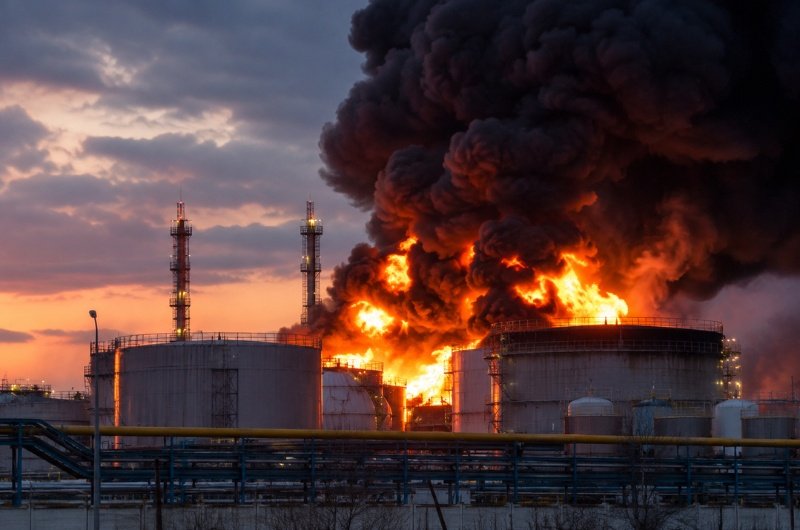
Ukraine launched a new wave of long-range drone attacks targeting Russian oil facilities overnight, as both sides continue to escalate military operations more than four years into the war. Russian officials said several energy sites were struck across multiple regions, while Ukrainian authorities described the attacks as part of an ongoing effort to weaken Russia’s military logistics and fuel supply. Moscow reported intercepting many of the drones, though damage to some facilities was confirmed. The latest strikes come as fighting continues along the front lines and diplomatic efforts to end the conflict remain stalled. Ukrainian President Volodymyr Zelenskyy has continued to press Western allies for additional military support, while Russia has maintained pressure through missile and drone attacks across Ukraine. The attacks underscore the growing role of energy infrastructure in the conflict. Oil refineries, fuel depots and storage facilities have become increasingly frequent targets as both sides seek to disrupt supply chains and reduce each other’s operational capabilities. With neither side showing signs of backing down, analysts say the conflict is likely to remain defined by long-range drone warfare, attacks on critical infrastructure and continued uncertainty over when meaningful peace negotiations might resume.
The New Business of Cleaning Up Earth’s Orbit

A new commercial space industry is emerging with an ambitious goal: removing aging satellites and dangerous debris from Earth’s orbit before they threaten future space missions. Thousands of inactive satellites, rocket fragments and other objects now circle the planet, creating growing risks for spacecraft, astronauts and the expanding network of communications satellites that support everything from GPS navigation to global internet service. As more launches take place each year, experts say keeping Earth’s orbit safe has become an increasingly urgent challenge. In response, aerospace companies are developing robotic spacecraft capable of inspecting, servicing and eventually removing defunct satellites from orbit. Some vehicles are being designed to capture aging spacecraft and guide them into Earth’s atmosphere, where they can safely burn up, while others aim to extend the operational lives of satellites through in-orbit servicing. The growing demand is creating new business opportunities across the space economy. Governments, commercial satellite operators and private investors are increasingly supporting technologies that could help reduce orbital congestion while protecting the infrastructure that modern life increasingly depends upon. As space activity accelerates, cleaning up Earth’s orbit is evolving into one of the newest frontiers of the commercial space industry, where innovation, sustainability and long-term access to space are beginning to converge.