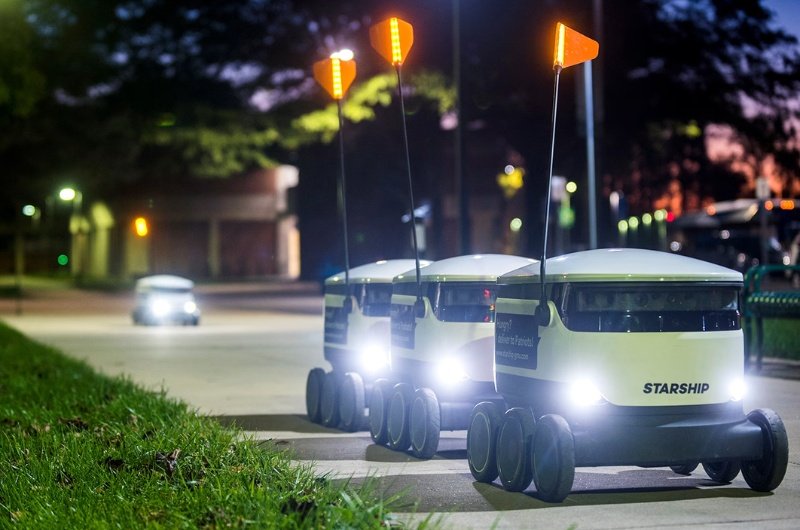
Uber Eats announced a new partnership with Starship Technologies this week, introducing advanced autonomous sidewalk-delivery robots that will begin operating in select UK cities starting in December. The agreement brings together Uber’s massive food-delivery network with what many analysts describe as the most mature, widely-deployed delivery-robot platform in the world — marking a shift from small-scale pilot programs to a larger commercial rollout.
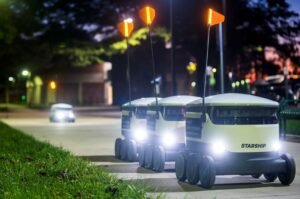
Starship Technologies has spent years developing and scaling ground-based delivery robots capable of navigating sidewalks and pedestrian traffic with minimal human oversight. Its compact six-wheel units have already completed millions of deliveries across hundreds of campuses, corporate sites, and city neighborhoods internationally. Built to operate at Level 4 autonomy, the robots are designed to function without direct human control within defined service areas — a capability that sets them apart from many emerging competitors still reliant on remote monitoring or assistance.
Under the new partnership, Uber customers in the UK will be able to order meals as usual through the Uber Eats app and choose robot delivery where available. Once dispatched, the robot travels independently to the destination using onboard cameras, radar, sensors, and machine-learning navigation. Customers can track their robot in real time and unlock the insulated storage compartment with a secure code once it arrives at their doorstep. Early service regions include Leeds and Sheffield, with additional cities expected to follow as infrastructure and adoption expand.
While Uber has already experimented with autonomous delivery partnerships in the United States, the collaboration with Starship represents a substantial technological upgrade. By leveraging a partner with a proven fleet already operating at scale, Uber positions itself at the forefront of last-mile transformation rather than simply testing emerging concepts. Industry watchers say the move could accelerate broader acceptance of robotic delivery, particularly in densely populated areas where short-distance vehicle trips contribute heavily to congestion and emissions.
Looking ahead, Uber and Starship have signaled plans to expand to additional markets in Europe and eventually into the United States. Questions remain around regulatory frameworks, labor implications, weather resilience, and the pace of consumer trust — but if successful, the rollout could signal the beginning of a fundamental shift in how goods travel to homes and businesses.