

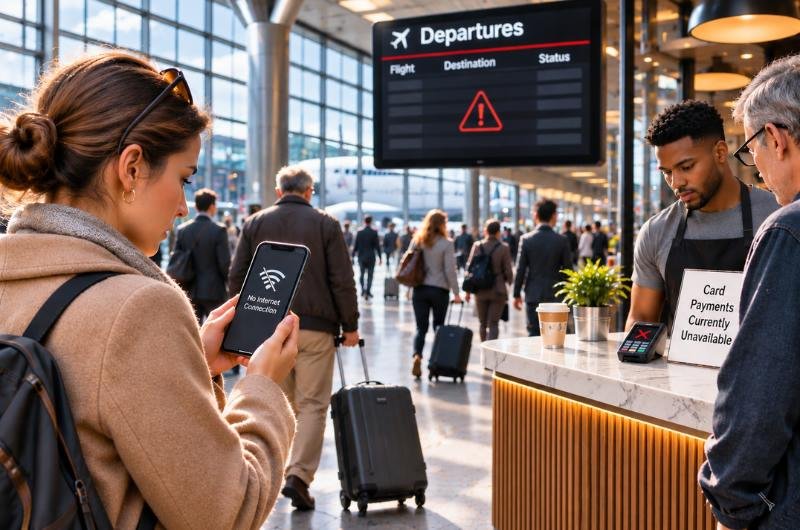
A series of technology failures disrupted American banking, air travel, and workplace communications between November 12 and November 16, 2026, affecting Microsoft services, the Federal Aviation Administration (FAA), United Airlines, and JPMorgan Chase. Although the incidents had different reported causes, their close timing revealed something worth considering: how much of everyday life depends on computer systems that can suddenly become unavailable.
We’ve made technology essential to nearly everything we do. But have we made ourselves equally prepared for the moments when it fails? That question extends far beyond the inconvenience of a frozen computer screen or an application that refuses to load. For millions of Americans, digital systems are how we access money, communicate with employers, make travel arrangements, purchase necessities, and manage our daily responsibilities.
The disruptions offered a striking illustration. Microsoft’s November 12 outage affected workplace services including Outlook and Teams. On November 13, problems involving aging FAA communications equipment led to a nationwide ground stop, disrupting thousands of flights. Three days later, United Airlines experienced a separate technology failure that delayed departing aircraft, while a software problem at JPMorgan Chase interrupted banking transactions. Federal officials have reported no evidence that the incidents were connected or part of a coordinated cyberattack.
The consequences of these failures are magnified by how thoroughly technology has replaced older ways of doing things. Banking increasingly takes place through apps, airline tickets live on smartphones, and essential workplace communications depend on online platforms. These conveniences have transformed daily life, but they have also created dependencies that are easy to overlook until something stops working. On November 17, Homeland Security Secretary Markwayne Mullin pointed to aging computer systems struggling to accommodate newer technology as a concern behind the recent disruptions.
For households, the recent disruptions also raise a practical question about emergency preparedness. If a banking system or payment network becomes unavailable, is there enough cash on hand to purchase groceries, gasoline, or other necessities? Are important phone numbers and travel documents accessible without an internet connection? Some readers may remember the days of paper phone books. They weren’t particularly sophisticated, but they worked without Wi-Fi! Is there a backup way to charge a phone or communicate with family members? Federal emergency guidance recommends keeping a small amount of cash in a safe place because automated teller machines (ATMs) and electronic payment systems may not work during a disruption. These are simple precautions, but they can make a meaningful difference when technology unexpectedly fails.
The responsibility does not rest entirely with consumers. Businesses, financial institutions, airlines, and government agencies must also invest in reliable equipment, carefully tested upgrades, backup systems, and clear communication when services are interrupted. Modernization is necessary, but introducing newer technology without ensuring that essential services can withstand failures creates risks of its own. The recent outages are not proof of a single nationwide technology crisis. They are reminders that reliability deserves as much attention as innovation.
The Takeaway
America’s recent technology disruptions reveal a growing gap between the convenience we’ve gained and the preparedness we may have lost. Digital systems have made life faster, easier, and more connected, but they have also made us increasingly dependent on services that can fail without warning. That dependence makes reliable infrastructure essential, while giving households a reason to maintain a few practical alternatives of their own.
The question is not whether technology will occasionally fail. It is whether we’ve prepared ourselves to function when it does.
——————–
Related:
Chase Software Failure Disrupts Banking Transactions Across the U.S.
United Airlines Technology Outage Delays Hundreds of Flights Following Nationwide Ground Stop
FAA Reveals New Details About Nationwide Flight Shutdown