


DHS Spokesperson Tricia McLaughlin Resigns Amid Political Backlash Over Immigration Enforcement
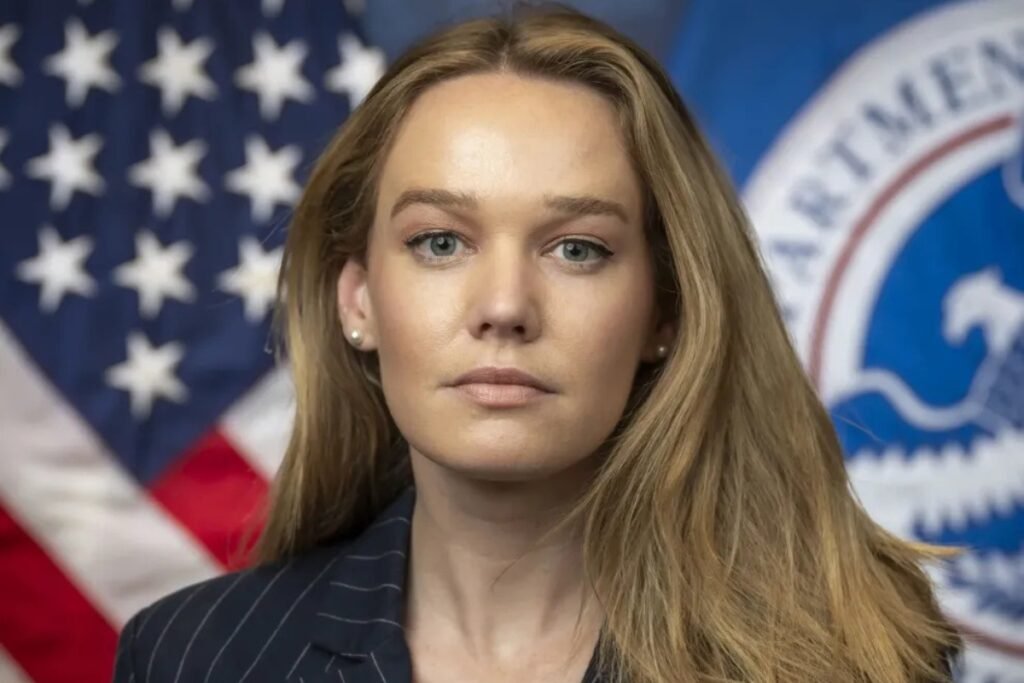
The Department of Homeland Security’s chief public affairs official, Tricia McLaughlin, announced her upcoming departure this week as political pressure intensifies over controversial immigration enforcement actions, particularly high-profile ICE raids that have drawn sharp criticism from lawmakers and community advocates. McLaughlin, who served as assistant secretary for public affairs, became one of the most visible voices defending the administration’s immigration policy and DHS operations. Her role involved explaining and justifying a range of enforcement strategies, from expanded removal efforts to federal deployments in cities grappling with public safety concerns. Her resignation comes at a challenging moment for DHS, which has recently faced public scrutiny and legal challenges tied to immigration enforcement actions that critics say have exceeded acceptable standards. The controversy has drawn attention from both sides of the political aisle, making DHS messaging one of the most fraught areas of the administration’s public communication strategy. In announcing her departure, McLaughlin described her time at DHS as an honor and said she was proud of her work communicating complex policy issues to the public. A department statement echoed that sentiment, praising her professionalism and dedication, and expressing appreciation for her service under difficult circumstances. McLaughlin’s exit is expected to take effect later this week, and DHS officials have said her deputy will assume the spokesperson role pending a permanent appointment. The transition comes as lawmakers question the department’s communication practices and demand greater transparency about enforcement priorities and decision-making. The timing of the resignation also dovetails with broader tensions over immigration policy in Washington. Recent enforcement operations carried out by Immigration and Customs Enforcement (ICE) have been met with protests and legal challenges in several major cities. Advocates have criticized the raids as heavy-handed, while supporters argue they are necessary to uphold immigration laws and public safety. DHS leadership has defended its authorities and actions, but the messaging challenges have been palpable as the department seeks to balance enforcement objectives with mounting public and political scrutiny. As the department moves forward, the departure of one of its principal communicators highlights the elevated stakes in how immigration policy is portrayed and understood by the public. With new leadership stepping into the communications role, all eyes will be on how DHS articulates its priorities amid ongoing debate.
Fire Weather Threatens Central U.S. as Warmth and Wind Elevate Risk

Unseasonably warm temperatures, dry vegetation, and strengthening winds are creating elevated fire weather conditions across parts of the central United States, prompting warnings from meteorologists and local officials as communities brace for potential wildfire outbreaks. Forecasters say the combination of above-average temperatures and gusty afternoon winds significantly increases the risk of fast-moving grass and brush fires. Even minor ignition sources — including sparks from vehicles, machinery, or unattended outdoor burns — could quickly spread under current conditions. The threat stretches across portions of the Plains and Midwest, where recent stretches of limited precipitation have left fuels unusually dry for mid-February. Fire weather alerts and advisories are in effect in several areas, urging residents to avoid outdoor burning and use caution with any activity that could generate sparks. While a cooler pattern is expected later in the week, officials warn that today’s warm, breezy conditions create a narrow but potentially dangerous window for fire activity. Emergency managers are encouraging residents to monitor local advisories and report smoke or fire immediately.
BREAKING NEWS: Rev. Jesse Jackson, Civil Rights Icon and Presidential Trailblazer, Dies at 84
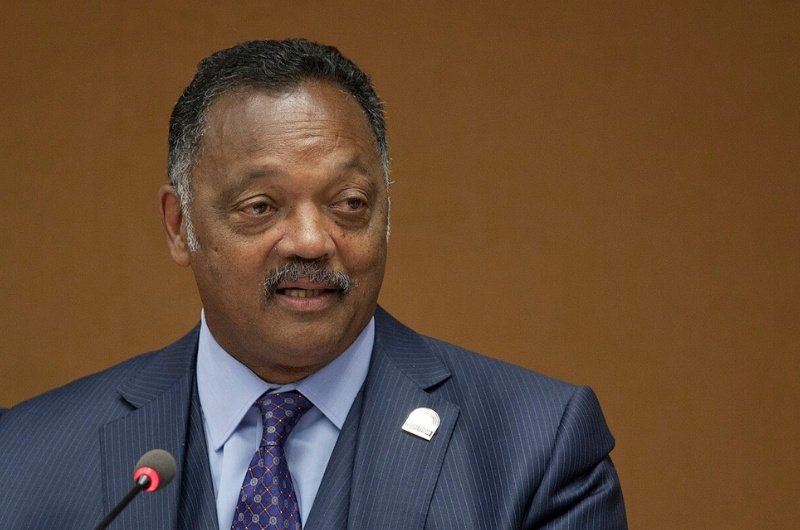
The Rev. Jesse Jackson, a towering figure of the modern civil rights era and a pioneering presidential candidate, has died at the age of 84. For more than five decades, Jackson stood at the intersection of activism, politics, and faith, helping shape the national conversation on race, economic justice, and political representation. A close associate of Dr. Martin Luther King Jr. during the 1960s, Jackson emerged from the civil rights movement as one of its most visible successors. He later founded what became the Rainbow PUSH Coalition, an organization dedicated to advancing economic opportunity, voter participation, and corporate accountability. Through marches, negotiations, and public advocacy, he positioned himself as both a protest leader and a power broker. Jackson made history with his 1984 and 1988 campaigns for the Democratic presidential nomination. His 1988 run, in particular, expanded the political coalition within the party and demonstrated the growing influence of Black voters in national elections. While he did not secure the nomination, his campaigns opened doors for future candidates and reshaped expectations about who could seek the nation’s highest office. In recent years, Jackson faced health challenges, including Parkinson’s disease, yet remained a symbolic presence in civic life. His passing closes a chapter that linked the moral urgency of the 1960s civil rights struggle with the evolving political landscape of modern America.
DHS Shutdown Raises Travel Concerns as Spring Break Approaches

A partial federal government shutdown affecting the U.S. Department of Homeland Security began early Saturday morning after Congress failed to pass a funding extension before a midnight deadline, placing airport security operations and other key federal services under temporary shutdown procedures nationwide. TSA officers and other essential personnel are required to continue working without pay during the lapse in funding. Airport security checkpoints remain open nationwide, but travel industry groups warn that prolonged uncertainty could create strain if employee absences increase during one of the busiest travel periods of the year. Spring Break travel is already ramping up across major U.S. airports, and even modest staffing disruptions can ripple through screening lines and flight schedules. Airlines and tourism organizations have urged lawmakers to reach a funding agreement quickly, noting that airport efficiency is critical to both traveler confidence and the broader economy. This is not a full federal shutdown. Funding for most government operations is secure through the fiscal year, but DHS — which oversees TSA, FEMA, Customs and Border Protection, the Coast Guard, and other security agencies — is operating without new appropriations until a deal is reached. For now, travelers are advised to monitor flight updates, arrive at airports earlier than usual, and check security wait times ahead of departure. While widespread disruptions have not yet materialized, the longer the funding lapse continues, the greater the potential for operational pressure at airports nationwide.
DHS Set to Shut Down After Congress Leaves Washington Without Funding Deal
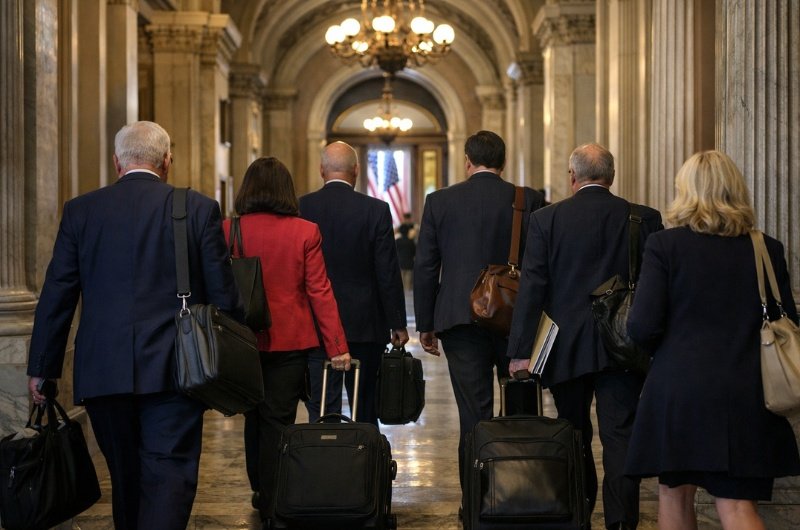
The Department of Homeland Security is on track to partially shut down this weekend after Congress departed for the Presidents Day recess without approving a funding extension, leaving one of the nation’s largest federal agencies facing an immediate budget lapse. Lawmakers had been negotiating a short-term funding solution to keep the department operating beyond Friday’s deadline, but disagreements over immigration enforcement and oversight provisions stalled progress. Without congressional action, DHS funding expires at midnight, triggering contingency plans across multiple agencies. The Department of Homeland Security oversees a wide range of federal operations, including Immigration and Customs Enforcement (ICE), the Transportation Security Administration (TSA), the Coast Guard, the Federal Emergency Management Agency (FEMA), and U.S. Customs and Border Protection. While many essential employees would continue working during a shutdown, thousands of others could face temporary furloughs or delayed pay. The funding breakdown underscores the deep divisions in Washington over border security policy and enforcement authority. Immigration strategy has become one of the most contentious issues in the current Congress, with lawmakers split over how aggressively federal agencies should operate and what guardrails should be imposed. Unless lawmakers reconvene and pass emergency legislation in the coming days, DHS operations will shift into shutdown status as early as Saturday — creating operational strain at airports, ports of entry, and disaster response coordination hubs nationwide. ——————– Related: DHS Shutdown Looms as Democrats Set Conditions for Funding Approval
Winter Olympics 2026: Milan-Cortina Games Bring Global Competition to Northern Italy

The 2026 Winter Olympic Games are underway across northern Italy, with competitions hosted jointly by Milan and the alpine resort town of Cortina d’Ampezzo. Officially branded Milano Cortina 2026, the Games run from February 6 through February 22 and mark Italy’s third time hosting the Winter Olympics. Italy previously hosted the Winter Games in Cortina in 1956 and in Turin in 2006. This year’s event is distinctive for its multi-city format, with venues spread across northern Italy rather than centered in a single metropolitan area. Milan is serving as the hub for indoor ice sports such as figure skating, short-track speed skating, and portions of the ice hockey tournament. Meanwhile, alpine skiing and several snow-based competitions are taking place in the Dolomite mountain region surrounding Cortina. Additional events are being staged in nearby Alpine communities, creating one of the most geographically expansive Winter Games in recent history. Nearly 3,000 athletes representing more than 80 nations are competing across a broad slate of winter disciplines. As marquee events approach — including downhill finals, figure skating competitions, and high-profile hockey matchups — global viewership is expected to rise sharply. Beyond medal counts, the Milan-Cortina Winter Olympics are serving as a major international showcase for winter sport, tourism, and cultural exchange in one of Europe’s most iconic alpine regions.
House Approves Stricter Voter Registration Rules Ahead of 2026 Midterms
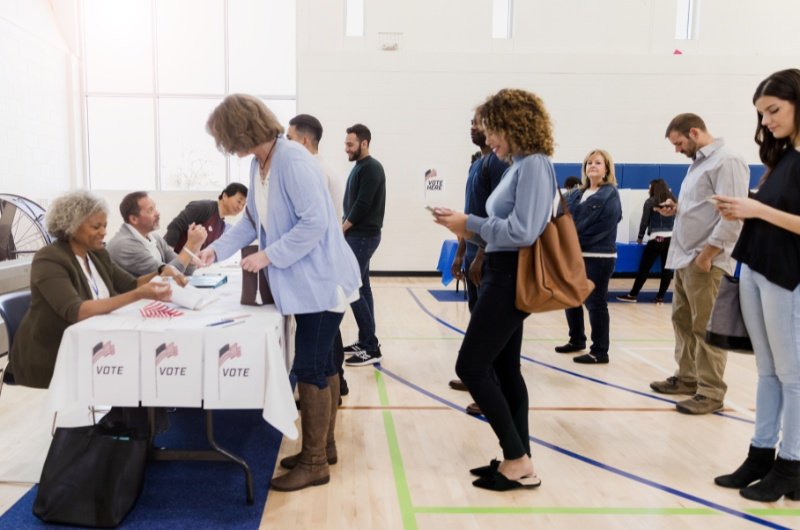
The Republican-controlled U.S. House has approved legislation that would impose new proof-of-citizenship requirements for voters ahead of the November 2026 midterm elections, advancing one of the party’s top election policy priorities. The bill would require individuals registering to vote in federal elections to provide documentary evidence of U.S. citizenship, such as a passport or birth certificate. It would also tighten identification standards for both in-person and mail-in voting. Supporters describe the measure as a safeguard intended to strengthen election integrity and reinforce public trust in the voting system. Democrats and voting rights advocates strongly oppose the proposal, arguing that documented instances of non-citizen voting are exceedingly rare and that additional paperwork requirements could create barriers for eligible voters. Critics warn the changes may disproportionately affect Americans who lack easy access to formal documents, including some older voters and individuals whose legal names have changed. The measure passed largely along party lines and now heads to the Senate, where its future remains uncertain. Even with Republican support, the legislation would likely face procedural hurdles requiring bipartisan cooperation to advance. The vote highlights the deepening national divide over election law as lawmakers prepare for what is expected to be a highly competitive 2026 midterm cycle.
Senate Republicans Push for DHS Funding Extension Amid Shutdown Concerns
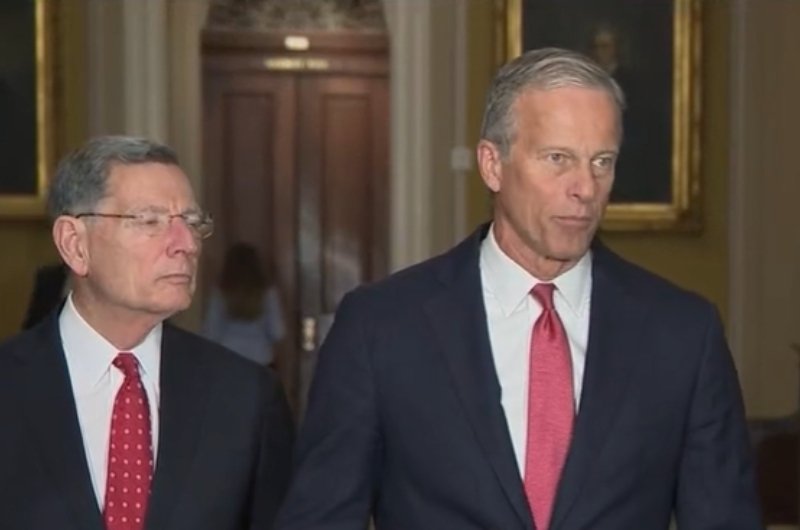
Senate Republican leaders urged Democrats to allow additional time to finalize funding for the Department of Homeland Security, warning that failure to act could risk disruption to critical federal agencies. Speaking during a news conference, Republican lawmakers emphasized that roughly 90% of federal government funding measures are already in place, leaving DHS as one of the final outstanding components. They noted that the department’s responsibilities extend far beyond immigration enforcement, including FEMA disaster response, the Coast Guard, TSA operations, and federal cybersecurity infrastructure. Republican leaders argued that negotiations between congressional leaders and the White House have been productive but remain incomplete. They said Democrats only recently received legislative text and called for a short-term extension of the current continuing resolution to allow talks to continue through the end of the fiscal year in September. A central point of contention remains immigration enforcement. Republicans stated they are unwilling to support provisions they believe would make it “harder, not easier” for law enforcement officials to detain and remove individuals they describe as dangerous undocumented immigrants. Democrats have pushed for greater oversight and policy adjustments, framing the debate as part of broader immigration reform discussions. With a potential shutdown looming if an agreement is not reached, both sides now face mounting pressure to secure a deal. Republican leaders signaled they are open to further negotiations but warned against what they described as holding essential agencies “hostage” during budget brinkmanship. Whether Democrats will agree to additional time or force procedural votes remains uncertain.
U.S. and India Unveil Trade Framework as Strategic Ties Deepen

The White House has announced a new trade framework with India, signaling a major step toward strengthening economic and strategic alignment between the two countries. The agreement outlines plans to reduce tariffs, expand market access, and accelerate negotiations toward a broader bilateral trade pact. Under the framework, both governments committed to easing long-standing trade barriers that have restricted exports and strained commercial relations. The United States plans to lower tariffs on selected Indian goods, while India agreed to eliminate or significantly reduce tariffs on a wide range of American industrial and agricultural products. Officials describe the approach as an effort to rebalance trade while creating clearer pathways for growth. A central component of the deal is India’s commitment to large-scale purchases of U.S. goods across sectors including energy, agriculture, technology, and manufacturing. The move is designed to reinforce supply chains and reduce dependence on rival powers for critical materials and products, reflecting the growing geopolitical dimension of global trade. The framework also expands cooperation in digital trade and technology policy, with both countries aiming to reduce digital barriers and align more closely on innovation, data flows, and emerging technologies. Additional provisions focus on supply-chain security and economic resilience, underscoring the deal’s strategic importance beyond commerce alone. While the agreement stops short of a full trade pact, it establishes a clear roadmap for continued negotiations. If finalized, a comprehensive U.S.–India trade agreement could reshape economic relations between the two democracies and strengthen their influence in an increasingly competitive global economy.
DHS Shutdown Looms as Democrats Set Conditions for Funding Approval
The Department of Homeland Security is just four days away from a potential shutdown, as negotiations over funding stall and Democrats lay out a list of conditions they say must be met before approving a spending bill. If no agreement is reached by the deadline, a shutdown would affect multiple agencies operating under the Department of Homeland Security, including immigration enforcement, border operations, cybersecurity, disaster response, and transportation security. While some essential services would continue, thousands of federal employees could be furloughed, and key programs would face disruptions. Democrats have made clear they will not approve DHS funding without what they describe as concrete legislative safeguards. According to party leaders, their conditions must be enacted directly as part of the DHS spending bill, not addressed through future negotiations or executive actions. The list includes ten demands focused on oversight, accountability, and constitutional protections. Among them are requirements for mandatory body cameras for immigration enforcement officers, stricter limits on when agents may enter private homes, and explicit enforcement of judicial warrant requirements. Democratic lawmakers are also pushing for measures that would prohibit the use of masks during enforcement operations, arguing that visible identification is necessary for accountability. They have emphasized that Fourth Amendment protections must be upheld, particularly during arrests and home entries, and that violations should be subject to independent investigation. Another key demand asserts the authority of state and local governments to conduct their own investigations into alleged violations of state and local laws, even when federal agencies are involved. Democrats argue this provision is essential to maintaining checks on federal power. Republicans have criticized the demands as overreach, warning that tying enforcement restrictions to funding could weaken DHS operations at a critical moment. They argue that immigration enforcement and national security should not be subject to what they describe as last-minute policy concessions. With the deadline approaching, neither side appears ready to back down. If talks fail, DHS would join a growing list of federal agencies caught in the crossfire of broader political disputes, once again raising questions about Congress’s ability to fund the government without crisis-driven deadlines. For now, the clock is ticking — and the outcome could determine not only whether DHS remains operational, but how its authority is defined moving forward.