


The Visibility Era, Part II: The New Gatekeepers
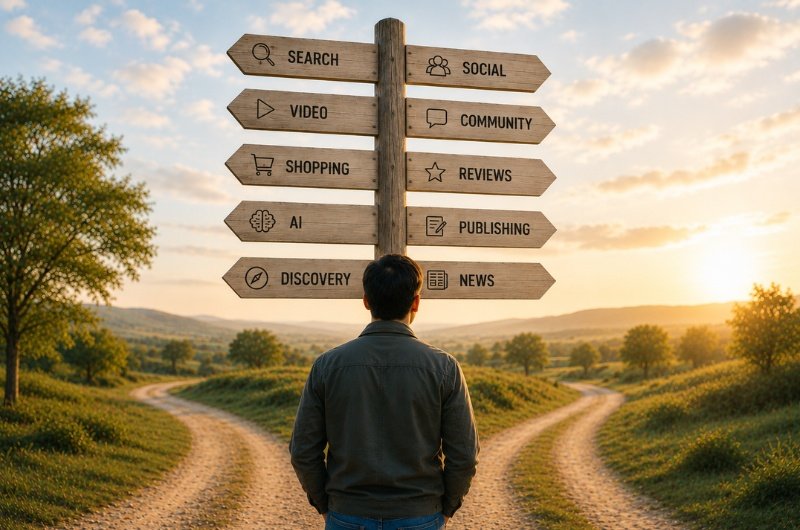
In Part I of *The Visibility Era*, we explored a growing reality of the modern internet: visibility is becoming increasingly difficult to earn. Every day, millions of articles, videos, podcasts, newsletters, social posts, and AI-generated pieces of content compete for attention across an already crowded digital landscape. But visibility is only part of the story. As the ways people find information continue to evolve, a new question emerges: who controls access to that information? In the past, search engines largely served as the primary gatekeepers of the web. Today, a growing collection of AI platforms, recommendation systems, marketplaces, social networks, and digital ecosystems are increasingly influencing what users see, what they trust, and ultimately what they choose. Yet scarcity alone does not explain what people see. Increasingly, visibility is being shaped by systems operating behind the scenes. For years, the internet was celebrated as a force that removed traditional gatekeepers. Anyone could launch a website, start a blog, create a YouTube channel, publish a newsletter, open an online store, or build a personal brand. The barriers to publishing have never been lower. The barriers to discovery are another matter. Today, algorithms help determine which videos appear in feeds, which websites rank in search results, which products surface in online marketplaces, and which creators receive recommendations. Artificial intelligence is beginning to play an even larger role, influencing how information is summarized, presented, and discovered across the web. The old gatekeepers have not disappeared. They have evolved. In previous generations, publishers, broadcasters, editors, and producers often decided which voices reached the public. Today’s gatekeepers are less visible but no less influential. Recommendation engines, search algorithms, social platforms, app stores, and AI-powered systems increasingly shape the pathways through which attention flows. Most users rarely think about these systems. They simply open an app, perform a search, scroll through a feed, or ask an AI assistant a question. Behind each interaction, complex technologies are making decisions about relevance, quality, popularity, engagement, authority, and countless other signals. The result is a digital world where publishing is decentralized, but discovery is increasingly filtered. This does not mean the system is unfair. In many ways, algorithms help people navigate an overwhelming amount of information. Without them, the modern internet would be nearly impossible to use. The challenge is that every filtering system influences outcomes. Some content is amplified, some is overlooked, and some rises quickly while other material struggles to find an audience regardless of its quality. For creators, entrepreneurs, publishers, and businesses, this reality carries important implications. Success online is no longer determined solely by creating something valuable. Visibility often depends on understanding how information moves through the platforms where audiences spend their time, and the ability to earn attention increasingly requires adapting to systems that are constantly changing. The rise of artificial intelligence may accelerate this trend. As more people rely on AI assistants to answer questions, summarize information, recommend products, and discover content, new layers of visibility management are emerging. Instead of competing only for search rankings or social reach, businesses may soon find themselves competing for inclusion within AI-generated responses and recommendations. The competition for visibility is becoming more sophisticated, and the systems governing visibility are becoming more powerful. The internet remains one of the most democratic publishing environments ever created. Millions of people can share ideas with a global audience at virtually no cost. That opportunity remains extraordinary. At the same time, the path between publishing and discovery is increasingly shaped by technologies that most users never see. Understanding those systems may become one of the defining skills of the digital age. Because in the Visibility Era, being heard is not simply about having something to say. It is also about understanding who — or what — controls the flow of attention.
The Visibility Era, Part I: The Internet Enters an Age of Visibility Scarcity

For decades, the internet operated on a simple promise: if something was valuable, people would eventually find it. Search engines expanded access to information, social media amplified voices, and digital publishing created the illusion that visibility was becoming more democratic over time. But quietly, the architecture of the internet has begun to change. The modern web is no longer driven primarily by open discovery. Increasingly, information is filtered before it reaches the public at all. AI summaries, recommendation engines, algorithmic feeds, machine-generated answers, and emerging AI agents are beginning to decide what gets surfaced, referenced, summarized, or ignored — often before a person clicks a single link. This is clearly a visibility shift. The next era of the internet may not be defined by who creates the most content, but by what becomes the most retrievable. In a world increasingly shaped by machine-mediated discovery, being online is no longer enough. The real challenge is being selected by systems that are rapidly becoming the gatekeepers of digital attention. That changes the equation for everyone: publishers, businesses, creators, brands, educators, analysts, and even ordinary professionals building an online presence. For years, the internet rewarded scale. More pages. More posts. More keywords. More updates. But as AI systems compress information into summaries and direct answers, the value of sheer volume may begin to weaken. Visibility itself is becoming scarcer. At the same time, trust is consolidating. Machines increasingly favor recognizable entities, established authority signals, structured knowledge, and sources that can be confidently interpreted and retrieved. In many cases, the future winners of the internet may not be the loudest voices, but the clearest and most consistently understood ones. That distinction matters, because the Visibility Era is not simply about traffic declines or changing search behavior. It represents a deeper transformation in how information is organized, surfaced, and remembered. The web is shifting from an environment where humans actively search for information to one where systems increasingly decide what information deserves attention first. And most people still do not fully see it happening. The implications reach far beyond publishing. Entire industries were built on the assumption that discoverability would continue expanding indefinitely. But if visibility becomes concentrated inside recommendation systems, AI interfaces, and machine-curated experiences, digital strategy itself begins to change. Archives matter differently. Authority matters differently. Recognition matters differently. Even language itself begins to matter differently. The companies and creators that adapt earliest may not necessarily be the ones producing the most content. They may be the ones building the strongest signals of clarity, identity, trust, and retrievability across the digital ecosystem. That may ultimately become the defining challenge of the next internet era: not whether something exists online — but whether it can still be meaningfully found. And for the first time in modern internet history, those may no longer be the same thing.
The Quiet Disappearance of Boredom

There was a time when boredom served a purpose. It showed up in quiet moments—waiting, sitting, staring out the window—and it wasn’t something to escape. It was something the mind moved through. And often, on the other side of that stillness, ideas began to form. Today, those moments are harder to find. What used to be empty space is now filled almost instantly. A phone comes out. A screen lights up. A scroll begins. Boredom doesn’t linger long enough to do what it once did—it gets replaced. This shift feels small, almost invisible. But over time, it changes something deeper. Because boredom wasn’t just the absence of activity—it was the beginning of thought. It gave the brain room to wander, to connect ideas, to create something new without direction or pressure. Now, that space is increasingly occupied. And while constant access to information has made life more efficient and connected, it may also be quietly reducing the moments where original thinking begins. Bringing It Back Reintroducing boredom doesn’t require disconnecting from everything. It may be as simple as giving it a new name—silence—and allowing a few moments to remain unfilled. No input. No distraction. Just space. Because in silence, we can hear, see, and think most clearly. Between the Lines The modern world has optimized for engagement. But creativity has never followed the same rules. It tends to appear between tasks, between thoughts, between moments of doing. When those moments disappear, something else may quietly disappear with them. ——————– Related: The Notification Economy: Why Your Attention Is Always in Demand
The New American Tension: Calm on the Surface, Pressure Underneath

Across America, the markets are steady, businesses are operating, and the economy appears to be holding — but beneath the surface, pressure is building in ways that are becoming harder to ignore. But beneath that surface, something else is happening — and more people are starting to feel it in very real ways. Gas prices begin to inch higher. Grocery bills refuse to come down. Insurance premiums rise quietly, almost without explanation. At the same time, global tensions continue to build, policy decisions are accelerating, and companies are being pushed into the center of political and cultural debates — whether they want to be or not. None of it looks like a crisis. But none of it feels entirely stable either. That’s where the tension lives. It’s the gap between what appears steady and what feels uncertain. Markets can rise sharply — even as household budgets feel tighter. A fund tied to oil can surge more than 50% in a month, while consumers brace for higher prices at the pump. A major retailer can gain ground in the market, even as it faces growing pressure from multiple sides of the public conversation. The signals don’t contradict each other. They reveal something deeper. This moment is defined by compression. Everything is still functioning — but with less room to absorb shock. Costs are higher. Reactions are faster. Decisions carry more weight, whether it’s a business responding to public pressure or a household adjusting spending in real time. That creates a different kind of environment — one where small shifts matter more. A policy change doesn’t just stay in Washington. It moves through contracts, companies, and communities. A global conflict doesn’t stay overseas. It shows up in energy markets, supply chains, and eventually, everyday expenses. A single stock move can reflect a broader trend that hasn’t fully reached the public yet. These are signals. And they’re becoming harder to ignore. The challenge is that this kind of shift doesn’t announce itself all at once. There’s no single headline that captures it. Instead, it builds gradually — across markets, across industries, and across everyday life. That’s why it can feel so difficult to explain. Everything looks calm. But it doesn’t feel calm. And that feeling isn’t random. It’s what happens when the system is still moving forward — but under a new kind of pressure. One that is quieter, more constant, and more personal. The most important changes don’t always arrive with disruption. Sometimes, they arrive as tension — just beneath the surface. Navigating a Moment Like This For individuals, the response doesn’t have to be dramatic — but it does need to be intentional. Pay attention to the signals, not just the headlines. Understand where pressure is building, and adjust early where you can. That might mean being more deliberate with spending, more thoughtful about risk, or simply more aware of how quickly conditions can shift. It’s also a moment to stay grounded. Not every change requires a reaction, but ignoring everything isn’t a strategy either. The goal is not to predict every move — it’s to remain steady while everything else is adjusting. Because while the environment may feel uncertain, clarity still creates an advantage. And in times like this, the people who stay aware, adaptable, and measured are often the ones who navigate change the best.
Shifting Focus Series (Part 3): The Shift in Online Discovery: AI, Search, and Who Owns the Audience

Artificial intelligence has crossed a threshold that is no longer theoretical. Tools developed by OpenAI, including ChatGPT, are now used by hundreds of millions of people each week, signaling that AI has moved from experimentation into daily digital infrastructure. More broadly, industry data indicates that over one billion people worldwide now interact with AI-powered tools in some form, from conversational interfaces to embedded assistants across major platforms. What comes next may be even more disruptive. Researchers and platform leaders increasingly point to agentic access as the next major shift — AI systems that do more than respond to prompts. Agentic tools are designed to plan, browse, compare, and act on a user’s behalf. Early versions are already emerging through experimental AI browsers, task-running agents, and AI-powered aggregators that collapse search, navigation, and execution into a single interface. This new layer of agentic browsers and aggregators has the potential to upend the architecture of the web itself. Instead of users navigating sites one click at a time, AI agents increasingly act as intermediaries — pulling information, synthesizing it, and delivering outcomes without directing users to the original source. For the first time since the rise of search engines, discovery is no longer driven by SEO alone, but increasingly shaped by AI systems that mediate how information is found and surfaced. Shifting Focus The economic effects are already visible. As AI-generated summaries and search overviews reduce click-through traffic, many web publishers are reporting sustained declines in search referrals. In response, publishers are shifting focus toward direct audience relationships, investing more heavily in podcasts, email newsletters, mobile alerts, and community-driven platforms. Some organizations are going a step further, quietly building integrated ecosystems that combine content and platforms under unified ownership — reducing exposure to third-party volatility while retaining flexibility as discovery models evolve. The emphasis is moving away from algorithmic dependence and toward owned distribution channels that offer stability in an AI-mediated environment. ——————– Related: Shifting Focus Series (Part 1): How AI Is Rewriting Digital Discovery and Why Search Traffic Is Vanishing Shifting Focus Series (Part 2): Beyond SEO — Thriving in the Age of AI Agents
AI Gives Businesses a Chance to Rethink the Workday in 2026

Editor’s Journal The future of work may be shorter — if businesses are willing to embrace AI and use it wisely. For decades, productivity gains have followed the same frustrating pattern: new tools make work faster, but employees rarely see the benefit. Instead of gaining time, workers are asked to do more. In 2026, artificial intelligence presents an opportunity to finally change that dynamic — not by pushing people harder, but by using technology to make work life genuinely easier. As businesses race to adopt AI, the conversation has focused heavily on efficiency, cost savings, and output. Those goals are understandable. But they are also incomplete. AI is already capable of reducing or eliminating many of the tasks that quietly consume the modern workday — writing, scheduling, data analysis, strategic planning, and more. For a growing number of jobs, the eight-hour workday has become a habit rather than a necessity. This opens the door to a long-overdue question: if AI can significantly reduce the time it takes to complete core responsibilities, why are we still organizing work around rigid, full-day schedules? A four-day workweek, or six-hour workdays at full pay, are no longer radical ideas. They are increasingly practical outcomes of smarter systems doing the repetitive work humans no longer have to spend hours on. There is also a compelling business case for this shift. Burnout has become one of the most expensive hidden costs in the modern workplace, driving turnover, disengagement, and declining creativity. Shorter workweeks and more flexible schedules have already shown improvements in focus, morale, and retention where they’ve been tested. Employees who feel trusted with their time tend to bring more clarity and energy to the hours that truly matter. Not every job can immediately move to a four-day week or six-hour workday. But leadership teams should begin thinking less about hours logged and more about outcomes achieved. AI makes that shift possible by separating productivity from presence — a distinction long overdue in knowledge work. The promise of artificial intelligence was never just about speed. It was about giving people back something they have been steadily losing: time. In 2026, forward-thinking businesses have a chance to prove that progress does not have to come at the expense of well-being. Used wisely, AI could mark the moment work finally begins to fit life — not the other way around.
The Skills That Will Matter More Than Capital in 2026

For much of modern history, success has favored those with access to money, resources, or the right connections. But from this editor’s desk, one truth is becoming increasingly clear: that equation is changing. As 2026 approaches, the advantage is shifting away from capital alone and toward capability — how people think, adapt, and respond to a rapidly changing world. One skill rising to the top is adaptability. Careers, industries, and business models are evolving faster than traditional paths can accommodate. Those who can learn quickly, pivot without panic, and operate outside rigid roles are emerging as the ones most able to withstand disruption. Static expertise is no longer enough. Flexibility has become a form of resilience. Equally essential is clear communication. As work becomes more decentralized and collaboration increasingly digital, the ability to express ideas with clarity and intention is separating those who lead from those who struggle to keep up. Whether communicating with teams, clients, or AI-powered systems, people who can provide context, direction, and judgment hold a distinct advantage that money alone cannot replicate. Another skill quietly reshaping opportunity is discernment — the ability to decide what matters and what does not. In an environment flooded with information, tools, and competing demands, success is no longer about chasing every opportunity. It favors those who can filter noise, make thoughtful decisions, and align their efforts with long-term priorities. Discernment is often overlooked, even as its impact becomes harder to ignore. Finally, self-direction is becoming a defining trait of modern stability. As traditional career structures loosen and external guardrails fade, individuals who can manage their time, maintain momentum, and move forward without constant oversight are finding new paths to progress. Increasingly, independence is not just a preference — it is a requirement. In 2026, capital will still matter. But it will increasingly follow skill, not precede it — a shift worth paying attention to now, not later. ——————– Recommended: The One Question Entrepreneurs and Side Hustlers Can’t Afford to Ignore in 2026
Rewiring Goal-Setting for 2026

Every new year begins with ambition. It also tends to begin with pressure — long lists of resolutions, carefully written goals, and the quiet belief that this is the year everything must change. But by February, many of those goals fade, not because people lack discipline, but because they took on too much at once. The problem isn’t motivation. It’s overload. When multiple goals compete for attention, focus becomes fragmented and progress slows. Instead of building momentum, people often find themselves managing expectations, juggling priorities, and feeling behind before the year truly gets started. Focus, it turns out, isn’t a personality trait — it’s a strategy. Goal-setting needs a reset. Rather than aiming for ten major changes, the smarter approach for 2026 is choosing just one primary goal — or at most two. The real shift happens when a goal moves beyond intention and into action. Instead of asking what you want by December, ask what progress should look like by March — and what can realistically be done each week to move closer to the goal. Big goals don’t fail because they’re unrealistic; they fail because they aren’t supported by simple action steps that carry them forward until they are achieved. Success in 2026 isn’t about urgency or reinvention. It’s about clarity. Fewer goals create more room for follow-through, more confidence in decision-making, and a calmer relationship with time. This year doesn’t need to be bigger. It needs to be intentional. The Takeaway If you’re setting goals for 2026, consider focusing on one or two goals that truly matter — and commit just as seriously to the action steps required to achieve them. Goals without action remain intentions. Write down the steps, make them specific, and build them into your weekly to-do lists. Clarity sets direction. Action carries goals across the finish line.
Readovia Celebrates A Successful First Year & Pauses for Winter Break

As we head into the Christmas and New Year’s holiday week, the Readovia team is stepping away from the newsroom to enjoy time with loved ones, celebrate meaningful traditions, and embrace the rest and reflection this season invites. This pause comes at the close of Readovia’s first full year in publication. After officially launching in December 2024, 2025 marked our inaugural year of consistent reporting, editorial refinement, and audience growth. Over the past twelve months, Readovia established its voice, expanded coverage across the topics shaping modern life, and built a growing community of readers who value clarity, context, and thoughtful journalism. With deep gratitude for you — our loyal readers and supporters from the very beginning — we’re pausing publication from Christmas Eve through New Year’s Day. We’ll return on January 2 with fresh stories, insightful coverage, and a renewed commitment to meaningful reporting in the year ahead. Of course, should a major breaking story arise, we’ll be here to cover it — pajamas and all. Until then, all of us at Readovia wish you peace, warmth, safe travels, and memorable moments that matter most. Happy Holidays, — Jewel Perry, Editor-in-Chief and The Readovia Team
Michelle Obama Responds to Trump’s Remarks With a Personal Tribute to the Reiners

Former First Lady Michelle Obama revealed that she and former President Barack Obama were scheduled to spend time with longtime friends Rob and Michele Reiner on the very night the couple was found dead at their Los Angeles home. Speaking during a late-night television appearance, Obama described the moment as deeply shocking, noting that the news reached them just as plans were supposed to unfold. The Obamas had known the Reiners for many years, and the loss struck not only as a public tragedy but as a profoundly personal one. The filmmaker and his wife were found dead in what authorities are investigating as a double homicide. Their son has since been arrested in connection with the case, adding another devastating layer to an already grim situation. During the interview, Michelle Obama also addressed public commentary that followed the deaths, pushing back strongly against remarks made by President Trump, who suggested the Reiners were “deranged.” Obama rejected that characterization outright, offering a forceful defense of their character and values. “Let me just say this: unlike some people, Rob and Michele Reiner are some of the most decent, courageous people you ever want to know,” she said. “They are not deranged or crazed. What they have always been are passionate people. In a time when there’s not a lot of courage going on, they were the kind of people who were ready to put their actions behind what they cared about. And they cared about their family, they cared about this country, and they cared about fairness and equity. And that is the truth — I do know them.” Her remarks blended grief with a broader rebuke of political rhetoric, underscoring how moments of personal loss are increasingly pulled into the national political conversation. What might once have remained a private mourning instead became another flashpoint in a deeply polarized public discourse. ————– Related: UPDATE: Hollywood Director Rob Reiner and Wife Found Dead at Los Angeles Home