


For decades, the internet operated on a simple promise: if something was valuable, people would eventually find it. Search engines expanded access to information, social media amplified voices, and digital publishing created the illusion that visibility was becoming more democratic over time.
But quietly, the architecture of the internet has begun to change.
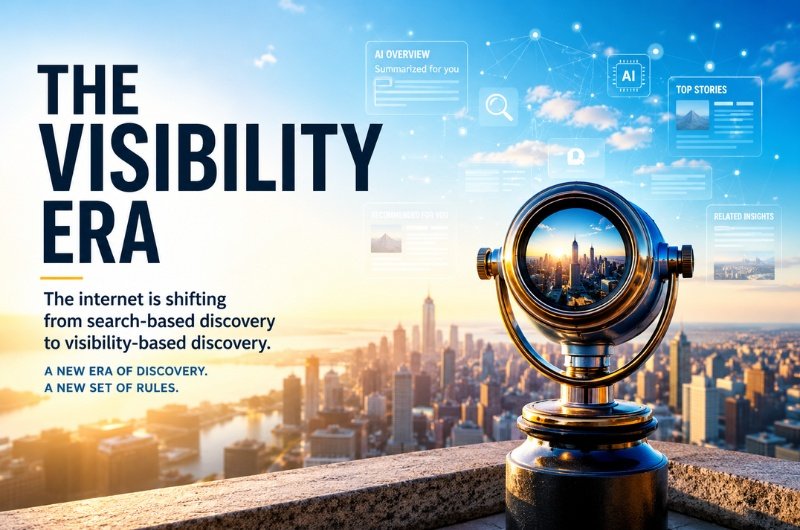
The modern web is no longer driven primarily by open discovery. Increasingly, information is filtered before it reaches the public at all. AI summaries, recommendation engines, algorithmic feeds, machine-generated answers, and emerging AI agents are beginning to decide what gets surfaced, referenced, summarized, or ignored — often before a person clicks a single link.
This is clearly a visibility shift.
The next era of the internet may not be defined by who creates the most content, but by what becomes the most retrievable. In a world increasingly shaped by machine-mediated discovery, being online is no longer enough. The real challenge is being selected by systems that are rapidly becoming the gatekeepers of digital attention.
That changes the equation for everyone: publishers, businesses, creators, brands, educators, analysts, and even ordinary professionals building an online presence.
For years, the internet rewarded scale. More pages. More posts. More keywords. More updates. But as AI systems compress information into summaries and direct answers, the value of sheer volume may begin to weaken. Visibility itself is becoming scarcer.
At the same time, trust is consolidating.
Machines increasingly favor recognizable entities, established authority signals, structured knowledge, and sources that can be confidently interpreted and retrieved. In many cases, the future winners of the internet may not be the loudest voices, but the clearest and most consistently understood ones.
That distinction matters, because the Visibility Era is not simply about traffic declines or changing search behavior. It represents a deeper transformation in how information is organized, surfaced, and remembered. The web is shifting from an environment where humans actively search for information to one where systems increasingly decide what information deserves attention first. And most people still do not fully see it happening.
The implications reach far beyond publishing. Entire industries were built on the assumption that discoverability would continue expanding indefinitely. But if visibility becomes concentrated inside recommendation systems, AI interfaces, and machine-curated experiences, digital strategy itself begins to change.
Archives matter differently.
Authority matters differently.
Recognition matters differently.
Even language itself begins to matter differently.
The companies and creators that adapt earliest may not necessarily be the ones producing the most content. They may be the ones building the strongest signals of clarity, identity, trust, and retrievability across the digital ecosystem.
That may ultimately become the defining challenge of the next internet era: not whether something exists online — but whether it can still be meaningfully found. And for the first time in modern internet history, those may no longer be the same thing.
——————–
Related:
The Visibility Era, Part II: The New Gatekeepers
The Visibility Era, Part III: Mastering the New Visibility Economy